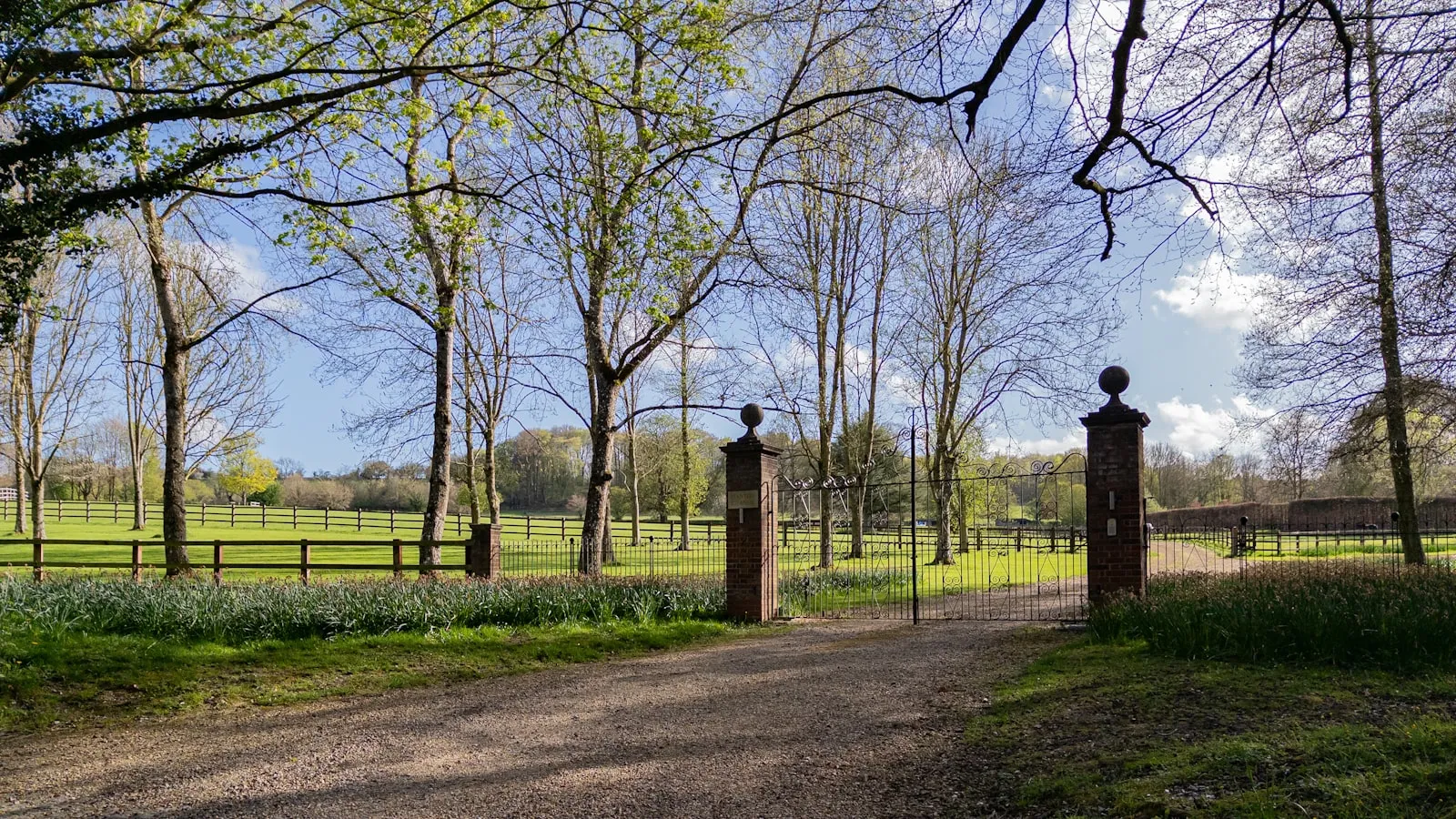
AWID makes some of the best long-range RFID readers in the access-control industry. They’re used in parking garages, apartment gates, business campuses, and military facilities. If you’ve ever pulled into a gated complex and the gate opened before you pressed anything, there’s a decent chance an AWID reader (or something like it) was involved.
That said, “commercial-grade” isn’t always a compliment when you’re shopping for a single-family driveway.
What AWID readers actually do
AWID readers use UHF RFID — the same frequency band as warehouse inventory systems and toll-road transponders. A passive windshield tag (no battery, no app) sits behind your rearview mirror. When your car enters the reader’s detection zone, the reader hits the tag with RF energy, the tag responds with its ID number, and if that ID is enrolled, the reader sends an open signal to the gate.
The whole exchange happens in under a second. From inside the car, it feels like the gate just knows you’re there.
The key word is “enrolled.” Unlike a buried exit wand that opens for any metal object moving at speed, an AWID reader only opens for vehicles whose credential ID is in the system. That per-vehicle identity is what makes the technology valuable in multi-tenant settings — and also what adds complexity everywhere else.
How readers connect to a gate
AWID readers output either Wiegand data (a two-wire protocol common in commercial access control) or a simple dry-contact closure. Most residential and light-commercial gate controllers — LiftMaster, GTO, TOPENS, Viking, HySecurity — expose an open-trigger input that accepts a momentary contact closure. So connecting an AWID reader to a gate is electrically straightforward.
The harder part is credential management. A bare AWID reader doesn’t decide who gets in; it just reads tag IDs and passes them up. You need something to receive that ID and decide whether to trigger the contact closure: either an access-control panel (a dedicated piece of hardware), cloud access-control software, or a controller that the reader manufacturer sells as a bundle.
For an apartment complex with 200 residents, that infrastructure pays for itself in seconds saved per vehicle and eliminated key-fob replacements. For a home with two cars, it’s a system designed around a problem you don’t have.
Where AWID makes sense
Long-range RFID access control genuinely earns its cost in a few situations:
Multi-tenant properties. When you’re managing dozens or hundreds of vehicles, per-credential control is necessary — not optional. You need to be able to add a new resident’s car on Monday and revoke a former resident’s tag on Friday without touching hardware.
High-throughput lanes. Parking garages, delivery yards, and commercial lots need to keep traffic moving. A system that can start opening the gate while the vehicle is still 15 feet away matters when you have 50 cars queuing at 8am.
Audit trails. AWID systems connected to access-control software log every entry event with a timestamp and credential ID. That’s useful for property managers, security teams, and anyone who needs to show who came and went.
Integration with broader access control. If a property already runs a commercial access-control system from Lenel, Genetec, or a similar platform, adding a vehicle reader that speaks Wiegand is a natural extension.
The single-family math
For a home with one to three residents, the picture changes.
A quality long-range RFID reader runs $500–1,500 depending on read range and environmental rating. Windshield tags are inexpensive per unit ($10–30), but the real cost is the access-control controller you need to make enrollment and revocation work. A basic controller that accepts Wiegand adds another $200–600. Total system cost for a single-family gate entry: $700–2,000+ before installation labor.
That’s before considering enrollment overhead. Each vehicle needs a tag, and someone needs to configure the controller. For a property manager handling many tenants, that overhead is part of the job. For a homeowner, it’s administrative work for a problem that a $30 key fob also solves.
There’s also range calibration. UHF RFID is sensitive to mounting angle, tag placement, and nearby metal structures (like the gate itself). Getting reliable reads at 15 feet on a residential driveway requires careful antenna positioning. Professional installers know this; homeowners often discover it after the fact.
None of this makes AWID a bad technology. It makes it the right tool for a different job.
A different approach for single-car homes
If you want the gate to open specifically when your car arrives — with no button, no app tap, and nothing buried in the driveway — Proxly’s GPS arrival tag is designed for that job without the access-control infrastructure.
Bottom line
AWID long-range readers are well-engineered, reliable, and genuinely hands-free. They’re the right answer when you’re managing vehicle access at scale: apartment gates, business parks, or any property where credential enrollment and revocation are ongoing tasks that justify the infrastructure.
For a single-family driveway, the per-vehicle identity they provide is real and valuable — you get exactly the selectivity that exit wands and geofencing can’t offer. The question is whether that selectivity is worth $700–2,000 in hardware and the complexity of running an access-control system at home.
Most homeowners looking at this technology would get the same practical result — gate opens when you arrive, not for every car — from a simpler approach designed for residential scale.
Frequently asked questions
- AWID makes UHF RFID readers that can detect a passive windshield tag from several feet away — far enough that the gate can start opening before the vehicle reaches it. They're designed for controlled-access facilities like apartment complexes, business parks, and gated communities where many vehicles need automated, identity-based entry.
- Technically yes. AWID readers output a standard Wiegand or contact-closure signal that most gate control boards accept. The practical barrier is cost and enrollment overhead: readers start well above $500, tags are $10–30 each, and you need access-control software or a controller to manage the credential list. For one or two residents, that's a lot of infrastructure.
- Each vehicle gets a passive UHF windshield tag programmed with a unique ID. The reader polls for that ID in its detection zone. When it matches an enrolled credential, it sends an open signal to the gate controller. Vehicles without a matching tag get no response.
- AWID's residential-adjacent models typically read from 3 to 20 feet depending on tag placement, antenna orientation, and the environment. That's enough to trigger the gate before you roll down your window, but it requires the tag to be positioned correctly on the windshield — usually upper-center behind the mirror.
- For a single-family home, the common options are: a key fob or remote clicker, a phone-based geofencing app, a Bluetooth proximity reader, a buried exit wand (which handles exit, not entry), or a GPS-based arrival tag that opens the gate specifically when your vehicle arrives. Each has different trade-offs on cost, installation, and per-car selectivity.
What is an AWID long-range reader?
Can I use an AWID reader on a residential driveway gate?
How does the reader tell vehicles apart?
What's the read range of an AWID reader?
What are the alternatives for hands-free residential gate entry?
Keep reading
What Is a Gate Opener's Duty Cycle and Why It Matters
Duty cycle tells you how hard a gate opener motor can work before it needs to cool down. Here's what the spec means, how to calculate your requirements, and what happens when you ignore it.
FAAC SimplyConnect Review: Setup, App Experience, and the Cloud Question
FAAC SimplyConnect adds WiFi app control to FAAC gate openers through a dealer-installed module. Here's what it does well, where it falls short, and what to know before adding it.
Mighty Mule Alternatives for Driveway Gates: What to Buy Instead in 2026
Mighty Mule works for light-duty gates. When you need better reliability or hands-free access, these are the alternatives worth considering for your driveway.