Just drive home. No remote. No app. No button.
How it works: the Tag rides with your car and opens your gate or garage the moment you arrive.
What Proxly is
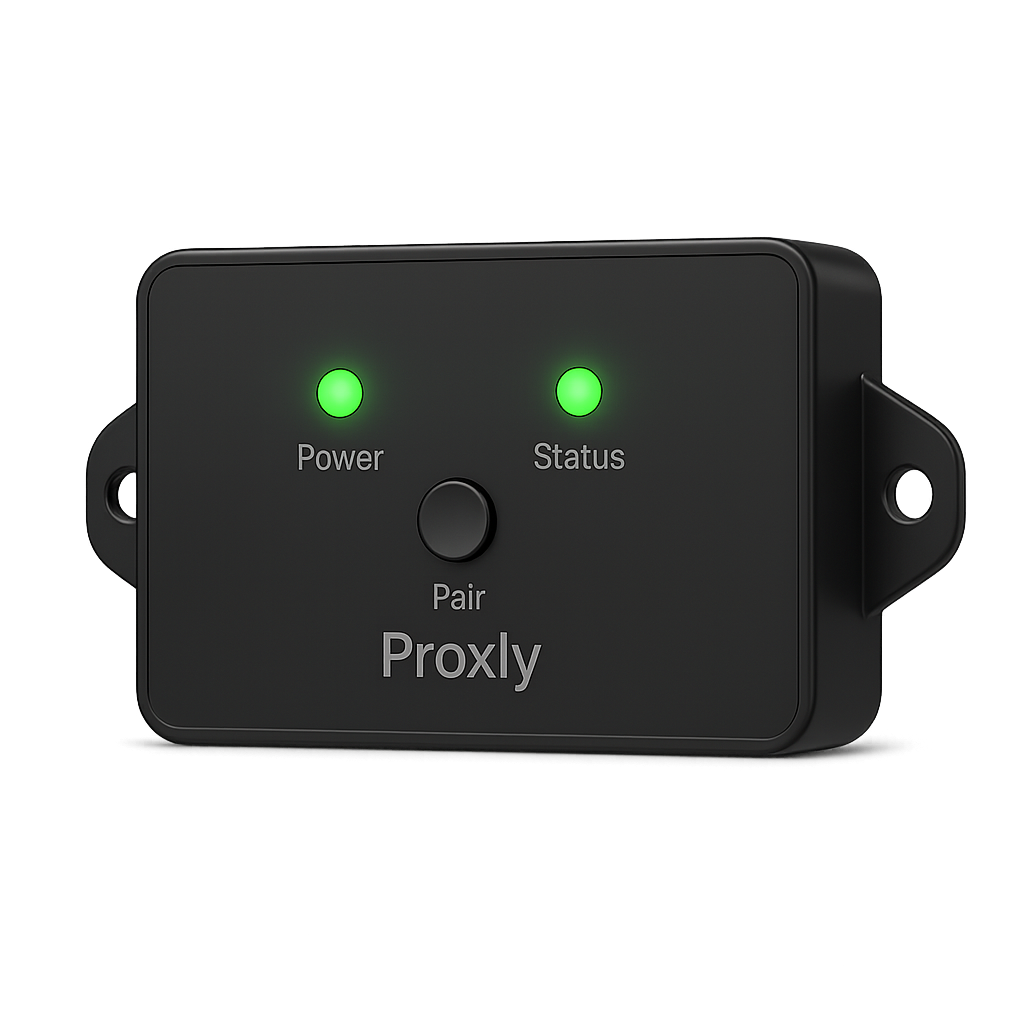
Proxly is a small GPS Tag that sticks to your windshield and a receiver Hub wired to your existing automatic gate or garage door opener. The Tag knows when you're arriving and tells the Hub to open your gate or garage, hands-free, the moment you pull in.
That's 1,460 times a year reaching for a clicker, fumbling for your phone, or waiting on a geofence.
Proxly takes all of it to zero.
Your current solutions all help — but they still leave you reaching, waiting, checking, or wondering if the gate opened. Here's where each one falls short.
Up close, a clicker or visor button is rock-solid. Out at the gate — a receiver 100+ feet down the driveway, behind a metal gatepost, in the weather — its range turns unpredictable: it fires one day and not the next.
One for the Tesla. One for the Range Rover. One for the truck you only drive on weekends. Half have dead batteries. The other half are in the wrong console.
Built-in car geofencing is better, but most cars don't have it — and it only works on that one car. Phone geofences drain the battery and fire 30 seconds late or half a block off. So you tried one, opened the app twice, and went back to the clicker.
Today it's a patchwork — a clicker for the garage, an app or a separate remote for the gate. No current product opens both reliably from the car.
Proxly's Tag has its own GPS and locally triggers the opener the moment you actually arrive — at gate distances, across opener brands, with no app and no subscription.
That's the gap we're building Proxly to close.
A small Tag in your car carries its own GPS, so it knows when you reach home. A Hub wired to your opener listens for it. Drive in and it's open; drive out and it opens again — hands-free, both ways. And because the Tag rides with the car, not in your pocket, it triggers when you actually drive in, not when you walk past on foot. It's gate and garage automation that rides with the car, not your phone.
Sticks to your windshield
Has its own GPS receiver, so it knows exactly where your vehicle is — without using your phone's GPS or draining your phone's battery. Sends an encrypted signal to your gate from up to 300 feet away.
Rechargeable via USB-C. We're still testing in real-world conditions, but our goal is up to a year on a single charge.
Wires to your gate opener
Two wires from the hub to two terminals on your gate opener's control board. We tell you exactly which ones. Works with LiftMaster, Chamberlain, DoorKing, FAAC, Nice, and most residential brands.
A note from Team Proxly
We're a small team — engineers, designers, homeowners. This started with our own garage doors: the remote was always in the wrong car, and the app lagged every time we turned into the driveway.
Then one of us got an EV. It unlocked just because the key was in a pocket — no button, no app. The car knew we were there. The garage didn't.
So we built one fix for both gates and garages — a Tag in the car, a Hub at the opener, and a gate that opens because you arrived.
We're pre-launch: working prototypes today, building toward production in the open on r/proxly.
Reserve early and you get our personal email — we read every one: getproxly@gmail.com.
— Team Proxly
Auto-open is the core. It works without the app, WiFi, or cloud — the Tag talks directly to the Hub over local radio.
Optional — connect the Hub to WiFi if you want the free app for remote control and schedules.
Your gate starts opening before you reach it.
Drive out hands-free, without reaching for a remote.
Press the button on the Tag to open, close, or cancel an automatic trigger.
No internet required for core auto-open.
The Tag and Hub use an encrypted connection that can't be cloned or replayed.
Let in the landscaper from your phone — it turns any opener into a smart garage you control from anywhere.
Open for the dog walker every Tuesday at 2pm.
The clicker security problem
A garage opener clicker on your visor is paired to your house. Stolen from your car in a parking lot, plus the registration paperwork (which has your home address), and a thief has the keys to your front door.
Documented in KTVU coverage of Moraga, CA — burglars hit ~15 unlocked cars in one night, used the openers to enter four homes. Same pattern in Point Loma.
The Tag has built-in anti-theft protection that renders it non-functional once it's been taken from your car. So even if a thief reads your address off the registration and drives to your house, the stolen Tag won't open your gate.
A disabled Tag can only be re-activated from your authorized app.
If your car gets broken into, your house stays safe.
Proxly works on any car, and its Hub wires into the low-voltage trigger every residential gate opener and garage door opener exposes. Whether it's a driveway gate opener or a garage door, if you can open it with a clicker today, Proxly can open it automatically. No subscription, ever.
Known exception: the latest Chamberlain/LiftMaster Security+ 3.0 garage door openers (post-2022) lock down the wired trigger input and are not supported.
Setup takes about 20–30 minutes: two wires to your opener and a Tag on the windshield. Prefer not to install it yourself? We have installer partners ready to handle the install for you.
Not sure if your opener works?
Email us your opener modelFour steps. About half an hour of install. Then nothing, ever again.
Reserve for $20 (fully refundable). Locks your $199 early bird price.
When we launch, you get a private early bird reward tier at the locked price.
Two wires from the hub to your gate opener. Stick the tag to your windshield.
That's it. Your gate opens before you arrive — and again as you leave.
Proxly isn't another remote. Tag and Hub handle your gate or your garage — on every car you drive — and open them hands-free as you pull in. You pay once. No subscription.
A fully refundable $20 reservation locks your $199 early bird price — limited to the first 100 customers. The full purchase happens later on Kickstarter. You're only charged for the product if the campaign succeeds.
Fully refundable anytime, for any reason.
Need a second Tag? One Hub supports multiple Tags. Additional Tags will be available as a Kickstarter add-on, so there's nothing else to add today.
How it works: your $20 reservation holds your early bird spot and price. When we launch on Kickstarter, you'll get access to a private early bird tier. If the campaign succeeds, you complete the purchase there. If you change your mind before then, we'll refund your reservation. Reserving ahead of a Kickstarter campaign is standard practice for crowdfunded launches.
Not sure if your gate is compatible? Email us your gate opener model and we'll confirm.
Everything you need to know about Proxly
Proxly connects through the standard low-voltage trigger most residential openers expose — two wires to two terminals on the control board, which covers a wide range of common openers. The install guide will show exactly which terminals to use on each opener type. Send us your opener model if you want a sanity check before you reserve.
No, not for the core auto-open. The Tag and Hub talk to each other directly over long-range radio — your gate opens whether your home WiFi is up or down. If you choose to connect the Hub to WiFi, you also unlock remote opening and scheduling from the Proxly app, but that's optional. The product works either way.
Sort of — but not the kind that doesn't work. Most "smart gate" apps use your phone's GPS to detect when you're home. That drains your battery, lags by 30+ seconds, and can trigger when you walk past your gate on foot. Proxly puts a dedicated GPS receiver inside the Tag, mounted in your vehicle. It knows exactly where your car is relative to your gate, with no battery drain on your phone and no false triggers when you're not driving.
For most standard gate openers, about 20-30 minutes. The Hub connects to your gate opener with two wires (we tell you exactly which terminals to use). The Tag sticks to your windshield with adhesive. You'll need a screwdriver and basic comfort opening up your gate opener's control box — roughly the same skill level as installing a doorbell transformer. If you'd rather have a pro handle it, we're building a network of installer partners and can recommend one in your area.
The Hub picks up your Tag from up to 300 feet away — far enough that the gate is fully open by the time you arrive, even at 25 mph. We tune the trigger distance to your specific driveway geometry during setup. The gate also opens as you exit the geofence, so it's open by the time you reach it on the way out.
The Tag has a rechargeable battery. We're still testing in real-world conditions, but our goal is up to a year on a single charge under normal use. When it runs low, you charge it with any standard USB-C cable in a few minutes — same kind of cable you already use for your phone or laptop.
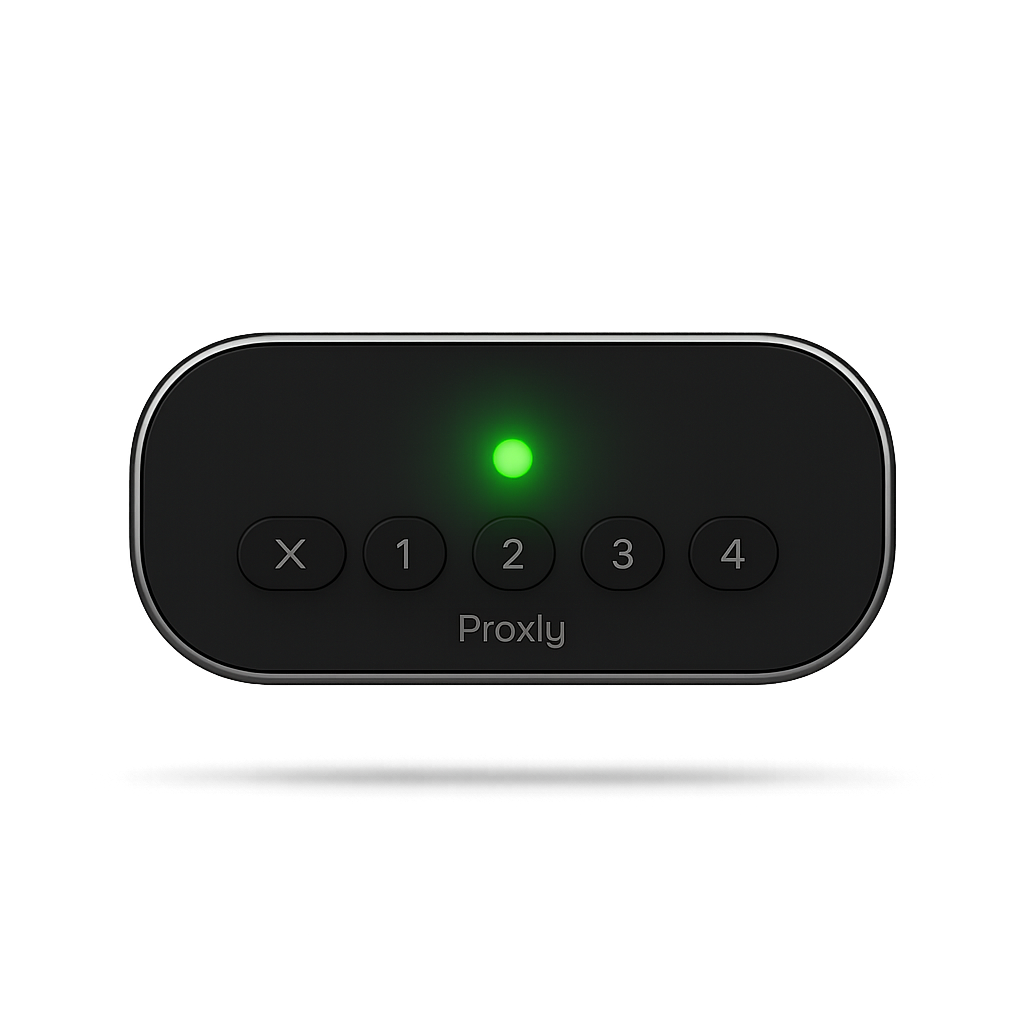
Press the X button on the Tag as you approach. It cancels the auto-open command and keeps your gate closed. Useful if you're just turning around in your driveway or need the gate to stay shut.
Your $20 reservation is fully refundable anytime — just email us. When we launch on Kickstarter, backers are covered by Kickstarter's terms, and we'll publish our return policy before the campaign.
We'll set the timeline on Kickstarter, driven by real build progress — so the date you see is one we're confident in. We're building it now with a small team in California. Reserving locks your $199 early bird price (regular $499); the $20 is refundable anytime.
We have working prototypes today and are building toward production in the open, sharing real progress as it happens. Kickstarter's all-or-nothing model works in your favor: you're only charged if the campaign succeeds, and your $20 reservation is refundable anytime until then.
Not yet. Proxly is FCC-certified for the US only at launch. International expansion is on the roadmap once we have field data and the equivalent regional certifications.
Drop your email and we'll keep you in the loop — build progress, compatibility updates, and a heads up when units start shipping.
Many newer cars are dropping the built-in garage button, moving it into software, or turning it into a paid add-on.
Proxly gives any car a hands-free opener — without a dealer retrofit, subscription, or vehicle-specific module.
Tesla Model 3 / Y / Cybertruck
Service install runs $300-$350 on refreshed Highland/Juniper bodies. Even after install, the built-in geofence misfires on long driveways and opens when you're leaving.
Read the deep dive →
Honda Accord / Civic / Passport (2023+)
11th-gen Accord and 2023+ Civic dropped the visor button as standard. The 2026 Passport went further — replacing it with a myQ subscription ($129 for 3 years or $179 for 5, after a 30-day trial).
Read more →
F-150 / F-150 Lightning (2024+)
The visor button used to be standard on Lariat and Platinum. As of 2024+, it only ships on the Tremor with the 402A option package. Everywhere else, aftermarket mirror retrofits run $200-$280.
Read more →
Polestar 3 · Lucid Gravity
Polestar 3 replaced the visor button with an app you navigate to on the touchscreen. Lucid Gravity sells the visor button as a paid dealer add-on. EV-native brands are split between going software-only or pushing the hardware to a paid retrofit.
Read more →
Or you have a working visor button in an older car and a long driveway, and the gate opens too early or doesn't fire on return. Same fix.
Driving a Cybertruck? Read why Proxly is the missing piece →