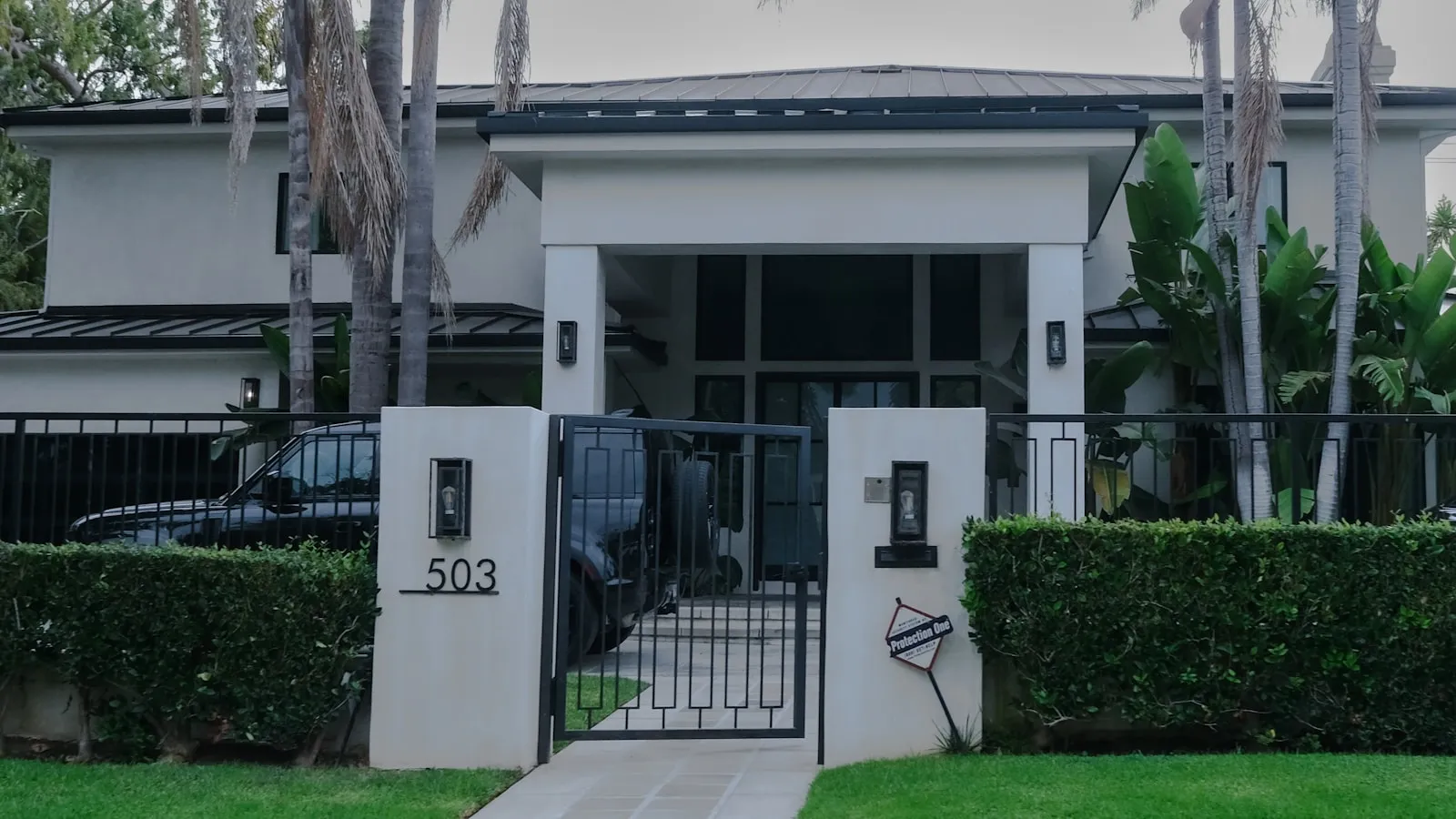
A residential gate opener is a 300-500 pound machine that moves fast enough to knock a person down. The safety reverse — the mechanism that stops or reverses the gate when it hits something — is not optional, and testing it takes about five minutes twice a year.
Most gate owners never do it. The gate closes, the light goes green, and that is good enough. It is not.
What the safety reverse actually does
All gate operators listed to UL 325 — the relevant US standard for residential gate operators — must include two distinct entrapment protection zones:
- Non-contact sensing: A photoelectric beam (photocell) that spans the gate opening. If the beam is broken while the gate is closing, the gate must stop or reverse.
- Contact sensing: If the gate physically contacts an obstacle, the operator must detect the resistance and stop or reverse within a short travel distance.
Both zones must work independently. A gate with a working photocell but a failed contact reverse still fails. A gate with a good contact reverse but a misaligned photocell still fails.
See how a residential gate opener actually works for a full breakdown of the mechanical and electrical layers involved.
Test 1: The photoelectric beam
You need a piece of cardboard or a thin wooden dowel — something that breaks the beam without exerting force.
- Stand clear of the gate’s path of travel.
- Start the gate closing.
- While the gate is moving, pass the cardboard through the photoelectric beam. The beam runs horizontally across the gate opening, typically 6-12 inches off the ground on residential installs.
- The gate must stop or reverse within one gate movement after the beam is broken.
What a pass looks like: The gate stops immediately or reverses. Repeat three times. All three should stop or reverse.
What a fail looks like: The gate continues closing through the broken beam. This means either the photocell pair is not functioning, the beam is already broken before you blocked it, or the operator is ignoring the sensor input.
Check the LEDs: Both the transmitter (TX) and receiver (RX) units have indicator lights. On most residential photocells:
- Transmitter: solid light means it is sending
- Receiver: solid light (typically green or amber) means the beam is unblocked; a different color or blinking means the beam is already broken or interrupted
If the receiver shows a “broken beam” reading before you put anything in the path, the sensor is misaligned or obstructed. Fix that first. See photo-eye sensor misalignment: the 90-second fix for alignment procedure.
Test 2: The contact (pressure) reverse
You need a solid 2x4 board or a length of lumber — anything rigid enough that the gate cannot crush it without triggering the reverse.
- Lay the 2x4 flat on the ground, across the gate’s path of travel, roughly in the middle of the travel zone.
- Start the gate closing.
- Watch what happens when the gate hits the board.
What a pass looks like: The gate stops or reverses within 1-2 feet of contacting the board. Most modern operators stop first, then reverse a short distance, then beep.
What a fail looks like: The gate pushes through or over the board without reversing. This means the force sensitivity is set too high — the operator is not detecting the resistance.
Caution: Do not use your hand or foot for this test. A gate operator is strong enough to cause serious injury before the force threshold triggers. Always use lumber or another inert object.
If the contact reverse fails: force sensitivity
Most residential gate operators have a force or sensitivity adjustment on the control board, sometimes labeled “Force,” “Sensitivity,” or “Torque.” It is usually a small knob or a bank of DIP switches.
- Turning force down (toward minimum) makes the operator more sensitive to resistance and more likely to stop on contact.
- Turning force up means the motor pushes harder before stopping.
Reduce the force setting one step at a time. Re-run the 2x4 test after each adjustment. If you reach the minimum setting and the gate still does not reverse, the problem is mechanical — a worn motor, a seized hinge or roller, or a rack and pinion with too much friction — not the sensitivity setting.
For a systematic approach to diagnosing an opener that is not responding correctly, a 12-point diagnostic covers the full failure tree.
If the contact reverse still fails after adjustment
Three possibilities:
- Mechanical binding: Something in the gate’s travel is adding resistance the motor is fighting before it even reaches the obstacle. Check hinges, rollers, and the rack for debris, corrosion, or misalignment.
- Faulty control board: The force-detection circuit may not be reading motor load correctly. A bench test by a technician can confirm.
- Wrong operator for the gate’s weight: An undersized operator running at or near its rated capacity may not have enough margin to detect additional load before the gate closes fully.
In cases 2 and 3, the fix is replacement — of the control board or the operator itself. The gate limit switch adjustment guide can help rule out a mis-set limit before assuming a board failure.
Testing schedule
| What to test | How often |
|---|---|
| Photoelectric beam | Monthly |
| Contact/pressure reverse | Annually, and after any service |
| Both tests together | After any gate repair, hardware replacement, or software update |
Monthly photocell tests take 30 seconds. Once the gate closes on your car because a bird shifted the sensor alignment six months ago, that schedule stops feeling excessive.
Reference
- UL 325 — Standard for Door, Drapery, Gate, Louver, and Window Operators and Systems (the governing US standard for residential gate operators)
- DASMA Technical Data Sheet 182 — Gate entrapment protection guidelines from the Door and Access Systems Manufacturers Association
Frequently asked questions
- A code-required feature that stops or reverses the gate when it contacts an obstacle or when a photoelectric beam is broken. All gate operators listed to UL 325 — the standard for residential gate operators — must include both entrapment protection zones.
- Test the photoelectric beam monthly. Test the contact-stop function at least once a year and after any service, adjustment, or replacement of the gate, motor, or control board.
- First reduce the force sensitivity on the control board — most operators have a force or torque knob or DIP switches. If the gate still closes through an obstacle after the adjustment, the motor, mechanical linkage, or control board likely needs a technician.
- UL 325 became mandatory for new installs in 2016. Openers installed before then are grandfathered, but adding working photoelectric sensors is inexpensive and strongly recommended regardless of install date.
- A steady indicator light usually means the beam is clear. But direct sunlight hitting the receiver lens can false-trigger the sensor. Shade the receiver or rotate the sensor pair so neither lens faces direct sun.
What is a gate opener's safety reverse?
How often should I test my gate's safety reverse?
What if my gate fails the contact test?
Does my older gate opener need UL 325 compliance?
My photocell LEDs are steady but the gate reverses for no reason. What is wrong?
Keep reading
What Is a Gate Opener's Duty Cycle and Why It Matters
Duty cycle tells you how hard a gate opener motor can work before it needs to cool down. Here's what the spec means, how to calculate your requirements, and what happens when you ignore it.

FAAC SimplyConnect Review: Setup, App Experience, and the Cloud Question
FAAC SimplyConnect adds WiFi app control to FAAC gate openers through a dealer-installed module. Here's what it does well, where it falls short, and what to know before adding it.
Mighty Mule Alternatives for Driveway Gates: What to Buy Instead in 2026
Mighty Mule works for light-duty gates. When you need better reliability or hands-free access, these are the alternatives worth considering for your driveway.