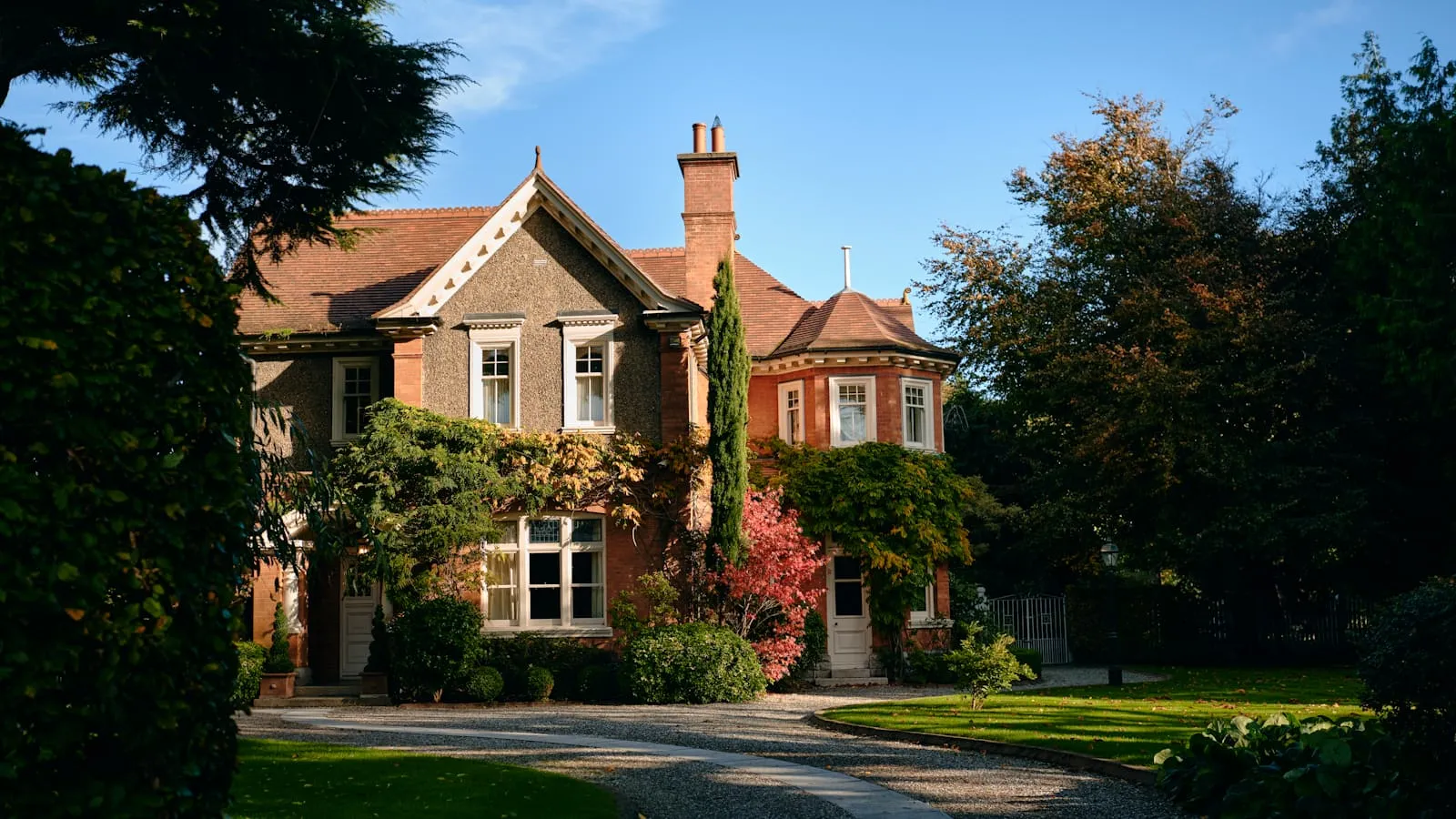
A standard residential gate opener is built for a gate within 50 feet of the house, wired and powered accordingly. Push it out to a long driveway — 150 feet or more to the gate post — and it hits three problems the spec sheet never mentions: the remote can’t reach, voltage sags on the long control wiring, and there’s no easy way of getting line power to the post. Remote range, wire gauge, and power source all have to be chosen for the distance, not defaulted to the standard parts.
A long driveway — anything over 150 feet from the house to the gate post — creates three distinct problems at once: how far the remote signal has to travel, how much resistance accumulates in the control wiring, and how you get line power to the opener in the first place. None of these is unsolvable. Each requires a deliberate choice before the equipment arrives on site.
What “long” actually means in practice
Distance problems don’t scale uniformly:
Under 100 feet. Standard equipment works without modification. A basic remote at its rated range, 18 AWG for control runs, and a standard outlet extension handle this zone without engineering.
100 to 250 feet. Remote range becomes situational. Trees, metal fence panels, and vehicle bodywork reduce real-world performance below the open-field spec. Control wiring in this range is still manageable with 16 AWG for a single accessory, but adding multiple devices — keypad, loop detector, photo eye — begins to stress the opener’s accessory terminals. Getting power to the post becomes a real project but not an extraordinary one.
Over 250 feet. Each of the three problems demands a planned answer before any equipment is selected or wire is ordered. Don’t assume standard residential gear scales.
Problem 1: RF remote range
A residential 315 MHz or 433 MHz remote is rated at its range under open-field conditions: no obstructions, no interference, no humidity. Real driveways don’t look like an open field.
Concrete block walls, oak trees, stucco, and metal fencing absorb or reflect the signal. A remote labelled “600-foot range” on the box may work reliably at 80 feet through a tree line. This isn’t a defect in the remote — it’s the physics of RF signal propagation through obstacles.
For long driveways, two approaches work:
Long-range receiver upgrade. Most major opener brands and third-party accessory manufacturers offer receiver modules that replace the stock antenna circuit on the control board. These use a high-gain antenna at the gate post and extend reliable range to 1,000 feet or more in open-field conditions. The transmitter side may also need an upgrade — some long-range kits require a matched remote. Confirm compatibility with your specific opener before ordering.
Wired keypad at the gate. A keypad mounted at the post eliminates the RF problem for entry entirely. You still need a remote or exit-loop trigger for the outbound direction, but the daily entry problem — the most common use case — is solved by wire rather than radio. A conduit-protected wired keypad, included in the buried wire bundle, often costs less than a long-range RF upgrade and holds up better over years of weather exposure.
If the driveway exceeds 200 feet and has any obstructions between the parking point and the gate, plan for one of these two before selecting a remote system.
Problem 2: Control wiring voltage drop
Gate opener control boards supply low-voltage DC to accessories — keypads, vehicle detection loops, photo eyes, and intercom panels — through labeled terminal blocks on the board. For most residential gate openers, that supply is 12 V or 24 V DC. For an overview of how the control board fits into the larger system, see How a Residential Gate Opener Actually Works.
This accessory power is designed for short runs. The longer the cable, the more resistance it adds to the circuit, and the lower the voltage that actually arrives at the accessory. When voltage drops below an accessory’s operating minimum, behavior becomes erratic: intermittent keypad failures, loop detectors that trigger randomly, photo eyes that won’t reset.
The calculation
Wire resistance varies by gauge. These figures apply to copper conductors in a two-conductor run:
| AWG | Resistance (Ω per 1,000 ft) | Total resistance — 300 ft run* |
|---|---|---|
| 18 | 6.4 | 3.84 Ω |
| 16 | 4.0 | 2.40 Ω |
| 14 | 2.5 | 1.50 Ω |
| 12 | 1.6 | 0.96 Ω |
*A 300-foot run uses 600 feet of total wire — 300 ft on the supply conductor, 300 ft on the return.
Voltage drop = current (amps) × total resistance (ohms).
Example — single keypad at 200 mA, 18 AWG, 300-foot run: 0.2 A × 3.84 Ω = 0.77 V drop. On a 12 V system that’s 6.4% — technically within most manufacturers’ 10% tolerance, but nothing left in reserve.
Example — keypad plus loop detector at 500 mA total, same run: 0.5 A × 3.84 Ω = 1.92 V drop. That’s 16% of 12 V. Most accessories misbehave above 10%.
The fix
Use 14 AWG for any control run over 200 feet with a single accessory. Use 12 AWG for runs over 200 feet with multiple accessories, or for any run over 400 feet regardless of load.
If the opener’s installation manual specifies a maximum accessory wiring distance — and most commercial-grade residential boards do — treat that figure as the published limit for the published wire gauge. Work backward from the resistance table to find the correct gauge for your actual distance.
When accessories cluster near the gate post (keypad, intercom, photo eyes all within 10 feet of the motor), running a single multi-conductor cable for all of them is cleaner than separate runs. Each conductor carries only its own device’s current.
For terms like dry contact, trigger terminal, and loop detector that appear throughout installer documentation, The Driveway-Gate Glossary covers them in plain English.
Problem 3: Getting power to the opener
Most residential gate openers require a 120 V AC outlet near the post — close enough that the motor’s internal transformer can do the step-down. The motor, control board, and accessories all run from that single 120 V feed.
For a 300-foot driveway, supplying that feed from the house panel means 300 feet of conduit in the ground. The work requires a licensed electrician in most jurisdictions because it originates at the home panel — typically as a GFCI-protected 20-amp circuit. The conduit and wire are relatively inexpensive. Trenching, conduit installation, and restoring the disturbed driveway or landscaping are not.
Two alternatives:
Secondary power supply at the post. Some installations run a separate 24 V or 12 V power supply at the gate post — sourced from a smaller, locally run circuit — and power only the accessories from that supply, keeping the trenched run shorter and lower-current.
Solar. A solar-powered gate opener handles its own power on-site. For long driveways, solar is often the economically rational choice: the trenching cost alone can exceed the cost of a solar kit. The constraints are daily cycle count and available sunlight. A gate that opens fifteen times daily — serving a busy household — can drain a standard solar kit battery faster than the panel recharges it in winter months or on shaded posts. Solar vs Hardwired Gate Openers: The Real Tradeoffs covers the sizing and trade-off analysis for both approaches.
Putting it together
Long-driveway gate installations succeed or fail based on planning before any equipment ships. The sequence:
- Measure the actual run from the gate post to the nearest panel and accessory source.
- Solve RF range first — if the run exceeds 200 feet with any obstructions, specify a long-range receiver kit or budget a wired keypad.
- Calculate control wiring — add up accessory current draws, multiply by total wire resistance at the target gauge, and confirm the voltage drop is under 10% of the supply voltage. Upsize the gauge if it isn’t.
- Decide on power — hardwired 120 V or solar. If hardwired, get a trench quote before finalizing the opener selection, since the electrical run spec affects which openers are practical for the site.
For what happens when a gate that was working stops responding, Gate Opener Won’t Open: A 12-Step Field Diagnostic works through the full failure-point sequence in order of how quickly each can be checked — from the power outlet to the control board output terminals.
Frequently asked questions
- Published remote range specs assume open-field conditions. In suburban environments with tree lines, stucco walls, or metal fencing, effective range is often 50-100 feet — not the 600-foot figure on the box. Long-range receiver upgrades exist for driveways where the gate sits beyond 150 feet from the parking point.
- Use 14 AWG minimum for a 300-foot run (600 feet of total wire in a two-conductor circuit). At a 200 mA accessory draw, 18 AWG produces a 0.77 V drop on a 12 V system — borderline. Add a second accessory and drop stays under 10% only with 14 AWG or heavier. When in doubt, go one gauge heavier than the calculation suggests.
- Yes, but each of three problems needs a planned answer: RF remotes need a long-range receiver upgrade, control wiring needs 12 AWG minimum, and getting 120 V power to the post requires trenching or a solar-powered opener. Address each independently before selecting equipment.
- Often the most practical option when the post is more than 200 feet from the nearest panel. Solar eliminates the trenching cost entirely. The real limits are daily cycle count and available sunlight — high-traffic gates and shaded or northern-climate posts need larger panels and battery banks than standard solar kits provide.
- Intercoms are typically more sensitive to voltage drop than basic keypads because they run audio, video, or data circuits alongside the power feed. Treat the intercom manufacturer's maximum wiring distance as a hard limit, not a guideline, and upsize wire gauge by one step if you're within 20% of that limit.
How far can a standard residential gate remote reliably reach?
What wire gauge should I use for a 300-foot gate accessory run?
Can a gate opener work 400 feet from the house?
Is solar a practical option for a gate opener on a very long driveway?
Does a longer driveway affect intercom wiring differently from standard control wiring?
Keep reading
What Is a Gate Opener's Duty Cycle and Why It Matters
Duty cycle tells you how hard a gate opener motor can work before it needs to cool down. Here's what the spec means, how to calculate your requirements, and what happens when you ignore it.

FAAC SimplyConnect Review: Setup, App Experience, and the Cloud Question
FAAC SimplyConnect adds WiFi app control to FAAC gate openers through a dealer-installed module. Here's what it does well, where it falls short, and what to know before adding it.
Mighty Mule Alternatives for Driveway Gates: What to Buy Instead in 2026
Mighty Mule works for light-duty gates. When you need better reliability or hands-free access, these are the alternatives worth considering for your driveway.