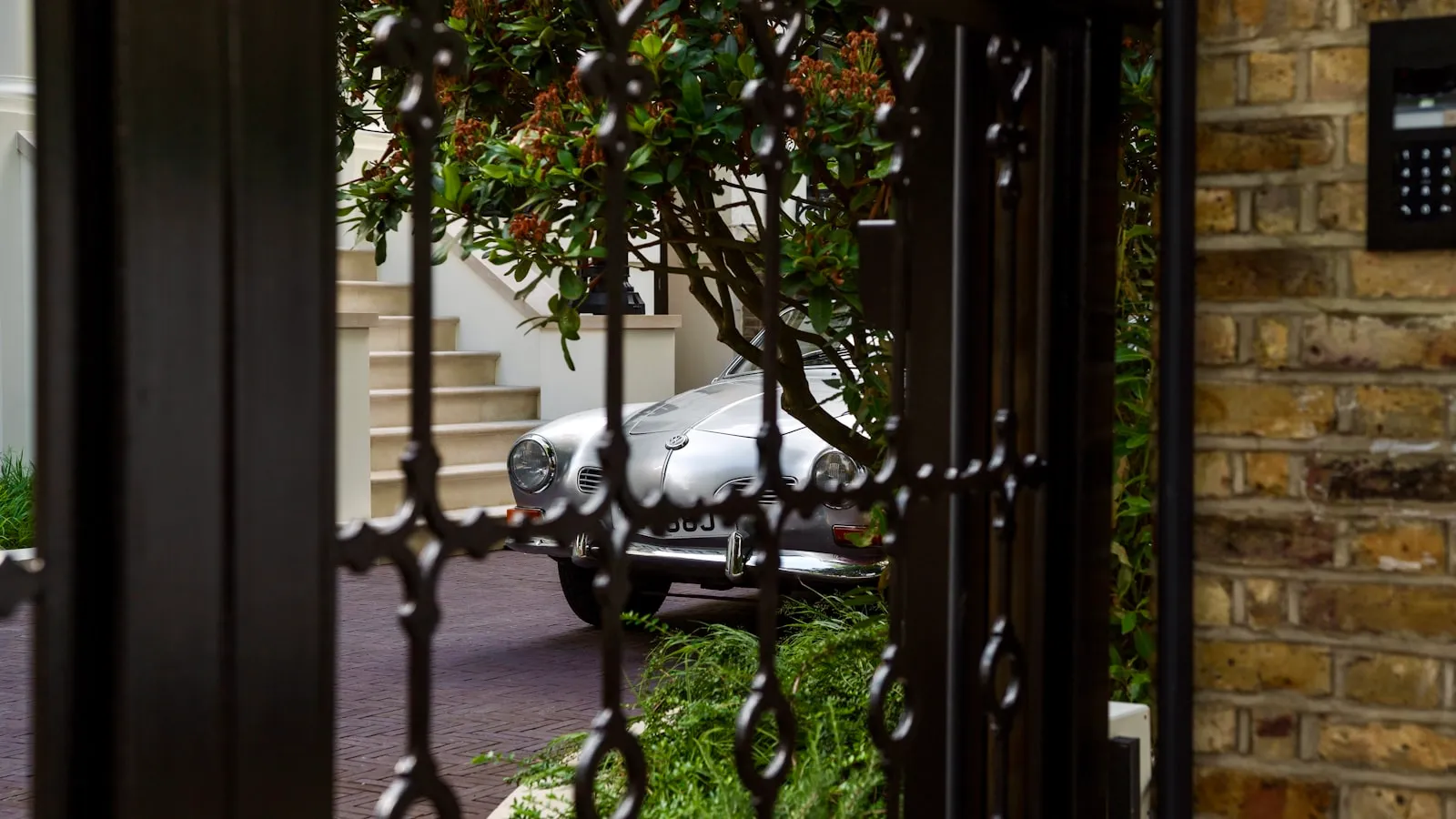
myQ is a reasonable way to control a garage door. For a driveway gate, the situation gets complicated quickly.
The core problem is protocol compatibility. myQ works natively with LiftMaster and Chamberlain operators using Security+ 2.0. Some LiftMaster commercial-grade gate operators support myQ directly—but most residential gate brands (Nice, FAAC, Mighty Mule, Apollo, DoorKing, TOPENS) have no native myQ connection. Getting myQ to control those operators requires wiring a relay interface to the gate’s dry-contact input, which works but adds a device and a dependency.
Even when myQ technically works with a gate, the arrival experience often misses what owners actually want. Geofence auto-open requires the myQ app running in the background, location services on, and a precise geofence radius. The gate starts moving when you’re already pulling in—not while you’re still on the street. In a perfect setup that’s fine. In a neighborhood where parking or family traffic triggers false opens, it gets old.
If you’re looking for alternatives, here is an honest account of what’s available.
The four main options
1. Remootio Gen 3
Remootio is the most direct replacement for myQ-style app control on a driveway gate. The device wires into the gate opener’s dry-contact input—two wires from the Remootio board to the opener’s relay terminals—and gives you remote open, close, and status from your phone.
Compatibility is broad. Because Remootio communicates with the gate via a relay closure (a dry-contact signal), it works with almost any residential gate opener that has a pushbutton or relay input. That includes Nice, FAAC, Apollo, Mighty Mule, DoorKing, and most LiftMaster gate operators regardless of myQ support.
Auto-open at arrival works via Bluetooth. When your phone comes within Bluetooth range of the Remootio device—typically 30-50 feet—it can trigger the gate automatically. That’s faster than a geofence but slower than GPS: you’re pulling into the driveway before the gate starts moving, not approaching from the street. For homes with a short driveway, this is enough. For longer setups, it means a pause at the gate.
Our full Remootio Gen 3 review covers the install process and long-term reliability in more detail.
Basic remote access via the Remootio app is free. Some advanced features—activity logs, time-based access, integration with third-party platforms—require a subscription. Check the current plan structure on Remootio’s site before purchasing, as tier contents have changed over time.
2. iSmartGate Pro
iSmartGate Pro takes a similar approach to Remootio: a small device wired to the gate opener’s relay input, controlled via a dedicated app, with optional camera integration.
Where iSmartGate differs is in its integration depth with Apple HomeKit and Alexa, which matters if you’re already running a home automation setup. The dry-contact interface means gate brand compatibility is broad—same logic as Remootio. The Bluetooth auto-open radius is comparable.
iSmartGate sells multiple versions (garage, gate, pro). The Pro version is the one rated for driveway gates; the entry-level model is primarily for garages. Verify you’re purchasing the correct variant.
3. HomeLink (built into many vehicles)
HomeLink is worth mentioning even though it is not a separate purchase. It is built into the visor or mirror of most premium vehicles and uses RF signals to trigger compatible gate openers directly—no phone, no app, no relay device.
The catch is the programming step and frequency matching. HomeLink supports several frequencies (288, 310, 315, 390, 433 MHz), and older gate openers using fixed-code RF remotes pair reliably. Rolling-code openers (Security+ 2.0 and similar) require a pairing sequence with the opener’s LEARN button. Driveway gates with no built-in RF receiver—common in commercial-grade models—require a separate receiver module before HomeLink can work at all.
If your gate already has an RF receiver, HomeLink is often the most reliable no-app option already sitting in your visor. See our guide to hands-free driveway gate openers for a full comparison of RF, Bluetooth, and GPS approaches.
4. GPS proximity auto-open (Proxly)
Proxly is a pre-launch system that works differently from the three above. Instead of an app tap, a geofence, or a Bluetooth ping, Proxly uses a small Tag affixed to your windshield. The Hub—a device wired with two wires to your gate opener’s control board—reads the Tag’s GPS position as you drive toward home. When you reach roughly 300 feet from the gate, it opens automatically. You never touch your phone.
The practical difference: the gate is moving before you reach it, not as you pull in. For a long driveway or a property where stopping at a closed gate is genuinely inconvenient, this matters.
Compatible with most residential gate openers via the same dry-contact relay approach. No subscription. No internet required at the moment of trigger. Encrypted signal.
Proxly is in pre-launch. You can check compatibility and reserve at getproxly.com/beta.
Side-by-side comparison
| myQ | Remootio Gen 3 | iSmartGate Pro | Proxly | |
|---|---|---|---|---|
| Gate brand compatibility | LiftMaster/Chamberlain native; others via relay | Broad (dry-contact relay) | Broad (dry-contact relay) | Broad (dry-contact relay) |
| App required at arrival? | Yes (geofence or manual tap) | Optional (Bluetooth auto-open) | Optional (Bluetooth auto-open) | No |
| Auto-open distance | ~0-100 ft (geofence) | ~30-50 ft (Bluetooth) | ~30-50 ft (Bluetooth) | ~300 ft (GPS) |
| Subscription | Some features paid; check current tiers | Basic free; advanced paid | Basic free; advanced paid | None |
| Status | Available | Available | Available | Pre-launch |
Which one fits which situation
myQ: Best when you have a LiftMaster gate operator with native myQ support and you’re already inside the myQ ecosystem for a garage door. Weakest for third-party gate brands and for anyone who dislikes app dependency.
Remootio Gen 3: Best for broad gate brand compatibility and a familiar app-control experience without myQ’s ecosystem lock-in. The Bluetooth auto-open helps on shorter driveways.
iSmartGate Pro: Best if you’re running HomeKit or Alexa already and want the gate integrated there. Functionally similar to Remootio otherwise.
HomeLink: Best when it’s already in your car and your gate has an RF receiver. Free, no ongoing account, works when the power and internet are out—because it’s radio frequency all the way.
Proxly: Best for longer driveways or any situation where you want the gate moving well before you arrive, with no phone in the loop. Worth watching if that use case fits; it’s in pre-launch now.
For a broader look at gate opener options across all brands, see the driveway gate opener buyer’s guide. For the full breakdown of which apps charge ongoing fees and which don’t, see our gate app subscription comparison.
Reference
- LiftMaster myQ product information: liftmaster.com
Frequently asked questions
- myQ works natively with LiftMaster and Chamberlain gate operators that use Security+ 2.0. Most residential gate brands—Nice, FAAC, Mighty Mule, Apollo, DoorKing—have no native myQ support. Getting app control on those operators requires a separate relay interface wired into the dry-contact input.
- It depends on what bothers you about myQ. For a similar app-controlled retrofit, Remootio Gen 3 or iSmartGate Pro both handle dry-contact gate openers well. If you want to stop pulling out your phone at arrival entirely, GPS proximity is the category to look at instead.
- Yes, for the core use case of remote open and close from your phone. Remootio works via a dry-contact relay and connects to most gate opener brands. It also has Bluetooth-based auto-open, which is faster than an app tap but still requires your phone nearby and unlocked.
- Remootio and iSmartGate both offer basic app control without a subscription, though some advanced features—activity logs, multiple users, shared access—sit behind paid plans. myQ's subscription structure has changed over time; check the current tier breakdown before buying any LiftMaster device.
- Proxly uses GPS proximity instead of an app. A Tag on your windshield and a Hub wired to your gate control board opens the gate automatically as your car approaches—about 300 feet out. No phone interaction at arrival, no subscription, no clicker. Currently in pre-launch at getproxly.com/beta.
Does myQ work with driveway gates?
What is the best myQ alternative for driveway gates?
Can Remootio replace myQ for a driveway gate?
Do myQ alternatives require a subscription?
What does Proxly do differently from myQ?
Keep reading
What Is a Gate Opener's Duty Cycle and Why It Matters
Duty cycle tells you how hard a gate opener motor can work before it needs to cool down. Here's what the spec means, how to calculate your requirements, and what happens when you ignore it.

FAAC SimplyConnect Review: Setup, App Experience, and the Cloud Question
FAAC SimplyConnect adds WiFi app control to FAAC gate openers through a dealer-installed module. Here's what it does well, where it falls short, and what to know before adding it.
Mighty Mule Alternatives for Driveway Gates: What to Buy Instead in 2026
Mighty Mule works for light-duty gates. When you need better reliability or hands-free access, these are the alternatives worth considering for your driveway.