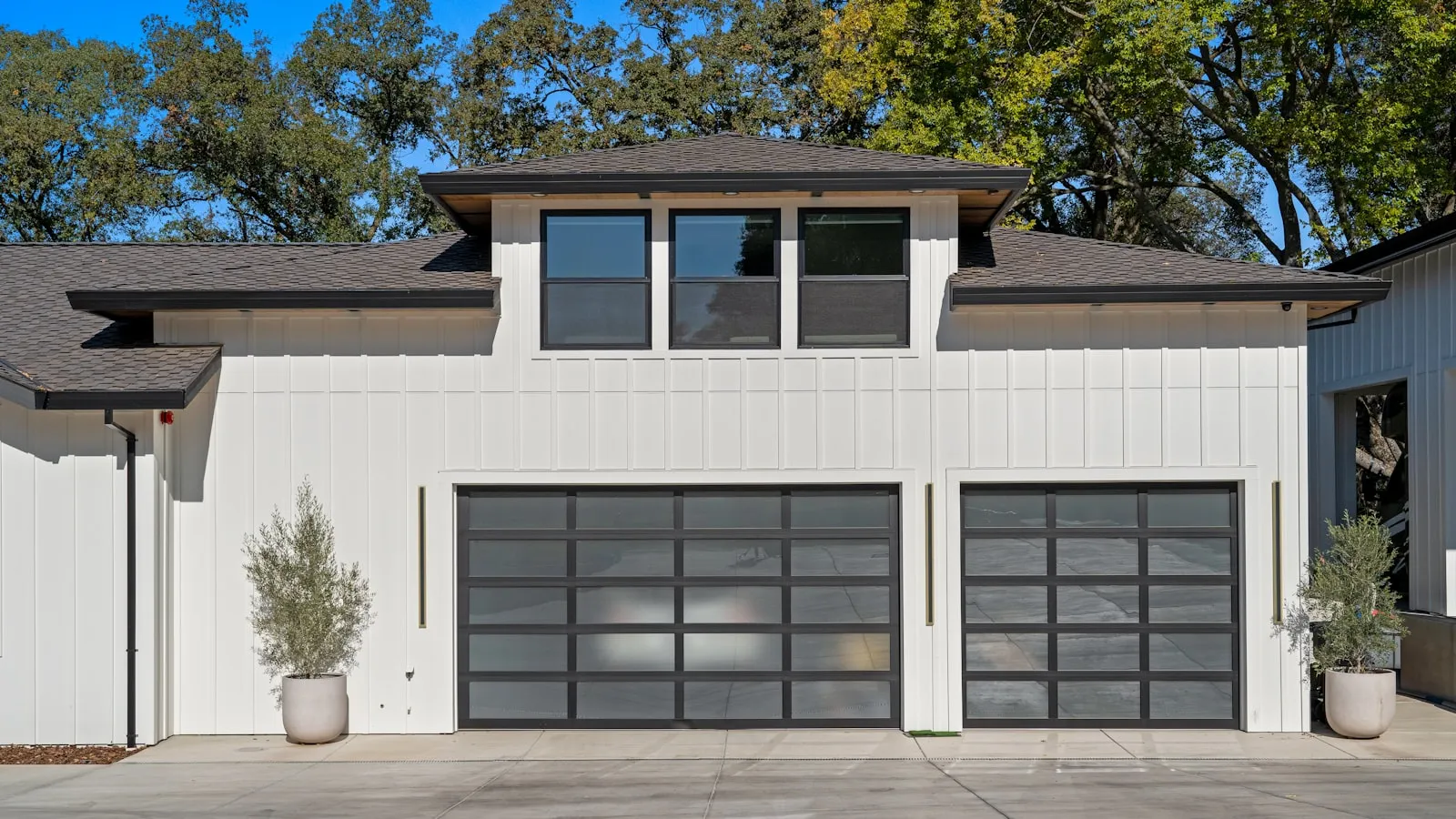
Hands-free arrival is the experience every garage door has been moving toward for two decades — first the visor button, then the phone app, then the geofence-triggered auto-open feature Tesla and Rivian owners get. For Chamberlain and LiftMaster garage doors specifically, the platform that drives most of that smart-home connectivity is myQ.
If you have a relatively recent LiftMaster or Chamberlain opener, or you are shopping for one, you will run into myQ as the answer to “how do I control my garage from my phone.” This review walks through what myQ actually does, what it costs, where it is strong, where it falls short, and what the modern alternatives look like in 2026 — including a section on the cases where Proxly is a better fit for the daily-use experience.
About Chamberlain and myQ
Chamberlain Group has been one of the dominant US garage door opener manufacturers since 1954, with the LiftMaster brand covering the higher-trim professional segment and the Chamberlain brand covering the consumer and big-box retail segment. Their combined US residential market share is somewhere between 60% and 70% depending on which industry estimate you reference, making them by far the most-installed opener brand in American homes.
myQ launched in 2011 as Chamberlain’s smart-garage platform. The original pitch was straightforward: most newer Chamberlain and LiftMaster openers ship with built-in Wi-Fi, and the myQ app lets you open or close the garage from anywhere, see whether the door is open or closed, and grant access to family members. For a homeowner with an existing Chamberlain garage door, myQ was the closest thing to a turnkey smart upgrade in the early 2010s.
Over the following decade, myQ added camera integrations, geofence-based Garage Auto-Open, third-party smart-home connectivity, and (more controversially) a subscription tier that gated some of the integrations behind a paid plan. The 2022 removal of Google Home and Alexa integration drew significant negative reaction from the smart-home community, much of which continues to shape buyer attitudes in 2026.
myQ remains the largest installed-base smart-garage platform by a wide margin. Whether it is the right platform for a specific household depends on what features you actually need and which opener brands you are willing to commit to.
Overview of myQ products
myQ exists in three forms depending on what hardware you already have.
Built-in (newer LiftMaster and Chamberlain openers)
Most LiftMaster and Chamberlain openers manufactured after roughly 2018 ship with myQ Wi-Fi built directly into the motor unit. There is no additional hardware to buy — you connect the opener to your home Wi-Fi network and pair it to the myQ app. This is the cleanest installation experience but locks you into the Chamberlain ecosystem from the start.
myQ Smart Garage Hub (retrofit for older openers)
For homeowners with older Chamberlain or LiftMaster openers, the myQ Smart Garage Hub is a separate $30-$80 retrofit unit. The Hub mounts to the ceiling near the existing opener, wires into the wall-button terminals on the opener’s motor unit, and adds the Wi-Fi and door-sensor that the older opener lacks. Installation involves running two low-voltage wires and mounting a small sensor on the door itself.
myQ Smart Garage Camera
The newer line of Chamberlain openers (post-2022 roughly) ships with a built-in camera in the motor unit. The camera streams live video to the myQ app and can record clips of door events. Camera footage storage requires a subscription on top of the basic myQ subscription.
myQ Smart Garage Hub review
Features
The core myQ app lets you:
- Open and close the garage door from anywhere via cellular or Wi-Fi
- See current door state (open, closed, moving, or unknown if the connection drops)
- Receive notifications when the door opens, closes, or has been left open longer than a configurable amount of time
- Set basic schedules (auto-close after X minutes; close at a specific time of day)
- Share access with family members
- View live or recorded camera footage on opener models with built-in cameras (subscription required for recording)
Subscription-gated features include:
- CarPlay and Android Auto integration (open from the in-car screen)
- Tesla in-car app integration
- IFTTT integration
- Some advanced smart-home protocols
- Multi-property fleet management for landlords or property managers
Pricing
Hardware:
- myQ Smart Garage Hub (retrofit): ~$30-$80 depending on retailer
- Newer Chamberlain or LiftMaster opener with myQ built in: ~$200-$500 for the full opener installation
- myQ-equipped camera opener: ~$300-$600
Subscription:
- $45 per year for the standard tier
- $179 for 5 years
- $299 for 10 years
The free tier includes app open/close, basic notifications, and basic schedules. The paid tier unlocks the in-car integrations and several smart-home features.
Pros
- Largest installed base by a wide margin. If you already have a recent Chamberlain or LiftMaster opener, the path to myQ is the shortest. The hardware is genuinely competent and the app is mature.
- Real engineering depth. myQ has been iterated for over a decade. The basic open/close flow is reliable for households on stable Wi-Fi.
- Established support network. Chamberlain has a real customer-service operation, real warranty processes, and a wide network of trained installers.
- Camera integration is a real product if you want it. The camera-equipped openers are a legitimate option for homeowners who want video coverage of the garage interior.
- Low hardware cost on the retrofit path. $30-$80 for the Smart Garage Hub is the cheapest way to add smart-garage capability to a working older opener.
Cons
- The subscription gates the integrations most modern households want. CarPlay, Android Auto, Alexa (partially), and the Tesla in-car app all require the paid tier. Households that bought the hardware expecting full smart-home integration may find that the parts they actually wanted are paywalled.
- Chamberlain and LiftMaster only. myQ does not work with Genie, Marantec, Nice, Apollo, DoorKing, FAAC, or any other opener brand. If your existing opener is not a Chamberlain or LiftMaster, myQ is not an option.
- No driveway gate support. myQ is designed for garage doors specifically. Driveway gate operators are not in scope.
- Cloud dependency on the critical path. Open and close commands route through Chamberlain’s servers. When their servers have an incident — or your home Wi-Fi has one — the app stops working until both come back.
- App reliability complaints recur. On r/myq, owners periodically report the app working on the first command after launch, then spinning until it’s force-quit and relaunched — a session-state pattern that surfaces, gets patched, and resurfaces over time. This is aggregate owner sentiment rather than a Chamberlain-confirmed defect, but it’s a consistent enough theme that it’s worth weighing if app reliability at the moment of arrival is what you care about.
- The 2022 Google Home / Alexa removal continues to shape buyer perception. Chamberlain said the removal was for security reasons; the audience interpreted it as a paywall move. Either way, the trust gap with the smart-home community persists.
- Third-party integrations were cut off in 2023. In November 2023 Chamberlain began actively blocking unauthorized third-party access to the myQ API, and the official myQ integration was removed from Home Assistant in the 2023.12 release that December. Chamberlain framed it as a reliability and performance decision; its partner program requires a paid partnership that open-source projects could not join. Either way, cloud-API-based local-control setups stopped working, and this is a frequently cited reason owners started looking for alternatives that don’t route through a manufacturer’s cloud.
- Security+ 3.0 lockout. Separately, the newest LiftMaster generation (2024 and later) moved the wall-console protocol off the wired bus, breaking RATGDO and Konnected, the popular wired-bus local-control alternatives. Households that valued the ability to integrate myQ openers into Home Assistant lost that option on Security+ 3.0 hardware too.
- Rug-pull anxiety. Even users who are currently happy with the free tier express concern that more features may move behind the subscription over time, citing the 2022 changes as a precedent.
myQ vs Proxly
myQ and Proxly are designed for different problems within the broader “control my garage from my car” category. myQ is a phone-app-based platform built primarily for from-anywhere remote control (open from bed, let in a delivery driver, check whether you left the door open). Proxly is a hardware-based system built primarily for hands-free arrival (the garage or gate opens automatically as the car pulls in, no button or app required). Some households want both layers; some want one or the other.
Here is the structural comparison:
| Feature | Proxly | myQ |
|---|---|---|
| Hands-free arrival (no button, no app tap) | Yes | Limited (Garage Auto-Open via phone geofence; paid tier; geofence precision varies) |
| Works with any opener brand | Yes | No (Chamberlain / LiftMaster only) |
| Works with driveway gates | Yes | No |
| Works with Security+ 3.0 openers | Yes (dry-contact, not wired bus) | Yes (Chamberlain’s own protocol) |
| Free app for remote open/close, schedules, notifications | Yes | Yes (basic tier; many integrations paywalled) |
| Free CarPlay / Android Auto integration | Yes | No (subscription required) |
| Free HomeKit / Google Home / Alexa integration | Yes | Partial (subscription required for full coverage) |
| No subscription required at any tier | Yes (structural to business model) | No |
| Anti-theft protection on the in-car device | Yes (Tag becomes non-functional if stolen) | N/A (phone-based; stolen phone with myQ access opens any paired door) |
| Hardware cost | $179-$229 single-stack at GA | $30-$80 + subscription |
| Established brand history | Pre-launch, founded 2025 | 14+ years of platform iteration |
| Largest installed base in category | No | Yes |
What myQ does better
myQ has the installed base, the mature support operation, and the Chamberlain-specific deep integration. For a household that already has a Chamberlain opener, accepts the subscription, and primarily wants from-anywhere phone-app control as the use case, myQ is a working answer. The hardware is inexpensive, the app is functional, and the support network is real.
What Proxly does better
For households where any of these conditions apply, Proxly is the cleaner fit:
- The opener is not a Chamberlain or LiftMaster (Genie, Marantec, Nice, Apollo, DoorKing, FAAC, etc.). myQ does not work here at all.
- There is a driveway gate in addition to the garage. myQ does not cover gates.
- Hands-free arrival is the actual daily friction. myQ’s Garage Auto-Open relies on the phone’s geofence, which on a longer driveway tends to fire too early out on the public road or not fire reliably on the way home. Proxly uses a dedicated GPS in the Tag rather than the phone, so the trigger distance isn’t tied to phone-geofence behavior.
- The household has multiple drivers or multiple openers (gate + garage + guesthouse). Proxly supports multi-Tag pairing and multiple openers off one Hub as a built-in capability.
- The household wants to avoid the subscription model entirely. Proxly is hardware-only revenue; the app is free with no paid tier planned for v1.
- The security profile of the in-car device matters. A stolen Proxly Tag, pulled from a parking-lot car by a thief who reads the home address off the registration, has built-in anti-theft protection that prevents the Tag from opening the owner’s gate when the thief drives there. A stolen phone with myQ access opens any door the owner has paired to it.
Why Proxly is a strong alternative for the cases myQ doesn’t cover
If you fit one or more of the situations above, the decision case for Proxly over myQ comes down to four points:
- Coverage. Proxly works on any opener brand and on driveway gates. myQ does not.
- Cost over time. Proxly is a one-time hardware purchase. myQ is hardware plus a subscription that compounds. Over a 10-year ownership period, a $179 Proxly Tag/Hub is less than $30 myQ hardware plus $179 for 5 years of subscription plus another $179 for the second 5 years.
- The daily experience. Proxly’s hands-free arrival doesn’t require pulling out a phone, opening an app, or touching a screen. myQ’s CarPlay button requires the subscription tier and still requires a tap.
- Trust posture. Proxly’s no-subscription commitment is structural to the business model (hardware-only revenue), not a marketing claim that could change with the next pricing review.
Proxly is built for the cases where myQ doesn’t quite fit — multi-opener households, non-Chamberlain openers, driveway gates, and homes where hands-free arrival is the actual daily friction. If that’s your situation, learn more at getproxly.com.
If your situation is a clean myQ fit — single-car single-Chamberlain-garage household, from-anywhere control as the main use case, no driveway gate, willing to either accept or skip the subscription — then myQ’s free tier without the subscription is a working option, and the right move is probably to stay with what works.
Frequently asked questions
How does myQ work?
myQ connects your Chamberlain or LiftMaster garage door opener to the internet via your home Wi-Fi. Commands from the myQ app on your phone route through Chamberlain’s servers to the opener, which then triggers the door motor. A sensor on the door itself reports the current open/closed state back to the app. The platform supports notifications, schedules, and multi-user access; the in-car and smart-home integrations are gated behind the subscription.
Is myQ free or does it require a subscription?
myQ’s basic open/close functionality via the app is free. CarPlay, Android Auto, Tesla in-car integration, IFTTT, and several smart-home features require the paid subscription ($45 per year or $179 for 5 years). Camera recording on camera-equipped models also requires the subscription.
Does myQ work with HomeLink?
myQ and HomeLink are independent systems. HomeLink is the RF-based button in many cars’ visors that pairs directly to the garage opener; myQ is Chamberlain’s cloud-based platform that controls the opener through Wi-Fi and the app. Both can control the same Chamberlain garage door, but they don’t talk to each other. Many households use both — HomeLink for the visor press and myQ for from-anywhere control.
Why doesn’t RATGDO work with my new LiftMaster opener?
The 2024-and-later LiftMaster generation (Security+ 3.0) moved the command and state data off the wired bus between the wall console and the motor unit. RATGDO worked by intercepting that wired-bus traffic; on Security+ 3.0 the bus carries power only. As of 2026, RATGDO supports Security+ 1.0 and 2.0 openers but not Security+ 3.0.
Does myQ work with driveway gates?
No. myQ is built for Chamberlain and LiftMaster garage door openers. Driveway gate operators, even Chamberlain’s own commercial gate motor line, are not part of the myQ platform.
Who owns Chamberlain Group?
Chamberlain Group has been owned by Blackstone (the private equity firm) since 2021, after previously being owned by The Duchossois Group. The ownership change has been cited by some commentators as a factor in the platform’s shift toward subscription-gated features, though Chamberlain has not publicly attributed the changes to ownership specifically.
What are the best alternatives to myQ?
The case for moving off myQ usually comes down to one or more of these: avoiding the subscription, opener brand compatibility (myQ is Chamberlain/LiftMaster only), needing driveway gate support, or wanting hands-free arrival instead of phone-app control. Proxly is built specifically for those cases — it works on any opener brand, supports driveway gates as well as garages, includes a free app with the full feature set, and triggers hands-free as your car arrives via a Tag with its own GPS. Learn more at getproxly.com.
Last updated: 2026-05-24. This review reflects information available at the time of writing and is presented to the best of our knowledge from publicly available sources. Pricing, subscription tiers, platform features, and product availability may change after publication; please verify current details directly with the manufacturer before making a purchase decision. Proxly is an independent product and is not affiliated with, sponsored by, or endorsed by Chamberlain Group, LiftMaster, or any other company mentioned in this article. All product names, logos, and trademarks are the property of their respective owners. If you spot an inaccuracy or have a correction, please email getproxly@gmail.com — we update reviews as new information becomes available.
Frequently asked questions
- myQ's basic open and close feature via the myQ app is free. However, several integrations including CarPlay, Android Auto, the Tesla in-car app, IFTTT, and some smart-home platforms require a subscription. The subscription is $45 per year or $179 for 5 years.
- Yes. myQ has a built-in integration on Tesla's in-car app for Model 3, Y, S, X, and Cybertruck — but using it requires a separate myQ subscription. The integration only works with Chamberlain and LiftMaster garage doors. It does not work on driveway gates or other opener brands.
- Chamberlain removed direct Google Home and Alexa integration in 2022, citing security concerns. Some integration has since been restored for limited use cases, but the audience reaction to the original removal continues to shape buying decisions in 2026.
- myQ and HomeLink are separate systems. HomeLink is the RF-based button in many cars' visors; myQ is Chamberlain's cloud-based platform. Both can control the same Chamberlain garage door independently, but they do not interact with each other. A HomeLink-equipped car owner does not need myQ unless they want app-based remote control.
- The newest LiftMaster generation (2024 and later, labeled Security+ 3.0) moved the wall-console protocol off the wired bus that RATGDO and Konnected relied on. The wired bus on those units no longer carries the command and state data that those projects could intercept, so RATGDO does not function on Security+ 3.0 openers.
- No. myQ is designed specifically for Chamberlain and LiftMaster garage door openers. It does not control driveway gate operators of any brand.
- The case for moving off myQ usually comes down to one or more of these: avoiding the subscription, opener brand compatibility (myQ is Chamberlain/LiftMaster only), needing driveway gate support, or wanting hands-free arrival instead of phone-app control. Proxly is built specifically for those cases — it works on any opener brand, supports driveway gates as well as garages, includes a free app with the full feature set, and triggers hands-free as your car arrives via a Tag with its own GPS.
- Owners on r/myq report a recurring pattern where the app opens or closes the door successfully on the first command, then spins indefinitely and won't respond until the app is force-quit and relaunched. This is owner-reported behavior, not a Chamberlain-confirmed defect, and it appears to be a session-state issue rather than a hardware fault. Things owners try: updating to the latest app version, clearing the app cache (Android) or signing out and back in (iOS), and toggling connectivity. If it persists, the fix is usually a Chamberlain support ticket to reset the account session server-side. The broader takeaway owners draw is that a cloud-and-app workflow has more moving parts to fail at the moment of arrival than a direct local trigger does.
- Yes. In November 2023 Chamberlain began actively blocking unauthorized third-party access to the myQ API, and the official myQ integration was removed from Home Assistant in the 2023.12 release in December 2023. Chamberlain stated the change was to improve performance and reliability for its user base and that unauthorized integrations were a small share of users but a large share of API traffic; its partner program requires a paid partnership that open-source projects like Home Assistant could not join. The practical result is that local-control setups built on the old API stopped working, which is one of the reasons some owners began looking for alternatives that don't depend on a manufacturer's cloud API.
- For the in-vehicle integration (Tesla center-display control, and CarPlay/Android Auto on supported brands), myQ lists a 30-day free trial and then $45 per year, $179 for 5 years, or $299 for 10 years on its official site. The OEM-bundled HondaLink path is priced separately by Honda at $129 for 3 years or $179 for 5 years. The basic open/close in the standalone myQ app remains free; the in-car and several smart-home integrations are the paid part.
Is myQ free to use?
Does myQ work with Tesla?
Does myQ work with Google Home or Alexa?
Is myQ compatible with HomeLink?
Why does RATGDO no longer work with my new LiftMaster opener?
Does myQ work with driveway gates?
What are the best alternatives to myQ?
Why does the myQ app only work once per launch?
Did Chamberlain block Home Assistant and other third-party myQ integrations?
How much does the in-car myQ subscription cost?
Keep reading
Gate Stuck Open in the Rain — What to Check First
Rain and condensation cause three specific failures that leave driveway gates stuck open. A step-by-step guide to finding the fault and getting your gate closing again.
Diagnosing a Gate Motor That Hums but Doesn't Move
A humming gate motor that won't cycle usually points to a failed run capacitor, a mechanical blockage, or a broken drive coupling. Here is a step-by-step diagnostic to isolate the cause.
Gate Limit Switch Adjustment: A Step-by-Step Guide
Limit switches tell your gate opener where to stop at each end of travel. When they drift, the gate over-travels, reverses short, or strains against the post. Here is how to find and adjust them.