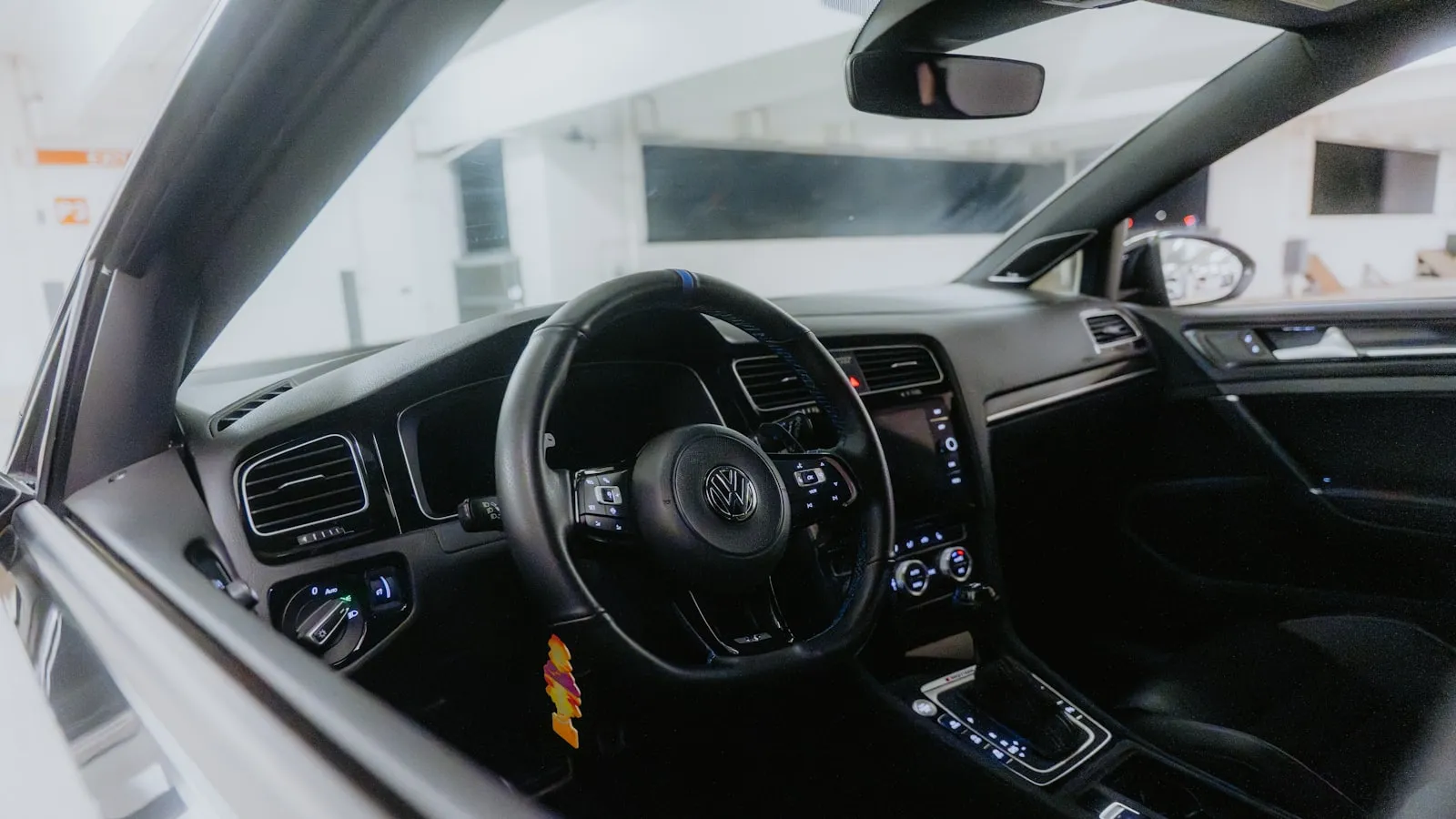
Cars without factory HomeLink have four hardware options for adding a car-mounted opener. Here is what each costs, what it requires, and which fits your opener brand.
Why cars end up without a visor opener
HomeLink has shipped in millions of vehicles since 1996, but it was never standard on every car, and the list of vehicles without it has grown considerably over the last several years. Premium cars have been removing or paywalling HomeLink across multiple brands: Tesla Model 3, Y, and Cybertruck do not ship with it; Honda moved it behind a HondaLink subscription on the 2026 Civic, Accord, and Passport; Polestar 3 replaced it with a touchscreen integration. Entry trims on mainstream cars often never included it at all.
Older vehicles with factory HomeLink occasionally have the Gentex module fail — leaving the visor buttons dead while everything else works.
In all of these cases, the solution is the same: add the capability back with aftermarket hardware.
What “universal” actually means
The word “universal” on a garage door remote box typically means the device can learn any RF frequency between 290 and 433 MHz. That range covers the vast majority of residential garage door openers in North America.
What it does not mean: you can point the remote at the opener from the driveway and it starts working.
Two programming modes exist, and which one applies depends on your opener type.
Fixed-code copy. Pre-1993 openers and some regional brands transmit the same code on every press. A universal remote captures this by holding the existing remote close to the new one and pressing both simultaneously. The new remote stores the signal.
LEARN-button pairing. Security+ 2.0 openers (most LiftMaster and Chamberlain units manufactured after approximately 2011), Genie Intellicode, and several others use rolling code — the transmitted code cycles on every press, so there is nothing useful to copy from the existing remote. Instead, the new remote programs directly at the opener: press the LEARN button on the motor head (a small colored button near the antenna wire), then within 30 seconds press and hold the new remote until the motor-head indicator light flashes or clicks. That handshake establishes the rolling-code relationship.
LEARN-button programming requires physical access to the opener motor head. For a garage opener that means a step stool or ladder. For a gate operator with its control board in a post-mounted enclosure, it means opening that enclosure with the correct tool. Programming cannot be done from the car.
Option 1: Universal visor remote ($15-30)
The most direct path. A small transmitter clips to the visor or sits in the center console. No car wiring required.
Chamberlain KLIK1U / KLIK2U. Designed specifically for Security+ 2.0 — the rolling-code protocol used by most LiftMaster and Chamberlain openers manufactured after 2011 at 315 MHz (and some older models at 390 MHz). The KLIK1U is single-channel ($15-20 retail); the KLIK2U adds a second channel ($20-25). Programs via the LEARN button on the opener head. Also handles older Security+ 1.0 fixed-code units via code copy. If your opener’s label says “Security+ 2.0” or your opener has a myQ logo, this is the correct starting point.
Genie GIT-series. Genie’s own universal remote for Intellicode rolling-code systems. Programs via the Intellicode sequence on Genie motor heads and handles both Intellicode 1 and Intellicode 2 protocols. Works on fixed-code Genie openers via code copy as well.
Multi-Code 3089 / Skylink G-Key equivalents. Older-format universal remotes that learn a fixed code from the existing remote. Inexpensive ($10-18) but limited to non-rolling-code systems. If your opener says “Security+,” “Intellicode,” or shows a myQ logo, these will not work.
Full details on the LEARN-button sequence for rolling-code gate openers are in our HomeLink rolling-code programming guide.
The practical limit of Option 1: you still press a button at every arrival. Battery life is typically two to four years per standard AAA or coin cell.
Option 2: HomeLink add-on visor clip (~$40-60 NOS)
The Gentex HomeLink Wireless Control Panel — model HLCP1 — was Gentex’s own aftermarket add-on for cars without factory HomeLink. It provided three standard HomeLink buttons in a clip-mounted housing that attached to the visor or overhead console. It programmed identically to factory HomeLink: Security+ 2.0 via the LEARN button, Security+ 1.0 via code copy, Genie Intellicode via the corresponding sequence.
The HLCP1 ran on its own coin-cell battery and required no car wiring. The clip was self-contained.
Gentex discontinued the HLCP1 in the early 2020s. It now surfaces as new-old-stock through automotive parts suppliers and Amazon Marketplace sellers, typically at $40-60 when available. Availability is intermittent.
The reason to look for one: among the four options here, the HLCP1 provides HomeLink-identical behavior at the lowest cost — when you can find it. For owners with a Security+ 2.0 or Intellicode 2 opener who want HomeLink equivalence without replacing the mirror, it is worth checking availability before committing to Option 3.
Option 3: Aftermarket HomeLink mirror ($200-350 installed)
Gentex produces aftermarket auto-dimming rearview mirrors with HomeLink built in for a wide range of vehicles. These are the same mirrors that appear as factory upgrades on many models and install the same way.
Installation connects to the car’s existing mirror wiring harness — typically a 3-pin or 5-pin connector behind the trim. Depending on the vehicle and the installer’s experience, the swap takes 20-45 minutes. No modification to the car’s electrical system beyond the connector.
The result is factory HomeLink behavior: three rolling-code channels, Security+ 2.0 and Intellicode support, car-powered (no battery to replace), and occupying the standard mirror location.
Finding the right mirror: Gentex and several auto-parts suppliers publish compatibility lookups by vehicle year, make, and model. The wiring harness connector must match — mirror connectors vary by manufacturer and trim level. Confirm the part number before ordering.
Cost runs $200-350 for the mirror itself; installer labor is additional if not self-installed. This is the most expensive of the four options and produces a factory-clean result that stays with the vehicle.
Option 4: Smart Wi-Fi module at the opener (no in-car hardware)
For owners who are less concerned about a physical button in the car and more interested in remote monitoring or semi-automated arrival, a Wi-Fi module wired to the opener can serve the same function from a different direction.
Remootio Gen 3, iSmartGate Pro, and Tailwind iQ3 each wire into the opener’s dry-contact wall-button terminals, connect to home Wi-Fi, and provide app-based open and close control. Remootio and iSmartGate support driveway gate operators as well as garage doors. Tailwind is garage-only.
Phone-based geofencing: all three platforms offer it. The app opens the opener as the phone enters the home geofence. The known constraint is OS-level geofence latency — Apple’s Core Location and Google’s Geofence API both recommend a minimum geofence radius of roughly 100 meters for reliable triggering. That covers most short driveways, but longer approaches may produce early or late triggers.
None of the three require a recurring subscription for basic functionality. Remote-from-anywhere access routes through each vendor’s cloud; local Wi-Fi control works when the cloud is unavailable.
For the full comparison of phone-based and all other approaches, every way to open your gate or garage from your car covers all seven categories side by side.
Frequency reference: what your opener uses
Frequency mismatches cause the majority of compatibility failures. This table covers the most common combinations; always verify against your opener’s manual or the manufacturer’s remote-compatibility guide.
| Brand | Common frequency | Protocol |
|---|---|---|
| LiftMaster / Chamberlain (post-2011) | 315 MHz | Security+ 2.0 (rolling code) |
| LiftMaster / Chamberlain (pre-2011) | 390 MHz | Security+ 1.0 (fixed or rolling) |
| Genie (Intellicode 1 / 2) | 390 MHz | Rolling code |
| Craftsman (Chamberlain-made, post-2011) | 315 MHz | Security+ 2.0 |
| Overhead Door (CodeDodger 2) | 372 MHz | Rolling code |
| Linear / Multi-Code | 318 MHz | Fixed code |
| Marantec | 433 MHz | Rolling code |
| Nice / Apollo (gate operator) | 433 MHz | Rolling or proprietary |
| FAAC (gate operator) | 433 MHz | Proprietary |
| DoorKing (gate operator) | 318 or 433 MHz | Fixed or proprietary |
The column that matters most for buyers: most US-market universal remotes, including the Chamberlain KLIK1U, target the 315/390 MHz Security+ ecosystem. A 315 MHz remote will not pair with a 433 MHz receiver regardless of how many times the LEARN button is pressed.
For driveway gate owners: the 433 MHz problem
Gate operators and garage door openers are not the same market, and most universal remotes sold through US retail channels (Amazon, Home Depot, hardware stores) target the 315 MHz garage door ecosystem. Gate operators frequently use different frequencies and, in some cases, proprietary protocols.
Nice/Apollo, FAAC, and many imported gate operators use 433 MHz receivers. A Chamberlain KLIK1U will not pair with any of them.
Owners of these gate brands have two reliable paths. First, contact the gate operator’s manufacturer or a local gate service company for the correct OEM remote — this is the guaranteed-compatible option, typically $30-80 depending on brand. Second, a 433 MHz universal remote from a supplier that stocks European or gate-industry equipment may work, but compatibility is less certain than with the OEM remote.
For gate operators that use proprietary encoding (some FAAC models, some DoorKing intercom-integrated systems), only the OEM remote or a professionally cloned unit will work. The gate operator’s documentation will specify whether it uses standard amplitude modulation at a stated frequency or a proprietary protocol.
The broader guide to opener compatibility and alternative approaches for driveway gate owners is at HomeLink alternatives for driveway gates.
Which option fits your situation
Fastest, simplest setup and comfortable with a button press: Universal visor remote. For Security+ 2.0 (most LiftMaster/Chamberlain), start with the KLIK1U. For Genie Intellicode, start with Genie’s GIT-series. Budget $15-25 and plan 15 minutes at the opener head.
HomeLink-equivalent behavior without mirror cost, willing to source discontinued hardware: Look for the Gentex HLCP1 new-old-stock. If found at $40-60, it programs identically to factory HomeLink.
Permanent, factory-clean result, comfortable with the cost: Aftermarket HomeLink mirror from Gentex. Confirm the part number for your vehicle. $200-350 in parts; 30-45 minutes installed.
Remote monitoring and semi-automated arrival from the phone: Smart Wi-Fi module (Remootio, iSmartGate, or Tailwind). No hardware in the car; the phone is the interface. Budget $45-120 in hardware.
Gate uses 433 MHz or a proprietary protocol: KLIK1U and most US-market universal remotes will not work. Contact the gate operator’s manufacturer for the correct OEM remote, or have a gate technician source or clone one.
Where Proxly fits
All four options above share one constraint: the opener still needs a trigger at every arrival — a button press, an app tap, or a phone geofence with its own latency floor. A newer category removes that trigger entirely.
Tag-and-Hub systems place a small windshield Tag with its own GPS on the car and wire a Hub into the opener’s wall-button terminals. As the car approaches home, the Hub fires the opener automatically — no button, no phone, no app required. Because the Tag has a dedicated GPS chip, it is not bound by the OS-level geofence floors that constrain phone-based approaches.
Proxly is building in this category. We are pre-launch — currently running a Beta-20 program. If hands-free arrival on any car with any opener brand is the constraint you are actually trying to solve, getproxly.com/beta is where to follow what we are building.
Bottom line
A car without factory HomeLink has real options at every price point. A universal visor remote covers most garage door situations for under $25. An aftermarket HomeLink mirror brings factory capability back permanently. For driveway gates, frequency matching is the step most buyers skip: confirm your gate operator’s receiver band before ordering anything.
If your situation is Security+ 2.0 garage door and a car without HomeLink, the Chamberlain KLIK1U and 15 minutes at the motor head is the answer. If it is a 433 MHz gate operator, the answer is the OEM remote for that brand.
FAQ
What is the best universal garage door opener for a car?
For Security+ 2.0 openers (most LiftMaster and Chamberlain manufactured after 2011), the Chamberlain KLIK1U handles rolling-code pairing via the LEARN button and retails for $15-20. For Genie Intellicode openers, Genie’s GIT-series remote does the equivalent. For older fixed-code systems, any 300-400 MHz universal remote under $20 works by copying the existing remote’s signal.
Can you add HomeLink to a car that doesn’t have it?
Three ways exist. The Gentex HLCP1 add-on visor clip provided full HomeLink behavior with no car wiring; it is discontinued but surfaces as new-old-stock for $40-60. An aftermarket Gentex auto-dimming mirror with HomeLink costs $200-350 installed. For Tesla Model 3 and Y, the service-center retrofit using part 1114984-00-B adds HomeLink for $300-350; no equivalent retrofit exists for the Cybertruck.
Does a universal remote work with a rolling-code garage door opener?
Yes, but not by copying the existing remote. Rolling code changes on every press, so the captured code is already stale. A compatible universal remote programs instead via the LEARN button on the opener’s motor head: press LEARN, then press and hold the new remote until the indicator light flashes. The Chamberlain KLIK1U supports Security+ 2.0 this way; Genie’s GIT-series supports Intellicode 2.
Why won’t my universal remote pair with my gate opener?
Most US-market universal remotes target 315 MHz, the band LiftMaster and Chamberlain garage openers use. Many residential gate operators — Nice/Apollo, FAAC, some DoorKing models — operate at 433 MHz. A 315 MHz remote will not pair with a 433 MHz receiver. Check your gate operator’s documentation for the receiver frequency before purchasing any universal remote.
What is the difference between a universal remote and HomeLink?
A universal remote is a separate handheld transmitter you carry or clip to the visor — you press it at each arrival. HomeLink is a Gentex-built RF module integrated into the car’s visor or mirror that does the same thing with a built-in button. Both require a press every time. HomeLink is car-powered with three dedicated channels; a universal remote is portable but adds hardware to carry and batteries to replace.
Can a smart Wi-Fi module replace an in-car opener button?
For most households, yes. A module like Remootio or iSmartGate wires to the opener and provides phone-app control. Phone-based geofencing can automate the open as you approach. The trade-off is OS-level geofence latency — Apple and Google recommend a minimum radius of roughly 100 meters for reliable triggering — and the phone must be awake and connected for the trigger to fire.
References
Frequently asked questions
- For Security+ 2.0 openers (most LiftMaster and Chamberlain manufactured after 2011), the Chamberlain KLIK1U handles rolling-code pairing via the LEARN button for $15-20. For Genie Intellicode openers, Genie's GIT-series remote does the equivalent. For older fixed-code systems, any 300-400 MHz universal remote under $20 works by copying the existing remote's signal.
- Three ways exist. The Gentex HLCP1 add-on visor clip provided full HomeLink behavior with no car wiring; it is discontinued but surfaces as new-old-stock for $40-60. An aftermarket Gentex auto-dimming mirror with HomeLink costs $200-350 installed. For Tesla Model 3 and Y, the service-center retrofit using part 1114984-00-B adds HomeLink for $300-350; no equivalent retrofit exists for the Cybertruck.
- Yes, but not by copying the existing remote. Rolling code changes on every press, so the captured code is already stale. A compatible universal remote programs via the LEARN button on the opener's motor head: press LEARN, then press and hold the new remote until the indicator light flashes. The Chamberlain KLIK1U supports Security+ 2.0 this way; Genie's GIT-series supports Intellicode 2.
- Most US-market universal remotes target 315 MHz, the band LiftMaster and Chamberlain garage openers use. Many residential gate operators — Nice/Apollo, FAAC, some DoorKing models — operate at 433 MHz. A 315 MHz remote will not pair with a 433 MHz receiver. Check your gate operator's documentation for the receiver frequency before purchasing any universal remote.
- A universal remote is a separate handheld transmitter you carry or clip to the visor — you press it at each arrival. HomeLink is a Gentex-built RF module integrated into the car's visor or mirror that does the same thing with a built-in button. Both require a press every time. HomeLink is car-powered with three dedicated channels; a universal remote is portable but adds hardware to carry and batteries to replace.
- For most households, yes. A module like Remootio or iSmartGate wires to the opener and provides phone-app control. Phone-based geofencing can automate the open as you approach. The trade-off is OS-level geofence latency — Apple and Google recommend a minimum radius of roughly 100 meters for reliable triggering — and the phone must be awake and connected for the trigger to fire.
What is the best universal garage door opener for a car?
Can you add HomeLink to a car that doesn't have it?
Does a universal remote work with a rolling-code garage door opener?
Why won't my universal remote pair with my gate opener?
What is the difference between a universal remote and HomeLink?
Can a smart Wi-Fi module replace an in-car opener button?
Keep reading
How to Program GMC HomeLink (Sierra, Yukon, Canyon, and Hummer EV)
Step-by-step guide to programming GMC HomeLink on Sierra, Yukon, Canyon, and Hummer EV — button location by model year, the rolling-code two-step, and five reasons training stalls.
HomeLink vs myQ: Honest Comparison for Driveway Gate Owners
HomeLink sends RF commands from your car's visor; myQ routes commands through the cloud. A direct comparison covering speed, offline reliability, and gate compatibility.
How to Program BMW HomeLink: X5, X7, i4, iX, and Older Models
How to pair BMW HomeLink on X5, X7, i4, and iX — including the two-step rolling-code sync, the iDrive prerequisite on EV models, and five reasons training stalls.