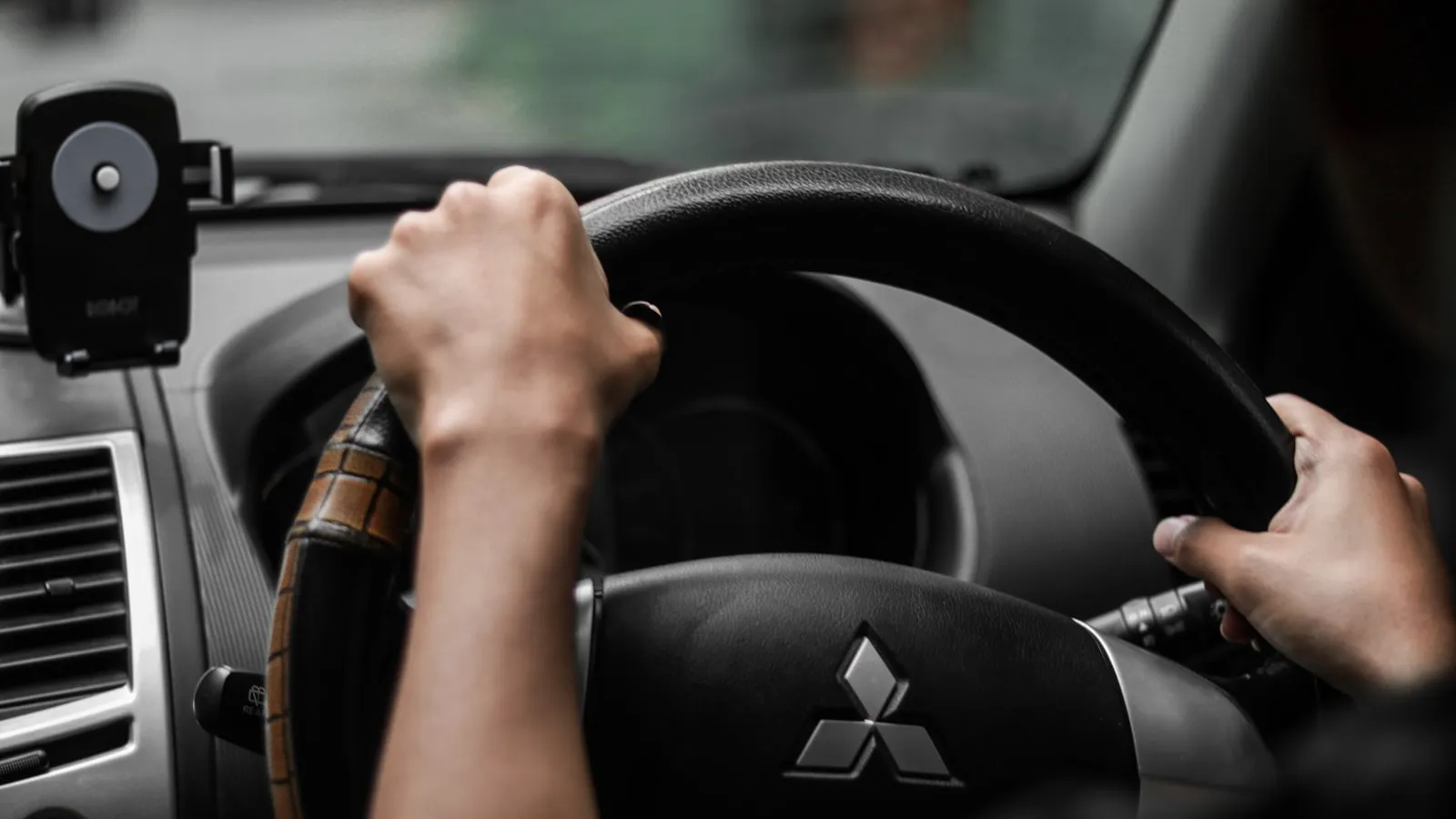
HomeLink and myQ address the same daily problem from opposite ends of the technology stack. HomeLink is a radio transmitter built into your car’s visor — it learns a frequency from an existing opener remote and fires it on button press. myQ is a cloud module installed on the opener’s control board — it routes app commands through LiftMaster’s servers to trigger the motor.
They are not direct substitutes, and the right choice depends on which failure mode you’re actually trying to avoid. This comparison covers both, and touches on where Proxly fits as a third approach for owners the first two options don’t fully serve.
What HomeLink Actually Is
HomeLink is manufactured by Gentex Corporation and built into the overhead console or driver-side visor of most Toyota, GM, BMW, Ford, Rivian, and many other vehicles. It stores up to three channels, each programmed from an original opener remote by radio frequency mirroring.
Older openers using fixed DIP-switch codes require only a one-step frequency copy. Rolling-code openers — LiftMaster Security+ 2.0, Chamberlain Security+, Genie Intellicode — require a two-step sequence: frequency copy first, then a LEARN-button sync at the opener’s motor head within about 30 seconds. Skipping the second step is the most common HomeLink failure mode; the opener simply treats every press as an unrecognized command. The two-step sequence for rolling-code openers is covered in the HomeLink rolling-code programming guide.
HomeLink transmits at 288, 310, 315, 390, 418, or 433 MHz, depending on the opener’s receiver. There is no app, no cloud account, and no subscription. The signal is local — it works when the phone is dead, the Wi-Fi is down, and LiftMaster’s servers are unreachable.
What myQ Actually Is
myQ is LiftMaster and Chamberlain’s Wi-Fi-connected access platform. The common hardware variants are the myQ Smart Garage Hub (a standalone add-on) and the 828LM Smart Control Panel, which replaces the wall button. Both connect to the opener’s logic board and relay commands from the myQ app through LiftMaster’s cloud to the motor.
The command chain runs: phone → LiftMaster servers → myQ module → opener motor. That round-trip adds perceptible latency. Under normal residential Wi-Fi conditions, the gate begins moving one to four seconds after the app button is tapped — slower than a direct RF press, and dependent on an uninterrupted path through the internet.
What myQ gains in that trade: remote monitoring and control from anywhere. Gate-open notifications. Time-based rules that can close the gate automatically after a set window. Guest access sharing via the app rather than handing over a physical clicker.
myQ’s basic monitoring and control tier has been available without a subscription fee; some third-party platform integrations have been gated behind paid tiers. Pricing and tier structure are subject to change — verify current terms at liftmaster.com before purchasing.
Head-to-Head: Six Dimensions
Speed. HomeLink wins. RF commands are near-instant; the gate begins responding in under a second. myQ’s cloud round-trip adds one to four seconds. For a driveway gate where you’re approaching a keypad, that latency is more noticeable than it is for a garage door triggered at the push of a button while parked.
Offline reliability. HomeLink wins. It operates fully independent of the internet. myQ stops responding if the home network is down, if there is a LiftMaster server issue, or if the app cannot establish a cloud connection.
Remote access. myQ wins. HomeLink works only within RF range of the opener — typically a few hundred feet in line of sight. myQ allows status monitoring and command sending from anywhere with a cell or Wi-Fi signal.
Cost. HomeLink ships with the car on equipped trims at no additional cost. myQ hardware retails at a modest price for the Smart Garage Hub; subscription costs depend on which features and integrations you use. Neither is particularly expensive for the hardware layer.
Access sharing. myQ wins. HomeLink sharing requires programming another vehicle’s visor from the same original remote — a physical, in-person process. myQ allows digital key sharing and temporary access through the app without distributing physical hardware.
Driveway gate compatibility. Both have real limits. HomeLink works if the gate operator has a compatible RF receiver at the right frequency and rolling-code protocol — many slide gate operators and commercial-grade swing gate operators do not. myQ’s hardware is designed for LiftMaster and Chamberlain models; it does not retrofit to Nice Apollo, FAAC, DoorKing, or Mighty Mule gate operators.
Which to Use
If the opener is HomeLink-compatible and the daily visor button routine is working reliably, HomeLink is hard to argue against: no ongoing cost, no internet dependency, no vendor relationship to maintain. Premium cars are increasingly removing HomeLink as standard equipment — worth reading before assuming your next vehicle will include it.
If remote monitoring, notifications, or app-based guest access is the priority, and the opener is a LiftMaster or Chamberlain model, myQ is the practical choice. The myQ Smart Garage Hub review covers the setup experience, platform limitations, and where subscription costs enter the picture.
If neither HomeLink nor myQ is giving you a reliable daily experience with a driveway gate, the opener’s control-board compatibility is usually the constraint — not the remote system itself. Gate operator protocol mismatches and receiver limitations are the more common failure than anything HomeLink or myQ does wrong.
The Third Option: Hands-Free Arrival
Both HomeLink and myQ still require active input at the moment you arrive. HomeLink needs the button press at the right moment. myQ needs the app triggered — either by a geofence event that fires correctly through iOS or Android location throttling, or by tapping the button manually. For owners who want the gate moving before they reach it, with no button and no app interaction, there is a different category.
Proxly is a pre-launch device in that category: a GPS-based windshield Tag and a two-wire Hub that connects to any gate opener’s control board. As your car approaches home, the Tag signals the Hub at a configured distance and the gate opens automatically. No subscription, no cloud round-trip, no phone required at the moment of arrival. If that is the problem you are trying to solve, getproxly.com/beta is where to learn more and reserve a spot.
Conclusion
HomeLink is the fastest, most offline-reliable credential for daily use. myQ is the remote-monitoring and sharing layer for households that need those features. Both belong in different slots of the same access workflow, and they coexist on the same opener without conflict.
For owners who have evaluated both and want the gate moving before the car arrives — without reaching for a button or opening an app — Proxly is a pre-launch alternative worth adding to the list.
Reference
- LiftMaster myQ products and compatibility: liftmaster.com
- HomeLink by Gentex Corporation: homelink.com
Frequently asked questions
- Yes. HomeLink communicates directly with the opener's RF receiver. myQ connects through its own control-board module. They run in parallel without interference — the result is three independent control points: visor button, phone app, and any existing key fob.
- No. myQ requires an active internet connection to route commands through LiftMaster's cloud servers. If your home network goes down or LiftMaster's infrastructure is unreachable, the app cannot operate the gate. HomeLink operates entirely independent of the internet.
- HomeLink is faster. RF commands travel at radio frequency and the gate begins responding in under a second. myQ routes commands through the cloud, adding roughly one to four seconds of round-trip latency — a gap that is noticeable compared to a direct RF remote.
- myQ hardware is designed for LiftMaster and Chamberlain openers. Most residential driveway gate operators — Nice Apollo, FAAC, DoorKing, Mighty Mule — are not on the compatibility list. Check liftmaster.com to verify your specific opener model before purchasing a myQ module.
- myQ's remote functionality depends on LiftMaster maintaining its cloud infrastructure and app support. If the platform is discontinued or restructured, remote commands stop working. HomeLink's RF operation is fully local and unaffected by any vendor's platform decisions — it functions as long as the car has power.
Can HomeLink and myQ work on the same gate opener at the same time?
Does myQ work without Wi-Fi?
Which opens a gate faster — HomeLink or myQ?
Does myQ work with driveway gate openers other than LiftMaster or Chamberlain?
What happens to myQ if LiftMaster changes or discontinues the platform?
Keep reading
How to Program GMC HomeLink (Sierra, Yukon, Canyon, and Hummer EV)
Step-by-step guide to programming GMC HomeLink on Sierra, Yukon, Canyon, and Hummer EV — button location by model year, the rolling-code two-step, and five reasons training stalls.
Universal Garage Door Opener for Your Car (No-HomeLink Buyer's Guide)
Cars without factory HomeLink have four hardware options for adding a car-mounted opener. Here is what each costs, what it requires, and which fits your opener brand.
How to Program BMW HomeLink: X5, X7, i4, iX, and Older Models
How to pair BMW HomeLink on X5, X7, i4, and iX — including the two-step rolling-code sync, the iDrive prerequisite on EV models, and five reasons training stalls.