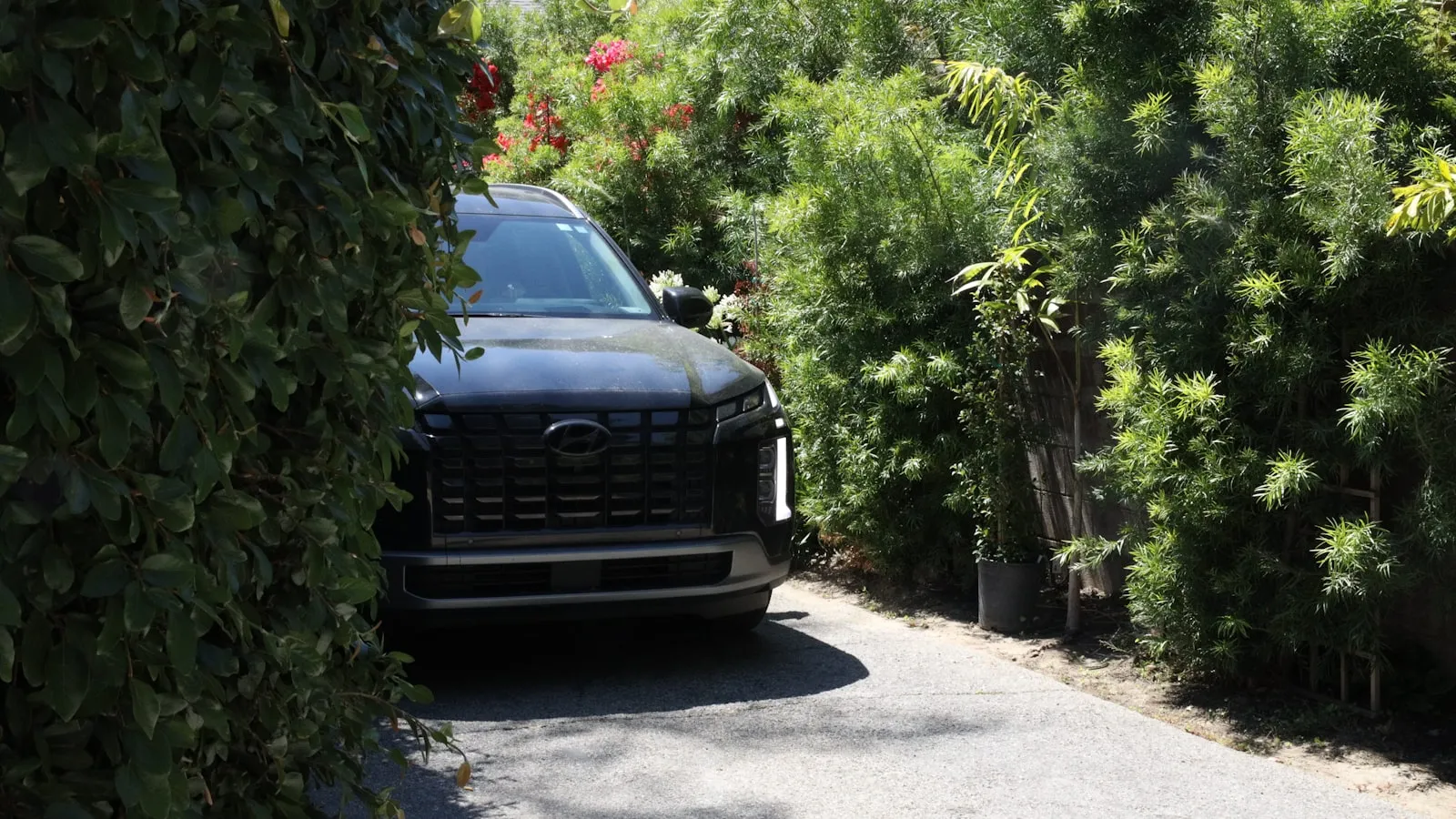
The visor button has opened gates the same way since 1993: get close, press it, the gate moves — the car is just where the transmitter lives. Car as credential flips that. Instead of a clicker, keypad code, HomeLink module, or phone app standing in for you, the gate opens because your specific vehicle is confirmed at the threshold, with no button, no account, and no proxy. Here is what that shift means in hardware terms.
That framing is precisely what “the car is the credential” replaces.
The Credential Is Always a Proxy
Every gate access method in common use today is a proxy for identity. A clicker is proof that you possess the right RF transmitter. A keypad code is proof that you know the right sequence. HomeLink is proof that your car’s visor module is enrolled in the opener’s rolling-code memory table. A phone app is proof that your authenticated account has permission to trigger the right cloud relay.
None of these prove that you — or your vehicle specifically — are at the gate. They prove you have something that has been associated with access. The token and the person can be decoupled.
This is not a fatal flaw. Token-based access has worked reliably for decades and will continue to work for most homeowners most of the time. But it does mean that every traditional gate system is, in authentication terms, a single possession factor. Someone can steal the clicker. Someone can shoulder-surf the keypad PIN. Someone can drive your car to a dealership loaner and take your gate access with it.
The vehicle-as-credential model restructures this. The credential is not something stored in the car or carried by the driver — it is the car, confirmed to be at the gate threshold at that moment.
Three Decades of Clicker Refinement
The fixed-code RF remote of the early 1990s was the first step away from keypad-only access. The credential moved with the vehicle. A driver pulling into their driveway didn’t need to stop at the gatepost keypad — they pressed a small button from the driver’s seat, the receiver decoded the signal, and the gate opened.
Fixed codes had an obvious weakness: any receiver that heard the transmission could replay it later. A code-grabber — a small, inexpensive device — could capture a valid code and retransmit it to open the gate. Manufacturers addressed this with rolling-code protocols. Chamberlain’s Security+ and later Security+ 2.0, and Nice/Apollo’s Intellicode, synchronized a counter between transmitter and receiver. Each button press advances the counter; a previously recorded signal is no longer valid because the counter has moved.
Rolling code hardened the clicker against replay attacks. It didn’t change the underlying credential model: possession of the transmitter is the authorization. Lose the remote, and whoever finds it can open your gate.
For the specific mechanics of how rolling-code enrollment works with HomeLink — including the step most setup guides skip — see HomeLink Programming for Rolling-Code Gate Openers.
HomeLink: The Visor Credential
HomeLink embedded the transmitter into the vehicle itself, beginning with General Motors vehicles in 1995 and expanding broadly across manufacturers through the 2000s. This solved a genuine convenience problem: the clicker left in the other car, the fob with a dead battery, the passenger who has never seen the remote. With HomeLink, the car and the credential were the same object.
That integration introduced a different complication. The credential is now attached to the vehicle’s hardware configuration, not to the owner’s identity. When a car is sold or a lease ends, the gate codes go with it. Previous owners remain enrolled in the opener’s memory table unless someone explicitly clears the slots — which the brief says to do in the car’s system, but which most dealers and new owners never think to do.
HomeLink also has a compatibility ceiling. It transmits RF at frequencies between 288 and 433 MHz. Gate openers that use proprietary protocols, wired-only inputs, or encrypted boards outside that band — a growing category as commercial-grade hardware filters into residential installs — are outside its range. And the driver must be within the transmitter’s effective range, typically 50 to 100 feet depending on the opener antenna and site geometry, before pressing the button. At a driveway gate, that often means stopping at the gate and waiting with the car running.
For EV owners troubleshooting why their HomeLink enrollment worked during the car dealership’s test but fails at their own gate, Why HomeLink Stops Working with Your Driveway Gate covers the five failure modes in diagnostic order.
The Phone Layer
The app-controlled retrofit market — myQ, Remootio, iSmartGate, ratgdo — introduced account-based credentials. App access is protected by a password and, in most implementations, can be revoked remotely without touching the gate hardware. This is an improvement from an identity standpoint: a password adds a knowledge factor on top of the possession factor (the phone), and compromised access can be cut off from anywhere.
But the phone remains a proxy. The phone authenticates you; the phone acts on your behalf. You are not the credential — your authenticated session on your phone is the credential.
This indirection introduces latency. The sequence runs: phone wakes from sleep, app loads, cloud request dispatches over cellular, opener receives the command. Owners who have timed this consistently find 4 to 12 seconds of added delay compared to a physical clicker, depending on cellular strength and cloud routing. At a driveway gate where the car is already stopped and idling, that gap is noticeable. It is also inconsistent — sometimes it is two seconds, sometimes it is fifteen.
The phone also introduces a single point of failure that the clicker does not have: if the cloud service is down, the cellular signal is absent, or the account session has expired, the credential does not work.
What Vehicle-as-Credential Actually Means
The concept is precise. In the vehicle-as-credential model, the vehicle’s confirmed presence at the gate threshold is the authorization.
Three conditions must hold simultaneously:
Verified vehicle identity. The access controller knows which specific vehicle is expected. This requires an encrypted enrollment — the vehicle presents proof of identity that cannot be captured from a passing car and replayed. A shared secret that travels over the air is vulnerable; a certificate-style exchange where each challenge-response is unique is not.
Confirmed position at the gate. The controller observes that the enrolled vehicle is within a defined geographic boundary tight enough to rule out a neighbor’s car or a delivery truck parked nearby. GPS with sufficient update frequency can locate a vehicle at a property boundary with meaningful precision. An encrypted short-range signal can tighten the window further, eliminating ambiguity in dense suburban blocks where houses sit close together.
Real-time correlation of both. Identity without confirmed position is device presence detection — useful for knowing your car is in range, insufficient for authorizing gate access. Position without identity is occupancy sensing — the gate knows something is there, but not what. The credential is the conjunction of verified identity and confirmed position, evaluated at the moment the vehicle approaches the threshold.
When these three conditions are met, the driver does not act. The gate evaluates the car at the perimeter, confirms authorization, and opens. There is no button to press, no phone to unlock, no app to load. The act of arriving in the right vehicle at the right location is the credential.
Why EVs Are the Right Platform
A 2008 Honda Pilot with a HomeLink module has roughly the same computational architecture as its gate credential system: an RF chip, a stored code table, and no connection to the vehicle’s primary compute. Gate control is a separate island with no link to the car’s sensors or network.
A 2024 Tesla Model Y, Rivian R1T, or BMW iX differs in a relevant way. These vehicles carry persistent GPS hardware that remains active on the 12V battery system, always-on cellular connectivity used for over-the-air updates and remote commands, a compute platform capable of running complex authorization logic, and a power budget that keeps all of this operational without the high-voltage traction pack engaged.
This does not mean these EVs have implemented vehicle-as-credential gate access — they have not. As any owner who has tried Tesla’s geofence feature at a driveway gate will confirm, Tesla’s geofence automation targets garage openers via the myQ cloud protocol, and that protocol simply does not translate to the dry-contact interface a driveway gate uses. For owners weighing the HomeLink alternative for Tesla options that actually exist today, the same constraint shapes every one of them. The capability of the vehicle’s hardware and the existence of a working gate integration are two different problems.
What EVs provide is the platform architecture this model requires. Persistent location sensing, always-on compute, encrypted communication — these are present by design in every current-generation EV because they are required for other features. The constraint is not the vehicle. The constraint is on the gate side: a receiver that understands vehicle-identity signals and knows how to translate an authenticated arrival into a dry-contact gate trigger.
The Hardware Reality
Every residential gate opener exposes a dry-contact input. It is two terminals on the control board — typically labeled PUSH, PB, or TRIG in the wiring diagram. When those two terminals are bridged for approximately 500 milliseconds, the opener cycles: the gate opens if it was closed, closes if it was open. This is the same interface used by a wall button, a physical clicker, a HomeLink module, a Remootio relay, and every other gate trigger that has ever been wired to a residential opener.
A vehicle-credential controller needs to do exactly one thing at the gate: bridge those two terminals when an enrolled vehicle is confirmed at the perimeter. The opener responds the same way it responds to any trigger. No modification to the gate operator, no proprietary opener protocol, no cloud dependency between the credential evaluation and the gate cycle.
The installation footprint is small — a controller module near the gate’s control board, two wires to the same terminals any remote receiver uses, and low-voltage power from the opener’s accessory output. The vehicle side requires a tag or module that the controller can identify and track: something small, mounted to the car, that presents a consistent encrypted identity.
This architecture is not theoretical. Every component exists as mature technology. The gap in 2026 is not in the individual pieces — it is that no widely available residential gate product has assembled the full stack: vehicle-paired identity, GPS perimeter confirmation, and dry-contact relay output, in a form that works across the range of openers (LiftMaster, Nice, FAAC, Mighty Mule, DoorKing) without requiring a proprietary opener or a cloud subscription.
Where Things Stand in 2026
The arrival experience for an EV owner with a driveway gate involves some combination of the following in 2026: a HomeLink press from the visor at close range, an app tap on the phone before leaving the last red light, a keypad walk from the stopped car, or waiting at the gate while an app-triggered relay completes its cloud round-trip. Owners shopping for a HomeLink alternative usually arrive here after one of those work-arounds has worn thin.
Each is a work-around for the underlying gap. The car has the hardware. The gate has the dry-contact interface. What is missing is a controller that bridges vehicle identity to gate action without routing through a phone account, a cloud service, or a button press.
For a view of how the full arrival stack — from charge curve to gate cycle — layers these systems and where each layer breaks down, The Premium-EV Arrival Stack covers the four-layer architecture in detail.
A current comparison of HomeLink alternatives for driveway gates documents the options that exist today with honest trade-offs. Several are genuinely useful. None fully implement the vehicle-as-credential model described here.
One product being built specifically to close this gap — a vehicle-paired Tag and a gate-side Hub with no phone app and no cloud subscription — is accepting early-access reservations at getproxly.com/beta.
Frequently asked questions
- It means the vehicle's confirmed position at the gate threshold — matched to an encrypted vehicle identity — authorizes the gate to open without the driver pressing anything. The car's known location at the right perimeter is the proof of authorization, not a button or an account.
- HomeLink requires a button press. The driver closes the distance, presses the visor button, and the RF signal tells the opener to cycle. Vehicle-as-credential is passive: a controller monitors for an enrolled vehicle and opens the gate when it arrives. No driver action is required.
- Not for driveway gates. Tesla's geofence feature can trigger a garage opener via myQ, but that protocol does not work with dry-contact driveway gates. A separate controller — paired to the vehicle and wired to the gate's control board — is required.
- Any vehicle with an always-on GPS module can provide the position component. EVs are better positioned because their compute stays live on the 12V system without engine-on, but the model is not exclusive to EVs in principle.
- No. Every residential gate opener — LiftMaster, Nice, FAAC, Mighty Mule, DoorKing — exposes a dry-contact input: two terminals on the control board that cycle the gate when bridged. A vehicle-credential controller outputs to that same interface. The opener does not change.
What does 'the car is the credential' mean for a driveway gate?
How is vehicle-based gate access different from HomeLink?
Does Tesla support vehicle-based driveway gate access natively?
Can any car serve as the credential, or only EVs?
Does this require replacing the existing gate opener?
Keep reading

GMC Hummer EV HomeLink: Driveway Gate Setup and Timing
The Hummer EV weighs 9,063 lbs. Most driveway gates take 15-20 seconds to open. Here's how to program HomeLink and get the approach timing right.
Why Tesla HomeLink Fails on Driveway Gates (And the Fix That Isn't a Better Button)
Tesla HomeLink works reliably on garage doors. Driveway gates are a different problem. Here is what goes wrong and what fixes it.
Cybertruck Driveway Gate: Three Ways In, One Hands-Free
Cybertruck owners have three options for a driveway gate: built-in HomeLink, Tesla's geofence, or a GPS tag that opens at 300 feet with no button press.