There are six ways to open a driveway gate from a Tesla — HomeLink, myQ, Remootio, iSmartGate, a phone geofence app, or vehicle-paired hardware — and only some open the gate before you reach it. Tesla’s own geofence auto-open works for a garage door at the end of a short driveway, but at a property-boundary gate it fires too late: the gate starts opening once you’ve pulled up to the panel, not 200 feet out.
Here’s what each option does at a driveway gate specifically and the honest trade-offs. For the full technical explanation of why the geofence timing breaks down at gates, see why Tesla’s geofence won’t open a driveway gate.
Option 1: HomeLink — The Button That Works at the Gate
HomeLink is the RF transmitter built into the visor or overhead console. At a gate, it does exactly what a handheld clicker does: press the button, the gate opens. You’re already at the gate when you press it, so there’s no approach-from-distance automation. But it’s reliable, requires no phone, and carries no subscription.
Which Teslas have it: Model S and Model X have shipped HomeLink as standard equipment across most model years. Model 3 and Model Y dropped it as standard in 2019 — it’s now a service-center add-on at around $300-$350 installed, plus a service appointment. Cybertruck has no retrofit path from Tesla.
Gate compatibility: HomeLink supports 315, 390, 418, and 433 MHz, covering most US residential gate openers. The programming process requires entering the gate’s learn mode — the same process used for any RF remote. Most swing-gate and slide-gate operators from LiftMaster, Nice, FAAC, and Mighty Mule are compatible, though rolling-code pairing steps vary by opener model.
The honest trade-off: HomeLink is a button, not an auto-open system. If a button press at the gate is acceptable and hands-free approach isn’t a priority, it’s the most reliable option with the fewest dependencies. For the full pairing walkthrough, see the complete HomeLink driveway gate guide.
Option 2: myQ Connected Services (Tesla In-Car Integration)
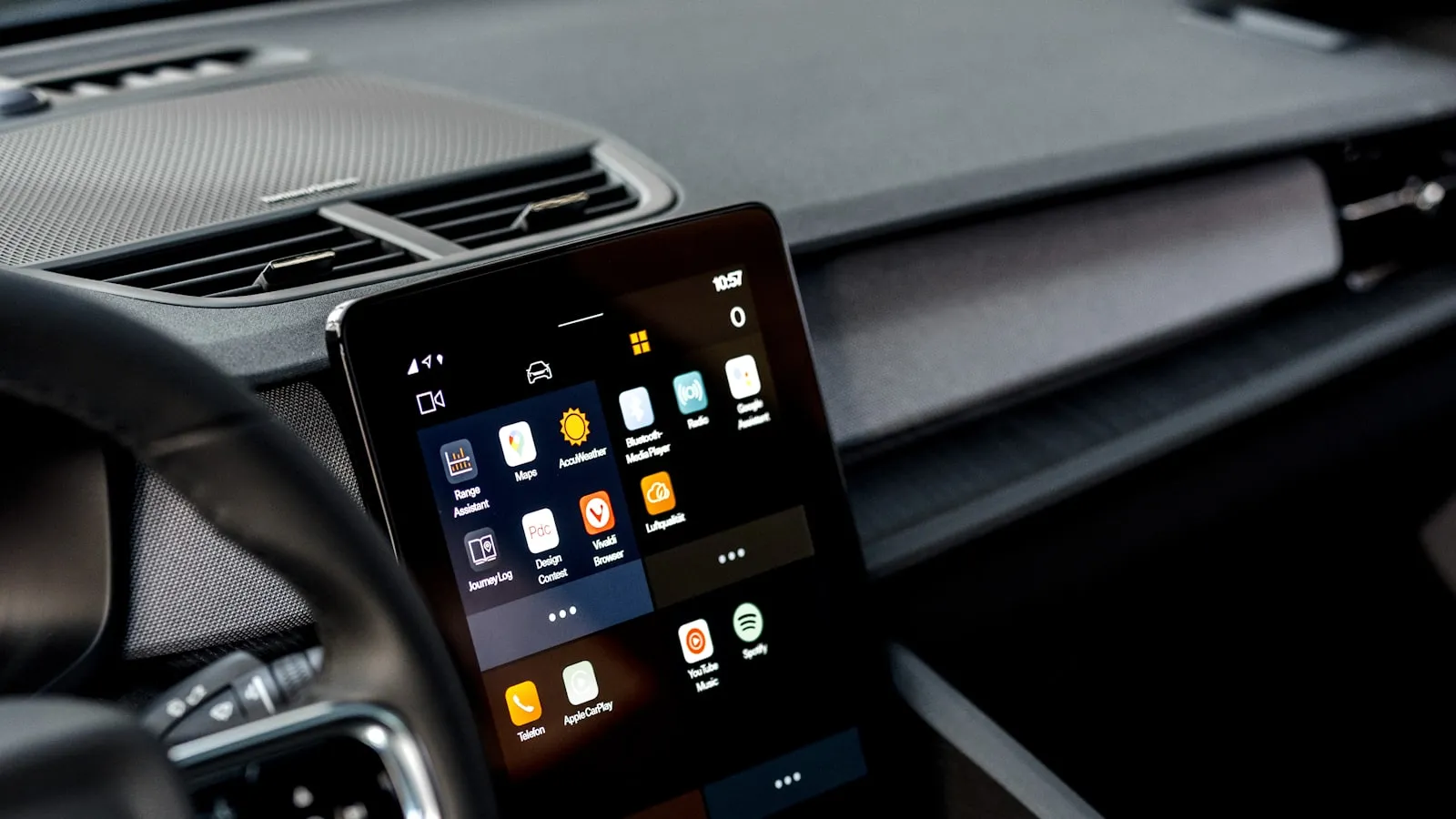
LiftMaster’s myQ platform integrates into Tesla’s in-car display on Model 3, Y, S, and X running recent software. The app, accessed through the Tesla touchscreen, shows gate or garage status and lets the driver open or close it remotely. On properties where the GPS timing aligns, it can also trigger an auto-open as the car approaches home.
Cost: myQ Connected Services runs $5/month or $45/year, billed by Chamberlain.
The gate problem: myQ works only with LiftMaster and Chamberlain family openers — both products of Chamberlain Group. Most residential driveway gate operators (Nice Apollo, FAAC, DoorKing, Viking, Mighty Mule, and others) are not in the Chamberlain family and are not supported. Even when the myQ integration is working in-car, the underlying geofence timing issue remains: the GPS trigger fires when the car is near home, not before the gate.
For a direct comparison of myQ and Remootio on driveway gates, see myQ vs Remootio for driveway gates.
Option 3: Remootio
Remootio is a Bluetooth + WiFi retrofit controller that wires to most gate operators via a dry-contact relay. It has no brand restriction — if the opener has a dry-contact input, which most residential operators do, Remootio is compatible.
The Remootio app includes a user-configurable geofence trigger: when a phone crosses the set radius around home, the app sends an open command via WiFi. Bluetooth auto-open activates at shorter range — typically 15-30 feet from the device — when the phone connects to the module directly.
Cost: Around $150-180 for the hardware depending on the model, with no subscription required for core functionality.
The honest trade-off: The geofence runs on the phone. If the phone isn’t accessible — stored in a bag in the back seat, or the app is force-closed by iOS or Android — the trigger won’t fire. Remootio’s configurable geofence radius gives more control than Tesla’s fixed radius, but the gate-open event still depends on phone location rather than vehicle position.
Option 4: iSmartGate
iSmartGate is a WiFi-based alternative that installs on a gate opener via dry contacts in the same way as Remootio. It adds HomeKit, Google Home, and Alexa integration — relevant for households already using one of those platforms for home automation.
Cost: Around $110-150 for the hub.
The geofence trigger works through the iSmartGate app or via connected platforms like Apple Home or IFTTT. Like Remootio, the gate-open event depends on phone presence and app state. Voice-assistant integration adds a convenience layer for manual remote opens but doesn’t change the approach-automation model.
Option 5: Physical Clicker in the Car
If the gate opener came with a handheld RF remote — or a spare is available from the installer — stashing it in the car is the zero-cost option. It requires no internet, no WiFi, no subscription, and no app.
The only requirement: press the button at the gate. There’s no geofence, no approach detection, no automation of any kind. The trade-off is the one button press. The failure rate under normal conditions is close to zero.
Option 6: Vehicle-Paired Hardware
One category sits outside the phone-geofence model entirely: a small RF tag mounted on the windshield that communicates with a hub wired directly to the gate operator. When the vehicle enters the detection range — without any driver action — the hub triggers the gate open.
The distinction from the above options is the trigger mechanism. There’s no phone GPS involved, no app running in the background, no cloud call. The tag identifies the vehicle; the hub detects the tag’s approach and sends the open signal to the operator. This is the “car as credential” architecture described in more detail in what “the car is the credential” actually means.
Proxly is one product in this category and is currently pre-launch. Reservation details are at getproxly.com/beta. It is one option among the six here, presented alongside alternatives the reader should evaluate honestly.
Side-by-Side
| Option | Approach automation | Phone required | Gate brands | Subscription |
|---|---|---|---|---|
| HomeLink | No — button press at gate | No | Most residential brands | No |
| myQ | GPS-based, LiftMaster/Chamberlain only | Yes | LiftMaster/Chamberlain | Yes |
| Remootio | Phone geofence + Bluetooth at 15-30 ft | Yes | Most brands (dry contact) | No |
| iSmartGate | Phone geofence or voice assistant | Yes | Most brands (dry contact) | No |
| Physical clicker | No — button press at gate | No | Any | No |
| Proxly | RF detection at ~300 ft from gate | No | Most brands (dry contact) | $199-499 |
The clearest dividing line is between options that remove the phone from the gate-open sequence (HomeLink, physical clicker, Proxly) and options that rely on a phone being present, running, and connected (myQ, Remootio, iSmartGate).
For Tesla owners who want something available today: HomeLink on compatible models delivers reliable button-press access at the gate with no subscription. Remootio is the most practical path for non-LiftMaster/Chamberlain gates where some level of geofence-based automation is wanted, with the phone-dependency caveat. For Cybertruck owners specifically — no HomeLink retrofit exists — Remootio or iSmartGate are the most direct routes while the market develops factory-supported alternatives.
Frequently asked questions
- No. myQ works only with LiftMaster and Chamberlain family openers — both Chamberlain Group brands. Residential driveway gate operators from Nice, FAAC, Mighty Mule, Viking, DoorKing, Apollo, and most other manufacturers are not supported. If the gate operator is not a LiftMaster or Chamberlain product, myQ will not communicate with it regardless of vehicle.
- The Remootio app includes a geofence trigger using your phone's GPS, which can fire while you are still some distance from home. Bluetooth auto-open activates at roughly 15-30 feet from the device. Both modes require your phone to be present with the app running in the background for the trigger to work.
- As of 2026, Tesla offers no HomeLink retrofit for the Cybertruck — the vehicle's frunk structure does not accommodate the module used on Model 3 and Y. Cybertruck owners rely on myQ for LiftMaster or Chamberlain gates, Remootio or iSmartGate for other brands, a physical clicker, or pre-launch hardware alternatives.
- Tesla's geofence fires when GPS places the car inside a set radius around home. For a gate at the property boundary, that trigger often fires when the car is already at the gate rather than 200-300 feet away from it. The geometry is different from a ceiling-mounted garage opener inside the driveway.
- A category of vehicle-paired hardware uses a windshield tag that communicates with a hub at the gate operator. The gate detects the approaching vehicle and opens without any phone, app, or cloud dependency. Proxly is one product in this category and is pre-launch as of 2026.
Does myQ work with gate openers other than LiftMaster and Chamberlain?
Can Remootio open my gate before I arrive?
Does Cybertruck have any HomeLink path for a driveway gate?
Why does Tesla's built-in geofence fail for driveway gates?
Is there a hands-free driveway gate opener that does not need a phone?
Keep reading

GMC Hummer EV HomeLink: Driveway Gate Setup and Timing
The Hummer EV weighs 9,063 lbs. Most driveway gates take 15-20 seconds to open. Here's how to program HomeLink and get the approach timing right.
Why Tesla HomeLink Fails on Driveway Gates (And the Fix That Isn't a Better Button)
Tesla HomeLink works reliably on garage doors. Driveway gates are a different problem. Here is what goes wrong and what fixes it.
Cybertruck Driveway Gate: Three Ways In, One Hands-Free
Cybertruck owners have three options for a driveway gate: built-in HomeLink, Tesla's geofence, or a GPS tag that opens at 300 feet with no button press.