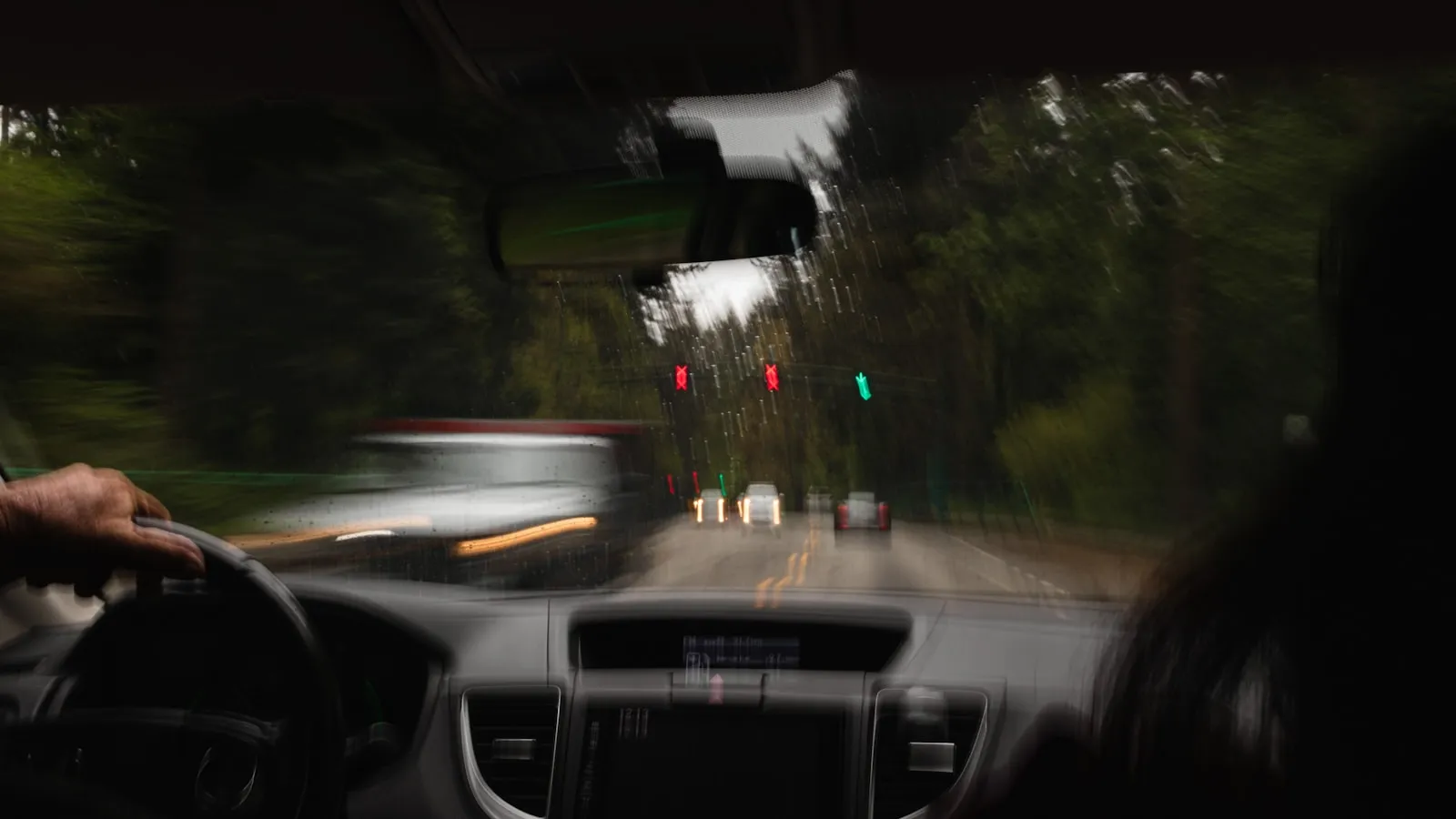
You pull up to your driveway gate in a downpour, wipers going, and reach to roll the window down for the keypad. You mostly don’t have to. HomeLink, an RF clicker, and a phone app all open the gate through closed glass, so the window stays up. The one method that makes you roll the window down is a keypad mounted at the gate post, arm out in the rain. The bigger friction rain exposes is the 15-to-25-second wait while the gate cycles.
At a driveway gate, the scenario plays out the same way for most owners: approach, stop, reach for the button or clicker, wait for the gate to open, pull through. In dry weather this is a background event. In rain, with the wipers running and water sheeting down the glass, every second at the gate registers.
The question of whether the window needs to come down turns out to be simpler than the frustration suggests. Most approaches work with the window up. What rain actually amplifies is the wait time—and those two problems have different solutions.
This is a comparison of the main approaches and how each performs in wet weather.
| Approach | Window required | Wait eliminated? |
|---|---|---|
| HomeLink button (visor or touchscreen) | No | No—gate still cycles normally |
| RF clicker | No | No—gate still cycles normally |
| Phone app (myQ, iSmartGate, Remootio) | No | No—plus app navigation |
| Gate keypad at post | Yes | No—and requires arm outside |
| Vehicle geofencing (Tesla garage feature) | No | No—doesn’t trigger for most gates |
| Auto-open (vehicle-paired, approaching) | No | Yes—gate moves before you arrive |
HomeLink — Visor Button or Touchscreen
Window required: No.
HomeLink transmits radio frequency signals in the range of 288 to 433 MHz, depending on the opener it was trained to. Those frequencies pass through automotive glass without the kind of attenuation that would matter at a residential driveway—typically 50 to 150 feet from the gate receiver to the car.
Press the button. The gate gets the signal and starts moving. The window stays closed.
For Tesla owners, there’s no visor button—HomeLink lives on the touchscreen, in the top status bar when the car is near a saved location. The receiver is at the front of the car rather than at the visor. Rain and glass still aren’t factors; the RF path is from the car’s front bumper area to the opener antenna at the gate, and glass doesn’t interrupt it.
For Security+ 2.0 and similar rolling-code gates, the pairing process requires a trip to the gate motor’s Learn button. That’s a one-time setup step, not a per-use one—and it covers the full reason that driveway gates are harder to pair with HomeLink than garages. We’ve written that up separately in our complete guide to why HomeLink stops working with driveway gates.
The rain verdict: Window stays up. Gate wait time is identical to dry weather—15 to 25 seconds for a swing gate. The problem rain exposes isn’t the window; it’s the wait.
RF Clicker (OEM Remote)
Window required: No.
The original remote that came with the gate opener transmits the same RF signals HomeLink does. The physics are identical—the signal passes through glass. You don’t need to lower the window.
The practical differences between a clicker and HomeLink come down to two things: transmit power and availability. OEM remotes from major manufacturers (LiftMaster, FAAC, Nice/Apollo) tend to have comparable range to HomeLink. Budget-tier remotes sold with lower-cost openers can have shorter effective range, though this varies by unit.
The bigger variable is availability. If the clicker lives on the visor, it’s as fast as HomeLink. If it’s in the center console or glove box, you’re navigating there in the dark, possibly in rain. Neither is a technical limitation of the remote—it’s a storage decision that becomes more consequential in bad weather.
See our comparison of HomeLink versus the RF clicker for a more complete breakdown of when one outperforms the other.
The rain verdict: Window stays up. Wait time unchanged. Finding-it friction varies by where it lives in the car.
Phone App (myQ, iSmartGate, Remootio, Others)
Window required: No—for the tap itself.
App-based controllers let you open the gate from the phone without lowering the window. The command goes from the app to a hub via cellular or Wi-Fi, and the gate motor receives the trigger.
Two real friction points come with this approach in rain.
First, getting to the app takes time. Unlock the phone, navigate to the app, tap Open. If you use the gate every day and the app is pinned to your home screen, this is three to five seconds. If the app hasn’t been used recently and has been cleared from memory by the OS, or if you’re not sure where you put your phone, it takes longer.
Second, network latency at the gate location is variable. Properties where the gate is near the edge of home Wi-Fi coverage or in a weak cellular area can see command round-trips that take several seconds instead of one. An app that opens in two seconds from the driveway apex may take six or eight near the post, depending on signal. Rain doesn’t cause this; property topology does.
The rain verdict: Window stays up. Response time varies with network conditions. Requires attention to the phone while stopped at the gate.
Gate Keypad at the Post
Window required: Yes.
A numeric keypad mounted at the gate post is the one approach in this comparison that requires the window down. Arm out, code entered, window back up. In rain, this means getting wet—a minor nuisance in light rain, a more significant one in a downpour.
For properties that use the keypad as the primary or backup method, this is worth noting. It’s the only gate-opening approach in common residential use that requires the driver to have any body part outside the car.
The rain verdict: Window must come down.
Vehicle Geofencing (Tesla Garage Feature)
Window required: No—when it triggers.
Tesla’s geofencing feature can automatically send a HomeLink command when the car enters a saved location’s radius. On paper, this sounds like it removes the stopping-and-pressing step entirely.
In practice, the feature works reliably for garages, where the timing aligns: the geofence fires at roughly the same distance from the structure where you’d otherwise press the button, and a garage door has a short enough travel time that you arrive as it finishes opening.
For driveway gates, the alignment is different. We’ve covered this in detail in why Tesla’s geofence doesn’t work for driveway gates—the short version is that gate position relative to the property boundary means the geofence either fires too early (gate opens while you’re on the road) or too late (you’re already stopped at the gate). Neither case removes the wait-at-the-gate moment that rain amplifies.
The rain verdict: No window required. Doesn’t reliably eliminate the stopped-in-rain scenario for most driveway gate setups.
The Variable Rain Actually Amplifies
This comparison keeps circling back to the same finding: the window question is simpler than the rain experience suggests. With HomeLink, an RF clicker, or a phone app, the window stays up. Only the keypad requires it down.
What rain changes is the subjective weight of the wait time. Twenty seconds at a closed gate in dry weather registers as background noise. The same twenty seconds in rain—engine on, wipers running, water on the glass, car stopped mid-driveway—becomes a full, present experience.
That’s a different problem than whether the window needs to come down, and it doesn’t have the same solution. Reducing wait time at the gate requires either a faster gate motor (limited by physics and the gate’s mass) or a system that starts the gate cycle before you arrive at it.
The premium EV arrival stack covers how different configurations handle the full arrival sequence—including the specific moment where rain and gate wait time intersect.
There is a small category of gate controllers that open the gate as you approach, so the gate is already moving by the time you reach it. You never stop in the rain at all. It’s still an emerging segment—Proxly is in early access for anyone following where this category goes.
Frequently asked questions
- Yes. HomeLink transmits RF at 288–433 MHz, which passes through automotive glass without meaningful attenuation at typical gate distances of 50–150 feet. Press the button from inside the car; the window stays up.
- With HomeLink or an RF clicker, yes—both transmit radio signals that pass through glass. With a phone app, yes, as long as you have a reliable cell or Wi-Fi signal. A keypad mounted at the gate post requires lowering the window.
- Heavy rain attenuates RF signals slightly, but the effect is minor at typical residential gate distances under 150 feet. A more common cause of reduced range is metal fencing creating a partial RF shadow at certain approach angles—unrelated to rain itself.
- A single-leaf swing gate takes 15–25 seconds to travel from closed to fully open. Slide gates vary from 8–30 seconds depending on gate length and motor speed. Those seconds feel longer when you're stopped in the rain.
- A system that opens the gate before you arrive eliminates stopping in rain entirely. Among conventional approaches, HomeLink and an RF clicker work through glass without lowering the window; a keypad at the post is the only approach that requires it.
Does HomeLink work through a closed car window?
Can I open my driveway gate from inside the car in the rain?
Does rain affect HomeLink or RF clicker range?
How long does a typical driveway gate take to open?
What is the lowest-friction way to open a gate in rain?
Keep reading
GMC Hummer EV HomeLink: Driveway Gate Setup and Timing
The Hummer EV weighs 9,063 lbs. Most driveway gates take 15-20 seconds to open. Here's how to program HomeLink and get the approach timing right.
Why Tesla HomeLink Fails on Driveway Gates (And the Fix That Isn't a Better Button)
Tesla HomeLink works reliably on garage doors. Driveway gates are a different problem. Here is what goes wrong and what fixes it.
Cybertruck Driveway Gate: Three Ways In, One Hands-Free
Cybertruck owners have three options for a driveway gate: built-in HomeLink, Tesla's geofence, or a GPS tag that opens at 300 feet with no button press.