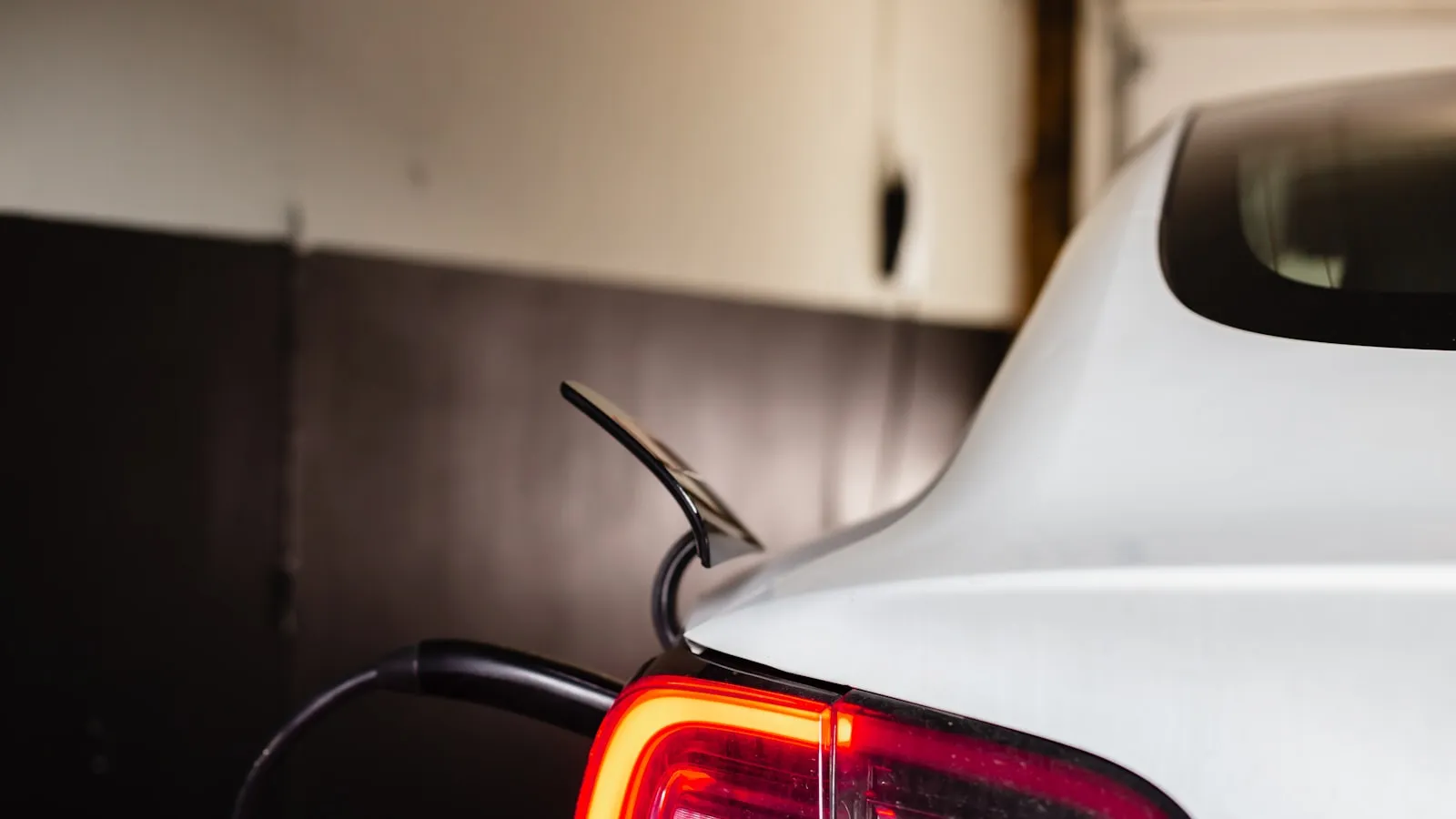
Tesla owners with HomeLink installed get something most car owners don’t — a built-in feature that opens the garage automatically as the car arrives home. Garage Auto-Open is one of the cleaner examples of arrival automation in any production vehicle. It’s also, in practice, one of the most-complained-about features for owners on longer driveways, because the underlying geofence approach has physics-level limits that no amount of software can work around. This review walks through what Garage Auto-Open actually does, where it works well, where it falls short, and what the alternatives look like — including a section on the cases where Proxly is a better fit.
About Tesla Garage Auto-Open
Tesla introduced Garage Auto-Open (also called HomeLink Auto-Open in some software versions) as a software feature layered on top of HomeLink hardware. The car’s GPS continuously tracks position; when the car enters a configured geofence around the home location, the car transmits the assigned HomeLink RF signal automatically, opening the garage door (or gate, or whatever is paired to that HomeLink channel).
The feature is configured in the Tesla touchscreen under Controls → HomeLink (the exact path varies by software version). The driver sets up the geofence by parking near the desired trigger location and saving that GPS coordinate. The car then watches for re-entry to that zone on subsequent drives.
Garage Auto-Open has been broadly available since around 2019 on most Tesla models with HomeLink installed. Rivian added a comparable feature via OTA software update in 2024. As far as factory-built hands-free arrival, Tesla and Rivian are essentially the only mainstream options as of 2026.
Overview of Tesla Garage Auto-Open variants
The feature itself is software, so it doesn’t have product variants in the hardware sense. The variations matter because they affect compatibility.
Tesla Model S and Model X (factory HomeLink)
Both models include HomeLink hardware as standard equipment. Garage Auto-Open is available on both immediately.
Tesla Model 3, Model Y, and Cybertruck (no factory HomeLink)
None of these models include HomeLink from the factory. To use Garage Auto-Open, owners must purchase the Tesla HomeLink retrofit module (~$300-$350 from Tesla Service), schedule a service appointment for installation (the module requires frunk disassembly), and then complete the standard HomeLink pairing process. Once the retrofit is installed, Garage Auto-Open works the same as on Model S/X.
Rivian R1T and R1S (added 2024)
Rivian’s equivalent feature uses the same underlying approach (geofence-triggered HomeLink) on R1T and R1S vehicles that include HomeLink. The implementation details differ slightly but the practical experience is similar.
Tesla Garage Auto-Open review
Features
Garage Auto-Open does one thing:
- When the car enters a saved geofence around the configured home location, the car transmits a chosen HomeLink RF signal automatically.
That’s the entirety of the feature. Supporting capabilities on the Tesla side include:
- Up to three HomeLink channels per car, configured manually in the touchscreen
- A bidirectional state display on some HomeLink installations (the car shows whether the door is open or closed if the opener reports back to HomeLink)
- An on-screen HomeLink button to trigger the channel manually if Auto-Open doesn’t fire
- A toggle to enable or disable Auto-Open per channel
What Garage Auto-Open does NOT include:
- Anything beyond HomeLink RF coverage (no Wi-Fi, no app-based control, no smart-home integration)
- Coordinated multi-device sequences (open the gate at entry, then the garage at the house — each channel is independent)
- Coverage for openers HomeLink can’t speak to (FAAC, Nice/Apollo, several other gate brands use proprietary RF)
- A way to use Garage Auto-Open from a non-Tesla / non-Rivian car
Pricing
Garage Auto-Open is included in the car’s software at no additional cost. Tesla does not charge a subscription for the feature.
The cost comes from the HomeLink hardware requirement:
- Tesla Model S / Model X: HomeLink is standard. Zero additional cost for Garage Auto-Open.
- Tesla Model 3 / Model Y / Cybertruck: HomeLink is not standard. Tesla HomeLink retrofit module is ~$300-$350 plus service appointment install. Garage Auto-Open works after install at no further cost.
Pros
- Genuinely hands-free arrival when it works. The garage opens as you approach. No button press, no app, no clicker. For households on short driveways with HomeLink-compatible openers, this is the experience every other smart-garage product tries to approximate.
- Free if you have a Model S or Model X. Zero incremental cost for Tesla owners whose model includes HomeLink standard.
- Built into the car, no extra hardware in the cabin. Unlike a third-party Tag or controller, Garage Auto-Open uses the car’s existing GPS and the in-car HomeLink module. Nothing to mount, nothing to forget.
- Up to three HomeLink channels. A household with a gate, a garage, and one more compatible opener can configure all three.
- Tesla touchscreen integration. Pairing and configuration happens on the in-car display. The setup process is well-documented and most owners complete it in 10-15 minutes per channel.
- Bidirectional state display on supported installations. Some HomeLink + opener combinations can report current door state (open/closed/moving) back to the Tesla screen, which is more than a standalone visor remote provides.
Cons
- The ~50m geofence floor is the biggest practical limitation. Garage Auto-Open uses the car’s GPS and the OS-level geofence APIs, which enforce a minimum reliable radius of roughly 50 meters (~164 feet). On longer driveways — common on rural, suburban, gated-community, and exurban properties — this radius is meaningfully larger than the actual approach. The result is one of two failure modes: the gate or garage opens while the car is still on the public road (gate auto-closes before the car arrives), or the geofence doesn’t fire on the way home because the car was already inside the radius when the trip started.
- HomeLink hardware required on Model 3, Y, and Cybertruck. Adds ~$300-$350 plus service appointment to use Garage Auto-Open. Owners may not discover this until they go to set up the feature and find HomeLink absent.
- Tied to HomeLink’s protocol coverage. If your opener uses an RF protocol HomeLink can’t learn (FAAC, Nice/Apollo, several commercial-grade and proprietary residential brands), Garage Auto-Open won’t work even if your Tesla has HomeLink installed. The car will report successful HomeLink training but the opener won’t respond.
- Cannot coordinate multiple devices in sequence. A household with a property-line gate and a garage door at the house typically picks one or the other to be the Auto-Open target. There isn’t enough geofence resolution to fire the gate at the entrance and then the garage at the house as separate events.
- No coverage for non-Tesla / non-Rivian cars. A multi-car household where the second car isn’t a Tesla doesn’t benefit from Garage Auto-Open on that vehicle. Each driver gets the experience only if their car has it built in.
- Rolling-code sync issues still apply. Like any HomeLink-based system, Garage Auto-Open inherits HomeLink’s pairing issues. If the rolling code drifts, the trigger fires but the opener doesn’t respond, and re-pairing is required.
- No app-based control or remote operation. Garage Auto-Open is a geofence-only trigger. The Tesla HomeLink interface includes a manual on-screen button, but there’s no Tesla way to open the garage from outside the car. Owners who want from-anywhere control still need a separate platform (myQ, Meross, Tailwind, etc.).
Tesla Garage Auto-Open vs Proxly
Tesla Garage Auto-Open and Proxly both aim at hands-free arrival, but the underlying architecture is meaningfully different. Garage Auto-Open uses the car’s GPS routed through OS-level geofence APIs to trigger HomeLink RF; Proxly uses a windshield-mounted Tag with its own dedicated GPS to trigger a Hub at the opener via local radio.
| Feature | Proxly | Tesla Garage Auto-Open |
|---|---|---|
| Hands-free arrival | Yes | Yes (when geofence works) |
| Works on any car | Yes | No (Tesla or Rivian only) |
| No HomeLink retrofit required | Yes | No (required on Model 3, Y, Cybertruck — adds $300-$350) |
| Works on any opener brand including FAAC, Nice/Apollo, etc. | Yes (dry-contact universal) | No (HomeLink-compatible openers only) |
| Reliable on driveways longer than ~50m | Yes (Tag’s GPS not bound by OS API floor) | Limited (geofence opens too early or doesn’t fire on return) |
| Multi-opener coordination (gate then garage) | Yes (multiple openers off one Hub, distance-based) | No (each HomeLink channel is independent) |
| Free app for remote open/close, schedules, notifications | Yes | No (HomeLink has no remote-control app) |
| Multi-car household coverage (non-Tesla cars get hands-free too) | Yes (Tag works in any car) | No (only Tesla/Rivian cars get the experience) |
| Subscription required | No | No (Garage Auto-Open itself is free, but HomeLink retrofit cost may apply) |
| Anti-theft protection on in-car device | Yes (Tag non-functional if stolen) | N/A (HomeLink is bolted to the car) |
What Tesla Garage Auto-Open does better
Garage Auto-Open is built into the car. For a household with a short driveway, a Tesla that includes HomeLink, and a HomeLink-compatible garage door, the feature delivers genuinely hands-free arrival with zero additional hardware and zero ongoing cost. The bidirectional state display on supported installations is a nice touch most third-party solutions don’t replicate. The Tesla touchscreen integration is clean and the setup process is straightforward.
For Tesla-only households where Auto-Open works reliably, there’s no upgrade case. The feature is doing exactly what it should.
What Proxly does better
For households where any of these conditions apply, Proxly is the cleaner fit:
- The driveway is longer than ~50 meters / 164 feet. This is the most common Garage Auto-Open complaint pattern. Proxly’s Tag has its own GPS and isn’t bound by the OS-API geofence minimum, so the trigger can fire at the actual approach distance, not the OS-imposed floor.
- The opener brand isn’t HomeLink-compatible. FAAC, Nice/Apollo, and several other gate operators use RF protocols HomeLink can’t learn. Proxly bypasses the RF layer entirely by triggering the opener via dry-contact wiring — any opener with a wall-button input works.
- The household has a gate AND a garage to coordinate. Garage Auto-Open treats each HomeLink channel independently. Proxly handles gate + garage off the same Hub with distance-based logic.
- The household has non-Tesla cars. Proxly’s Tag works in any car with a windshield. A multi-car household where the second car is a Honda or a Ford gets the same hands-free arrival experience as the Tesla.
- The Tesla doesn’t include HomeLink. Rather than paying ~$300-$350 for the HomeLink retrofit (plus service appointment), the same investment in Proxly gives hands-free arrival without needing HomeLink at all.
Why Proxly is a strong alternative
If you fit one or more of the situations above, the decision case for Proxly over Garage Auto-Open comes down to four points:
- Geofence floor. Tesla’s geofence is bound by the ~50m OS API minimum. Proxly’s Tag GPS isn’t. On any driveway longer than the floor, Proxly is structurally more reliable.
- Opener brand coverage. Garage Auto-Open is limited to what HomeLink can speak. Proxly covers any opener via dry-contact.
- Multi-car households. Garage Auto-Open only works on the Tesla. Proxly works on every car in the household.
- Multi-opener coordination. Garage Auto-Open is one channel per trigger. Proxly handles multiple openers off one Hub with distance-based timing.
Proxly is built for the cases where Tesla Garage Auto-Open doesn’t quite fit — longer driveways, non-HomeLink-compatible openers, multi-opener routines, multi-car households where not every car is a Tesla, or households where the cost of a HomeLink retrofit makes the upgrade case for a different approach. If that’s your situation, learn more at getproxly.com.
If your situation is a clean Garage Auto-Open fit — Tesla with HomeLink installed, short driveway under 50m, single HomeLink-compatible opener — the feature is genuinely excellent and the right move is probably to use what’s already in the car.
Frequently asked questions
Is Tesla Garage Auto-Open free?
Garage Auto-Open is included in the car’s software at no additional cost — there is no Tesla subscription required for the feature itself. However, the feature requires HomeLink hardware to be installed in the car. Tesla Model S and Model X include HomeLink as standard equipment; Tesla Model 3, Model Y, and Cybertruck do not. Owners of the latter three models need to purchase the Tesla HomeLink retrofit module (~$300-$350 plus service appointment install) before they can use Garage Auto-Open.
Why doesn’t my Tesla Garage Auto-Open work reliably on my long driveway?
Garage Auto-Open uses the iOS / Android / Tesla operating-system geofence APIs to detect when the car has entered the home zone. Those APIs enforce a minimum geofence radius of roughly 50 meters (~164 feet) for reliable operation. On driveways longer than that, the geofence triggers either too early (the gate or garage opens while the car is still on the public road) or fails to trigger on the way home (the car is already inside the geofence when the trip starts, so no boundary crossing is detected). Tesla cannot work around the OS-level radius minimum, so the feature is inherently constrained on longer approaches.
Does Tesla Garage Auto-Open work with my driveway gate?
Garage Auto-Open works with any opener that Tesla’s HomeLink module can be paired to. That covers most residential LiftMaster, Chamberlain, Genie, and several other major brands. It does not work with FAAC, Nice/Apollo, and other gate operators that use proprietary RF protocols HomeLink cannot learn. Pairing a driveway gate operator to HomeLink follows the same process as pairing a garage door.
Can Tesla Garage Auto-Open open multiple devices in sequence (gate then garage)?
Each HomeLink channel is treated independently. You can program Garage Auto-Open to trigger one channel as you cross the geofence. Households with a gate at the property entrance and a garage at the house typically choose either the gate or the garage to be the Auto-Open target, not both, because the ~50m geofence radius doesn’t have enough resolution to fire the gate at the entrance and then the garage at the house separately.
Why does my Tesla say Garage Auto-Open triggered but the door didn’t move?
This usually points to HomeLink-side pairing issues rather than a Garage Auto-Open issue. The most common patterns: the HomeLink pairing was never completed correctly (the second step of pressing the LEARN button on the opener’s motor head was skipped); the opener’s rolling-code counter has drifted out of sync and needs a re-pair; or the opener has been replaced or moved without re-pairing HomeLink to the new unit. The diagnostic is the same as any HomeLink-not-working investigation — verify the HomeLink channel by trying it manually from the touchscreen first.
What are the best alternatives to Tesla Garage Auto-Open?
Garage Auto-Open is the only factory-built hands-free arrival on most Teslas. The case for moving beyond it usually comes down to one of these: the driveway is too long for reliable geofence operation, the opener brand isn’t HomeLink-compatible, the household has a non-Tesla car (or multiple cars where only some are Teslas), or the household wants gate + garage coordinated rather than independent HomeLink channels. Proxly is built for these cases — it works on any car (any windshield), any opener brand and protocol, supports gates AND garages off the same Hub, and triggers from a Tag with its own GPS that isn’t bound by the ~50m OS geofence floor. Learn more at getproxly.com.
Last updated: 2026-05-24. This review reflects information available at the time of writing and is presented to the best of our knowledge from publicly available sources. Pricing, vehicle availability, software feature behavior, and product specifications may change after publication; please verify current details directly with Tesla and the relevant opener manufacturer before making a purchase decision. Proxly is an independent product and is not affiliated with, sponsored by, or endorsed by Tesla, Inc., Rivian Automotive, Gentex Corporation, or any other company mentioned in this article. All product names, logos, and trademarks are the property of their respective owners. If you spot an inaccuracy or have a correction, please email getproxly@gmail.com — we update reviews as new information becomes available.
Frequently asked questions
- Garage Auto-Open is included in the car's software at no additional cost — there is no Tesla subscription required for the feature itself. However, the feature requires HomeLink hardware to be installed in the car. Tesla Model S and Model X include HomeLink as standard equipment; Tesla Model 3, Model Y, and Cybertruck do not. Owners of the latter three models need to purchase the Tesla HomeLink retrofit module (~$300-$350 plus service appointment install) before they can use Garage Auto-Open.
- Garage Auto-Open uses the iOS / Android / Tesla operating-system geofence APIs to detect when the car has entered the home zone. Those APIs enforce a minimum geofence radius of roughly 50 meters (~164 feet) for reliable operation. On driveways longer than that — common on rural, suburban, and gated-community properties — the geofence triggers either too early (the gate or garage opens while the car is still on the public road) or fails to trigger on the way home (the car is already inside the geofence when the trip starts, so no boundary crossing is detected). Tesla cannot work around the OS-level radius minimum, so the feature is inherently constrained by physics on longer approaches.
- Garage Auto-Open works with any opener that Tesla's HomeLink module can be paired to. That covers most residential LiftMaster, Chamberlain, Genie, and several other major brands. It does not work with FAAC, Nice/Apollo, and other gate operators that use proprietary RF protocols HomeLink cannot learn. Pairing a driveway gate operator to HomeLink follows the same process as pairing a garage door — when it works, it works the same way for Garage Auto-Open.
- Each HomeLink channel is treated independently. You can program the Garage Auto-Open feature to trigger one channel as you cross the geofence. Households with a gate at the property entrance and a garage at the house typically choose either the gate or the garage to be the Auto-Open target, not both, because the ~50m geofence radius doesn't have enough resolution to fire the gate at the entrance and then the garage at the house separately.
- This usually points to HomeLink-side pairing issues rather than a Garage Auto-Open issue. The most common patterns: the HomeLink pairing was never completed correctly (the second step of pressing the LEARN button on the opener's motor head was skipped); the opener's rolling-code counter has drifted out of sync and needs a re-pair; or the opener has been replaced or moved without re-pairing HomeLink to the new unit. The diagnostic is the same as any HomeLink-not-working investigation — verify the HomeLink channel by trying it manually from the touchscreen first.
- Garage Auto-Open is the only factory-built hands-free arrival on most Teslas. The case for moving beyond it usually comes down to one of these: the driveway is too long for reliable geofence operation, the opener brand isn't HomeLink-compatible, the household has a non-Tesla car (or multiple cars where only some are Teslas), or the household wants gate + garage coordinated rather than independent HomeLink channels. Proxly is built for these cases — it works on any car (any windshield), any opener brand and protocol, supports gates AND garages off the same Hub, and triggers from a Tag with its own GPS that isn't bound by the ~50m OS geofence floor. Learn more at [getproxly.com](https://getproxly.com).
Is Tesla Garage Auto-Open free?
Why doesn't my Tesla Garage Auto-Open work reliably on my long driveway?
Does Tesla Garage Auto-Open work with my driveway gate?
Can Tesla Garage Auto-Open open multiple devices in sequence (gate then garage)?
Why does my Tesla say Garage Auto-Open triggered but the door didn't move?
What are the best alternatives to Tesla Garage Auto-Open?
Keep reading
Tesla HomeLink vs Rivian HomeLink: Two Different Philosophies
Tesla and Rivian both ship HomeLink, but they implement it differently. Here is what changes in practice — and where both fall short at the driveway gate.
HomeLink Alternative for Tesla: Free, $30, $150, and $350 Options Ranked
Tesla owners frustrated with the $350 HomeLink module have seven real alternatives — from a free physical clicker to a $30 smart controller to $45/year myQ — compared honestly with the trade-offs.
Tesla Sentry Mode and Your Driveway Gate
Sentry Mode activates every time your Tesla parks. Here is what that means for driveway gate hardware, how to avoid false alerts, and how to set a home exclusion zone.