
A gate opener that runs fine during the day but goes silent when the power cuts out is usually carrying a spent backup battery. The motor itself is fine. The control board is fine. The problem is that the sealed lead-acid (SLA) battery keeping the system alive during outages can no longer hold a charge.
This is one of the most overlooked maintenance items on a residential gate opener — partly because the failure is invisible until it matters most.
What the backup battery does
Most residential gate operators run on 24V AC from a hardwired circuit. An on-board charger circuit keeps a backup battery topped up continuously. When utility power drops, the opener switches to battery automatically. Depending on the battery size and how many cycles the gate runs, a healthy battery can operate a single residential gate for anywhere from 50 to 200 full open/close cycles on a single charge.
To understand the full power architecture of a residential gate system, see how a residential gate opener actually works.
Two configurations are common:
- 12V single battery — used on most LiftMaster slide gate operators (CSW24UL, CSL24UL series), most Mighty Mule and GTO/PRO units, and most single-arm swing gate openers
- 24V dual battery — two 12V batteries wired in series; standard on FAAC 400/600 series operators, most hydraulic swing gate drives, and some Nice/Apollo commercial units
Signs the battery needs replacement
A battery fault shows up in a few consistent ways:
- Gate responds to commands during normal AC power but stops moving when you manually cut power at the breaker
- Gate starts a cycle, motor slows, beeps, and stops before completing the stroke — particularly during warm weather when battery draw is highest
- Control board LED flashes a battery-fault pattern (orange blink on most LiftMaster boards; check the board’s label or wiring diagram for the specific code)
- Voltage at the battery terminals reads below 10.5V (12V system) or 21V (24V system) with a multimeter, measured at rest with no load
A gate that reverses erratically mid-cycle is sometimes a battery issue rather than a mechanical one — see why your gate closes halfway and reverses for a systematic way to separate the two.
What battery to buy
Residential gate opener batteries are standard sealed lead-acid (SLA), also sold as AGM (absorbed glass mat). The two dimensions that matter:
Voltage: Must match the system exactly — 12V for single-battery systems, 12V × 2 for series 24V systems. Mixing voltages damages the charging circuit.
Capacity (Ah): Match the original or go one step up.
| Rating | Typical use case |
|---|---|
| 12V / 7Ah | Small single-arm openers, low cycle count |
| 12V / 18Ah | Most single residential slide gates |
| 12V / 26Ah | Double gates, high-cycle installations, solar backup |
Undersizing the Ah rating is the most common mistake. A 7Ah battery installed where an 18Ah was designed causes premature failure because the battery hits its discharge floor too quickly and sulfates during recovery charging.
Physical fit: Most residential gate opener housings are sized for a Group 22NF or Group 26 case. Measure the battery compartment if the original is no longer readable, and confirm that the new battery’s terminals match the connector orientation.
Replacement procedure
Tools needed: flathead screwdriver (medium), safety glasses. Wire crimpers if spade connectors are corroded.
-
Cut utility power at the breaker or disconnect switch. The on-board charger is live when AC power is present. Work with power off.
-
Open the motor housing. Most residential slide gate operators have a hinged cover secured by two or three screws. Swing gate operators vary — some have a panel on the front, others a top cover.
-
Photograph the battery and its connectors before touching anything. Polarity matters. Reversed terminal connections will blow the reverse-polarity fuse on boards that have one, and may damage the charging circuit on boards that don’t.
-
Disconnect the negative terminal first, then the positive. This sequence reduces the risk of sparking across the board.
-
Inspect the spade connectors. White or greenish buildup indicates corrosion and high contact resistance. A corroded connector will drain the new battery faster and create erratic low-voltage faults. Replace corroded connectors with new spade crimps rated for the wire gauge — usually 18–14 AWG.
-
Install the new battery. Positive terminal first, then negative. Press each spade connector firmly until it sits flat against the battery terminal — a half-seated connector is enough to cause intermittent failure.
-
Restore AC power. The charger circuit begins topping up the new battery immediately. Most SLA batteries ship at roughly 70–80% charge; the on-board charger brings them to full float voltage (typically 13.6–13.8V for a 12V system) within 8–12 hours under normal load.
-
Run a full open/close cycle and then manually cut AC power at the breaker to confirm the gate operates on battery alone.
12V or 24V — which does my opener use?
The motor housing label is the fastest answer. The battery voltage requirement is printed there. If the label is unreadable, count the batteries already installed: one battery means a 12V system; two batteries mean they are wired in series for 24V.
On a 24V system, both batteries must be replaced as a pair. A mismatched pair — one new, one old — puts unequal strain on each cell during charge and discharge. The older battery pulls the system voltage down and accelerates failure in both cells within weeks.
Expected lifespan and replacement schedule
SLA batteries under continuous float-charge service typically last three to five years. High ambient temperatures accelerate sulfation, the internal chemical process that permanently reduces capacity. A gate opener housing that sits in direct sun in a hot climate needs a battery check every two years rather than three.
Scheduled replacement is cheaper than an emergency call. An opener that fails during a power outage on a Friday night is a service-call scenario; a $40 battery replaced on schedule is not.
If you are troubleshooting an opener that will not respond at all — battery or not — the gate opener won’t open diagnostic walks through the full 12-step check including battery voltage, board power, and motor tests.
Frequently asked questions
- The most reliable sign is a gate that operates on utility power but stops responding during a power cut. A multimeter check confirms it: a 12V SLA battery at rest should read 12.6V or higher when healthy. Below 10.5V means it can no longer hold a useful charge. Many control boards also flash a battery-fault LED.
- Most residential slide gate openers take a 12V sealed lead-acid battery, typically 18Ah for single-gate installations. Heavy-duty units and most FAAC hydraulic openers run two 12V batteries in series for a 24V system. The motor housing label will state the required voltage and Ah rating.
- Neither works reliably. A car battery's internal chemistry is not compatible with the float-charge circuit in most gate opener control boards. Standard lithium batteries require different charge voltage profiles than SLA. Use a replacement sealed lead-acid battery with the same voltage and Ah rating as the original.
- Three to five years under typical residential use with continuous float-charging. High heat — above 35°C regularly — shortens that to two to three years by accelerating sulfation inside the cells. Replacing on a calendar schedule avoids a failure during a power outage.
- Yes. A 24V system uses two 12V batteries in series. If one ages faster than the other, the weaker cell drags down the stronger one within a few weeks of mixed use. Both batteries share the same charge and discharge cycles, so replacing them as a pair keeps the system balanced.
How do I know if my gate opener battery needs replacement?
What size battery does a residential gate opener use?
Can I substitute a car battery or lithium battery?
How long do gate opener batteries last?
Should I replace both batteries on a 24V system?
Keep reading
Why How You Open Your Garage Door Actually Matters
Most car owners don't think about how they open their garage door. After 1,000 button presses a year, they should. Here's the convenience and security case.
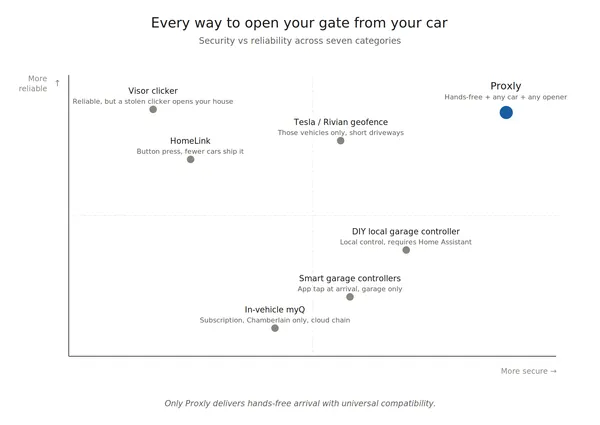
Every Way to Open Your Gate or Garage From Your Car in 2026
Seven categories of solutions for opening your gate or garage from your car — honest pros and cons, the security note no one mentions, and a side-by-side comparison.

Why Your Gate Closes Halfway and Reverses
A gate that stops and reverses before fully closing is almost always triggered by the obstacle-detection safety circuit. Here is how to diagnose and fix it without a service call.