If you’ve gone shopping for a smarter way to open your gate or garage from the car, the landscape isn’t mapped well anywhere we’ve seen. Manufacturer documentation describes one product at a time. Reddit and Facebook threads cover individual frustrations. Auto-press reviews focus on which car comes with what. Nowhere is there a clean side-by-side that covers all the options with honest trade-offs.
This is that piece. Seven categories of solutions exist for opening your gate or garage from your car in 2026, plus an eighth — Proxly — that we’re building because we don’t think any of the other seven nail the full set of constraints. We’ll cover each one as honestly as we can, including where ours is or isn’t the right fit.
If you have a gated driveway, you’ll read this in the context of “what works for both my gate and my garage.” If you have just a garage, the gate categories don’t apply but the garage ones do. The structure below covers both surfaces because the underlying technology overlaps heavily.
The seven categories
1. Visor clickers (OEM and universal)
The RF remote that came with your opener, or a $15-30 universal clicker (Skylink, Multi-Code, Genie GIT-1, Chamberlain KLIK1U).
How it works: A small transmitter sends an RF signal on your opener’s frequency band — typically 288-433 MHz depending on opener brand and vintage. The receiver at the opener matches the signal and triggers the motor. Rolling-code systems cycle the transmitted code on each press for security.
Pros: Cheap. No subscription. Works offline. Battery life is typically one to three years. Extremely reliable over years of use. Universal applicability — virtually every residential opener can pair with a compatible clicker.
Cons: Manual. You reach for it and press it, every time. If it’s in the center console when you arrive, the gate waits. Multi-driver households need multiple clickers, each programmed separately. Rolling-code drift over years occasionally requires re-pairing. Cars with multiple openers (community gate + garage + guesthouse) end up with multiple clickers stacked on the visor.
The security problem worth knowing about: A clicker on the visor turns a car break-in into a house break-in. KTVU covered a documented case in Moraga, California where burglars hit ~15 unlocked cars in one night, grabbed the openers plus the vehicle registration showing the home address, and used the openers to enter four of the homes. 10News reported the same pattern in Point Loma — a separate area, same crime. A clicker is paired to the opener, not to your car. Anyone holding it can use it on the matching opener.
Best for: Owners who want the simplest setup, who don’t mind the manual step, and who park inside the garage (so the clicker isn’t visible from outside the car at parking lots and events).
2. HomeLink (factory or retrofit)
Three RF buttons in the visor or rearview mirror, included in many cars since 1996. Operates at 288-433 MHz, learns from your existing opener remote or directly from a Security+ 2.0 motor head.
How it works: HomeLink learns the RF signal of your opener and replicates it. On modern Security+ 2.0 openers, HomeLink pairs through the motor’s LEARN button without needing to read your handheld remote first.
Pros: No subscription. No app. Works with most residential opener brands. Powered by the car (no batteries to replace). Three channels, so a household with gate + garage + one more can fit. Reliable on short driveways with good RF line-of-sight.
Cons: Not on every car anymore. Tesla Model 3, Y, and Cybertruck don’t ship with it standard. Honda dropped it from 11th-gen Accord / Civic. The 2026 Honda Passport replaced it with a myQ subscription paywall. Polestar 3 replaced it with a touchscreen app. Ford F-150 / Lightning trimmed it to the Tremor 402A option. We covered the broader pattern in Premium Cars Are De-featuring HomeLink — Mercedes EQS, Genesis GV60, and Hyundai Ioniq 5 Limited still ship it standard, so the trend isn’t universal, but it’s real.
Retrofits exist where the car never shipped it ($300-350 for Tesla Service install on Model 3/Y; Cybertruck has no retrofit available; $250-300 dealer mirror for Honda Accord/Civic; $200-280 aftermarket Gentex auto-dimming mirror for F-150 mid-trim). All still involve a button press at every arrival.
Other limitations: rolling-code generation mismatches (Security+ 1.0 vs 2.0 vs 3.0) cause silent pairing failures even when the car has HomeLink. HomeLink doesn’t speak to FAAC, Nice/Apollo, or other gate brands that use proprietary RF protocols. The 3-channel cap doesn’t scale past gate + garage + guesthouse.
Best for: Owners whose cars ship with HomeLink standard, whose opener is on the HomeLink-compatible list, who have a short approach distance, and who are OK with the visor-button press at every arrival.
3. In-vehicle myQ (and other car-brand cloud integrations)
A software feature in the car’s infotainment that controls a LiftMaster or Chamberlain garage door through Chamberlain’s myQ cloud. Available on Tesla, GM (Chevy/GMC/Buick/Cadillac), Ford/Lincoln (SYNC 4+), Hyundai (Bluelink), Kia (Kia Connect), Honda (HondaLink), and others.
How it works: The driver taps a “garage” button on the touchscreen. The car’s cellular connection sends the command to the car brand’s cloud, which forwards it to Chamberlain’s myQ cloud, which forwards it to the homeowner’s myQ Wi-Fi controller, which triggers the opener via the wall-button input. The closing direction includes a federally-mandated audible warning beep (UL 16 CFR Part 1211) before the door starts moving — that’s regulation, not a bug.
Pros: No retrofit hardware required on the car side (subscription unlocks the feature in the existing infotainment). Built into the car’s touchscreen. Status visible: if the opener reports door state back, the car shows whether it’s open or closed.
Cons: Subscription required ($45/year, $179/5 years, or $299/10 years on Tesla; bundled into connected-services on other brands; outright purchase model on 2026 Honda Passport at $129/3 years or $179/5 years). Cloud-dependent: device → Wi-Fi → home internet → Chamberlain cloud → car brand cloud → infotainment is a four-layer chain. Any layer wobbles, the feature fails silently. LiftMaster / Chamberlain garage doors only — no Genie, no Marantec, no FAAC, no driveway gates. Geofence-based auto-open features (Tesla Garage Auto-Open) layer on top of this but inherit the cloud limitations.
The closing beep is the part most commonly mistaken for a bug. It’s a UL safety regulation for cloud-triggered closes — every app-press has the audible warning before the door moves. The slow opening (a minute or more on some reports) is the cloud chain misaligning, not the regulation.
Best for: Owners with LiftMaster or Chamberlain garage doors, who are OK with a recurring subscription, and who don’t have a driveway gate to consider.
4. Smart garage controllers (Meross, Tailwind, iSmartGate, Remootio)
A Wi-Fi module that wires into the opener’s dry-contact terminals, turning the existing opener into an app-controllable device. $30-150 hardware depending on the platform.
How it works: The module connects to your home Wi-Fi and links to the opener’s control board through the same wall-button input the in-wall button uses. Open and close commands come from a smartphone app. From-anywhere control routes through the vendor’s cloud; local control happens over your Wi-Fi LAN.
Pros: Most have no recurring subscription (the hardware is the one-time cost). HomeKit, Google Home, and Alexa integration on most. iSmartGate and Remootio especially have better driveway-gate support than myQ, since they use dry-contact wiring that’s brand-agnostic. Multi-user. Notifications.
Cons: Still app-based at the moment of arrival — open the phone, unlock it, open the app, tap the button. From-anywhere features require cloud + Wi-Fi + cellular all healthy. Phone-based geofencing where offered (most of these platforms have it) is bound by OS-level geofence reliability — the trigger fires early, late, or not at all depending on phone OS state. Most cover garage doors well; only iSmartGate and Remootio handle gates well; Meross and Tailwind are garage-only.
Best for: Owners who want remote monitoring (check status from bed, let the landscaper in from work) more than they want hands-free arrival. The arrival experience is similar to a clicker but with worse latency and a dependency on phone.
5. DIY (RATGDO, Shelly 1, Aqara T2, ESPHome custom)
Bare hardware ($15-60) wired into the opener and integrated via Home Assistant, HomeKit (via HomeBridge), or MQTT.
How it works: A small microcontroller (ESP8266 / ESP32-based) wires into the opener’s Security+ 2.0 wall-control port (RATGDO) or its dry-contact terminals (Shelly, Aqara). The user owns the home-automation stack — Home Assistant is the most common — and the controller is exposed locally as a switch + sensor. Automations like geofence-triggered open are built by the user.
Pros: Local-only, no cloud, no subscription. First-class Home Assistant integration on RATGDO. The cheapest path with the deepest configurability if you already run Home Assistant. Status reporting accurate because the controller reads the opener’s actual state rather than guessing. We covered RATGDO specifically in ratgdo Review.
Cons: DIY install required. Opening the opener housing, identifying terminals, wiring three or four wires, flashing firmware. Reasonable for users comfortable with electronics, unfriendly to consumers who aren’t. Requires a home-automation host (Home Assistant, HomeKit, MQTT) to be useful. RATGDO is LiftMaster Security+ 2.0 specifically; doesn’t help on other brands or on the newer Security+ 3.0 openers. No hands-free arrival out of the box — that has to be built via phone-side geofence automations, which inherit the OS geofence reliability issues.
Best for: Home Assistant power users with a LiftMaster Security+ 2.0 opener who want local-only control and don’t mind the DIY install. Excellent in its lane, narrow lane.
6. Car-integrated geofence (Tesla Garage Auto-Open, Rivian)
A software feature in the car that triggers HomeLink automatically when the car enters a geofence around the configured home location.
How it works: The car’s onboard GPS continuously tracks position. When the car enters the saved geofence, the car transmits the assigned HomeLink RF signal. Tesla has had this since around 2019; Rivian added the equivalent in 2024.
Pros: Genuinely hands-free arrival when it works. Built into the car — no extra in-cabin hardware. Up to three HomeLink channels (one trigger per channel). Free, where HomeLink is installed (which on most Teslas means after a paid retrofit since 2019).
Cons: Tesla and Rivian only. Requires HomeLink installed on the car (a paid retrofit on Model 3, Y, and Cybertruck — and Cybertruck has no retrofit available). The geofence radius is set by Tesla/Rivian and isn’t user-configurable; community reports put the effective trigger radius around 50-150 feet. On long driveways, the gate fires too early (before the car is in range) or fails to re-trigger on return. Direction-of-travel isn’t read by the geofence — Tesla owners report the gate opening when they leave the neighborhood, not just when they arrive. We covered this specifically in Tesla Garage Auto-Open Review.
Best for: Tesla or Rivian owners with HomeLink installed, a short driveway, and a HomeLink-compatible opener. For longer driveways or non-HomeLink-compatible openers (FAAC, Nice/Apollo), this approach doesn’t work cleanly.
7. Dedicated hands-free hardware (Tag + Hub systems)
A small windshield-mounted Tag with its own GPS that communicates with a Hub wired into the opener’s wall-button input. The opener triggers as the vehicle approaches; no phone, no app action, no button press.
How it works: The Tag has a dedicated GPS chip and a short-range radio (sub-GHz). The Hub at the opener listens for the Tag and triggers the opener via the wall-button input — the same dry-contact input every residential opener exposes. Because the Tag has its own GPS, the trigger isn’t bound by OS-level geofence APIs or phone state.
Pros: Hands-free arrival on any car (any windshield). Works with any opener brand via dry-contact (not limited to HomeLink-compatible or Chamberlain-compatible). Handles gates AND garages off the same Hub. Local radio between Tag and Hub means no cloud round-trip and no Wi-Fi requirement at arrival. Tag’s own GPS isn’t bound by phone OS geofence floors, so longer driveways work where Tesla Garage Auto-Open misfires.
Cons: Most products in this category are pre-launch or early-stage as of 2026 — Proxly is one entrant; we are pre-launch (Beta-20 program running, Kickstarter ahead). One-time hardware cost. Edge cases not yet supported by Proxly v1: motorcycles, topless convertibles without a clean windshield mount surface, commercial gates with no dry-contact input.
Best for: Multi-opener households (gate + garage + community gate). Premium-car owners whose vehicle doesn’t ship with HomeLink. Owners on long driveways where geofence-based features misfire. Households with non-HomeLink-compatible gate brands (FAAC, Nice/Apollo).
Where the gaps in the landscape are
Looking across the seven categories, three gaps emerge — places where every existing option falls short:
Hands-free arrival on any car. Tesla Garage Auto-Open and Rivian’s version are the only factory hands-free options. Both require HomeLink installed on the car (a paid retrofit on the cars that don’t ship with it), a HomeLink-compatible opener, and a short enough driveway for the geofence floor to work. Every other category requires a button press or phone tap at arrival.
Hands-free plus multi-opener. Households with a gate + garage + guesthouse hit the 3-channel HomeLink limit, the Chamberlain-only myQ limit, and the garage-only smart-controller limit all at once. The DIY path can stitch multiple openers together via Home Assistant, but only if you’re technical and willing to invest the time.
Hands-free plus non-Chamberlain opener. myQ and most smart garage controllers are garage-only and Chamberlain-locked. HomeLink covers more brands but still loses to FAAC, Nice/Apollo, and several others. The DIY path covers most brands but excludes Security+ 3.0 (post-2024 LiftMaster).
These are the gaps Proxly is being built into. If your situation fits one of these — or two, or three — that’s where the third-party Tag-and-Hub category genuinely wins over what currently exists.
At-a-glance comparison
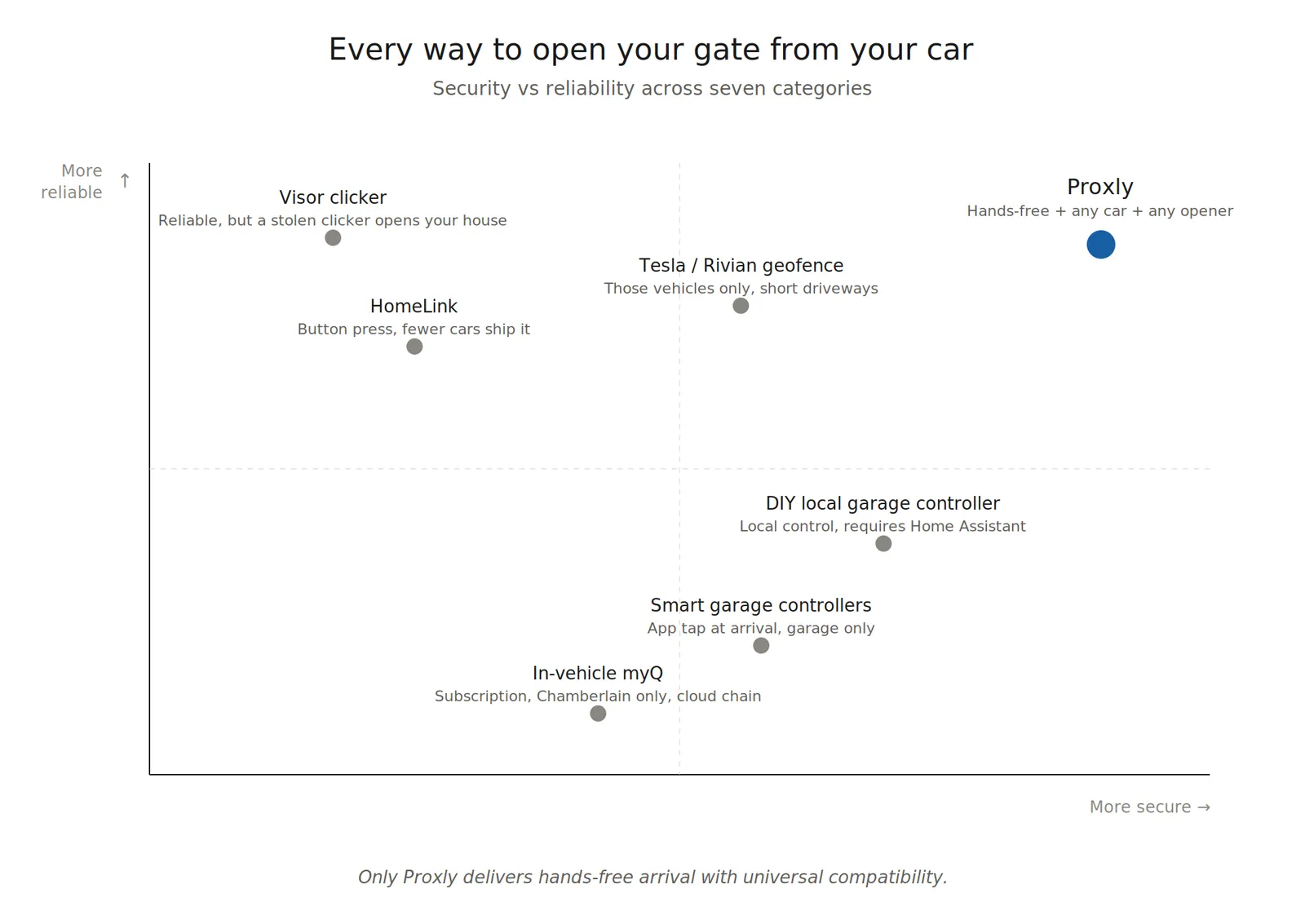
The chart at the top of this article maps the seven categories on the two dimensions that matter most for daily use: reliability and security against the documented car-break-in attack pattern. The detailed table below covers more dimensions — opener compatibility, any-car coverage, subscription requirements, and theft resistance.
| Option | Hands-free arrival | Any car | Any opener brand | Gates + garages | No subscription | Theft-resistant |
|---|---|---|---|---|---|---|
| Visor clicker (OEM / universal) | No | Yes | Yes | Partial | Yes | No |
| HomeLink (factory or retrofit) | No | Partial | Partial | Yes | Yes | Partial |
| In-vehicle myQ | Partial | No | No | No | No | Partial |
| Smart garage controllers | No | Yes | Yes | Partial | Yes | Yes |
| DIY (RATGDO / Shelly / Aqara) | No | Yes | Partial | Partial | Yes | Yes |
| Car-integrated geofence (Tesla / Rivian) | Partial | No | No | Partial | Yes | Partial |
| Dedicated Tag + Hub (Proxly) | Yes | Yes | Yes | Yes | Yes | Yes |
Partial = works in some cases but with significant caveats. See the detailed sections above for the actual constraints.
A note on the “theft-resistant” column: a clicker can be physically taken from a car and used on your house. HomeLink stays bolted to the car so it’s harder to steal individually, but the car itself can be stolen with HomeLink still active. Smart garage controllers and DIY sit at the opener, not in the car, so there’s nothing in the car for a parking-lot thief to grab. A Tag-and-Hub system where the Tag has anti-theft protection (becomes non-functional once taken from the car) eliminates the parking-lot-attack vector entirely.
Which option fits your situation
Simplest setup, no configuration, no commitment: A clicker or universal visor remote. Proven over decades. Nothing to configure beyond the initial pairing.
Remote access for deliveries and dog walkers more than daily-arrival hands-free: A smart garage controller. Meross is the cheapest HomeKit option; Tailwind is the no-subscription favorite; iSmartGate and Remootio extend cleanly to gates.
Tesla or Rivian, short driveway, HomeLink-compatible garage door, willing to pay for the retrofit: HomeLink + the factory Garage Auto-Open feature. When it works, it works well.
LiftMaster or Chamberlain garage, comfortable with a subscription, multi-driver household: In-vehicle myQ. The 2026 Honda Passport model is the cleanest implementation; Tesla’s subscription is more expensive per year but cheaper at the 10-year tier.
Home Assistant power user, LiftMaster Security+ 2.0 opener, comfortable wiring three terminals: RATGDO. Best-in-class for the audience it serves; useless for everyone else.
Multi-opener household, non-HomeLink-compatible gate brand, long driveway, or premium car that doesn’t ship with HomeLink — and willing to wait for a pre-launch product: Dedicated Tag-and-Hub hardware. Proxly is the entrant we’re building; we’re pre-launch as of 2026. Other entrants may emerge in this category over the next 2-3 years; this is the youngest of the seven categories.
Bottom line
There is no single best option for every household. Each of the seven categories has a lane it serves well and a lane it serves poorly.
The decision usually comes down to which trade-off you can live with: subscription cost, daily-driver friction, cloud reliability, theft exposure, opener brand restrictions, or pre-launch hardware risk.
If you’re frustrated enough with your current setup to be reading this far, the honest answer is probably one of three: (1) the option you’re using is actually right for your situation and you just want validation, (2) you’re a multi-opener household and the category-by-category trade-off table above will point you toward the smart-controller, DIY, or Tag-and-Hub direction, or (3) you have a premium car that quietly de-featured HomeLink and you’re discovering the gap for the first time.
For category 3, we wrote a separate piece on why premium cars are de-featuring HomeLink — the trend across Tesla, Honda, Ford, Polestar, Lucid Gravity, and others, plus the counter-examples (Mercedes EQS, Genesis GV60, Hyundai Ioniq 5 Limited) that show the trend isn’t universal.
For category 2, the Tag-and-Hub direction is what we’re building at Proxly. The Beta-20 program (getproxly.com/beta) and the Kickstarter campaign that follows are how we’re getting it into the hands of real households first.
For category 1, you’re already there. Stay with what works.
Frequently asked questions
What’s the simplest way to open my garage from my car?
A handheld RF clicker. The remote that came with your opener — or a $15-30 universal replacement — works without internet, without a subscription, and on essentially any opener it’s been paired to. The trade-off is that you still press a button at every arrival. If hands-free arrival isn’t your top priority and you just want something reliable, the clicker is hard to beat.
Is HomeLink still standard on new cars in 2026?
No. HomeLink has been quietly removed from several premium and EV car lines over the last 3-5 years. Tesla Model 3, Y, and Cybertruck don’t ship with it standard. Honda dropped it from 11th-gen Accord / Civic. The 2026 Honda Passport replaced it with a myQ subscription paywall. Polestar 3 replaced it with a touchscreen app. Ford F-150 / Lightning trimmed it to the Tremor 402A option. Counter-examples still exist — Mercedes EQS, Genesis GV60, Hyundai Ioniq 5 Limited (which actually upgraded to two-way HomeLink) — so the trend isn’t universal.
Does myQ work with any garage door brand?
myQ is the cloud platform that pairs primarily with LiftMaster and Chamberlain openers (both Chamberlain Group brands). It does not work with most other residential brands without third-party adapters, and it does not control driveway gates at all.
What’s the difference between phone geofencing and car-side geofencing?
Phone geofencing uses your smartphone’s GPS and OS-level geofence APIs to trigger an opener when the phone enters a defined radius around home. Apple’s CLLocationManager and Google’s Geofence API both recommend a minimum radius of ~100 meters for reliable triggering. Car-side geofencing — like Tesla Garage Auto-Open or Rivian’s equivalent — uses the car’s own GPS chip and proprietary geofence logic. The car’s GPS is more accurate than a phone’s, but the radius is still not user-configurable on Tesla.
Can a stolen garage clicker really be used to break into my house?
Yes, and it’s a documented pattern. KTVU’s coverage of a Moraga, California burglary ring showed thieves hitting roughly 15 unlocked cars in one night, stealing the garage door openers plus the vehicle registration (which lists the home address), then using the openers to enter four homes. 10News reported the same pattern in Point Loma. A handheld RF clicker is paired to the opener — not to your car — so anyone holding it can use it on the matching opener.
Is there a hands-free option that works on any car and any opener?
As of 2026, this category is small. Tesla Garage Auto-Open and Rivian’s equivalent are car-integrated hands-free, but only on those vehicles and only with HomeLink installed. Phone-based geofence apps (Remootio, iSmartGate) are nearly hands-free but rely on phone GPS and a third-party module wired to the opener. Dedicated Tag-and-Hub systems aim for hands-free on any car and any opener brand — Proxly is one entrant in this category, currently pre-launch.
Last updated: 2026-05-26. This article reflects information available at the time of writing and is presented to the best of our knowledge from publicly available sources, manufacturer documentation, automotive press coverage, and owner-forum discussion. Subscription pricing, hardware availability, opener compatibility, and product feature behavior change frequently; please verify current details directly with each manufacturer before making a purchase decision. Proxly is an independent product and is not affiliated with, sponsored by, or endorsed by The Chamberlain Group LLC, LiftMaster, Gentex Corporation, Tesla, Inc., Honda Motor Co., Ford Motor Company, Polestar, Lucid Motors, General Motors, Hyundai Motor Company, Kia Corporation, Genesis Motors, Mercedes-Benz, BMW, Meross Technology, Tailwind, Remootio, iSmartGate, Konnected, or any other company mentioned in this article. All product names, logos, and trademarks are the property of their respective owners. If you spot an inaccuracy or have a correction, please email getproxly@gmail.com — we update articles as new information becomes available.
Frequently asked questions
- A handheld RF clicker. The remote that came with your opener — or a $15-30 universal replacement — works without internet, without a subscription, and on essentially any opener it's been paired to. The trade-off is that you still press a button at every arrival. If hands-free arrival isn't your top priority and you just want something reliable, the clicker is hard to beat.
- No. HomeLink has been quietly removed from several premium and EV car lines over the last 3-5 years. Tesla Model 3, Y, and Cybertruck don't ship with it standard (a service-center retrofit costs $300-350 on Model 3/Y; Cybertruck has no retrofit available). Honda dropped it from 11th-gen Accord / Civic. The 2026 Honda Passport replaced it with a myQ subscription paywall ($129-$179 multi-year). Polestar 3 replaced it with a touchscreen app. Ford F-150 / Lightning trimmed it to the Tremor 402A option. Counter-examples still exist — Mercedes EQS, Genesis GV60, Hyundai Ioniq 5 Limited (which actually upgraded to two-way HomeLink) — so the trend isn't universal.
- myQ is the cloud platform that pairs primarily with LiftMaster and Chamberlain openers (both Chamberlain Group brands). It does not work with most other residential brands without third-party adapters, and it does not control driveway gates at all. The 2026 Honda Passport, Tesla, Kia EV6, and a growing number of in-vehicle integrations are routing through myQ rather than HomeLink, which extends myQ's reach as the in-car opener — but the underlying opener still needs to be LiftMaster or Chamberlain family.
- Phone geofencing uses your smartphone's GPS and OS-level geofence APIs to trigger an opener when the phone enters a defined radius around home. Apple's CLLocationManager and Google's Geofence API both recommend a minimum radius of ~100 meters for reliable triggering. Car-side geofencing — like Tesla Garage Auto-Open or Rivian's equivalent — uses the car's own GPS chip and proprietary geofence logic. The car's GPS is more accurate than a phone's, but the radius is still not user-configurable on Tesla. Both approaches misfire on long driveways or when the car's stationary near the boundary.
- Yes, and it's a documented pattern. KTVU's coverage of a Moraga, California burglary ring showed thieves hitting roughly 15 unlocked cars in one night, stealing the garage door openers plus the vehicle registration (which lists the home address), then using the openers to enter four homes. 10News reported the same pattern in Point Loma. A handheld RF clicker is paired to the opener — not to your car — so anyone holding it can use it on the matching opener. This is one of the underexposed reasons hands-free Tag-based systems (where the device is paired to the car and becomes non-functional once taken from it) are interesting beyond just convenience.
- As of 2026, this category is small. Tesla Garage Auto-Open and Rivian's equivalent are car-integrated hands-free, but only on those vehicles and only with HomeLink installed. Phone-based geofence apps (Remootio, iSmartGate) are nearly hands-free but rely on phone GPS and a third-party module wired to the opener. Dedicated Tag-and-Hub systems — where a small windshield-mounted Tag with its own GPS communicates with a Hub at the opener — aim for hands-free on any car and any opener brand. Proxly is one entrant in this category, currently pre-launch as of 2026. The honest answer is: there isn't yet a shipping product that delivers fully hands-free + works on any car + works on any opener + no subscription + no DIY install.
What's the simplest way to open my garage from my car?
Is HomeLink still standard on new cars in 2026?
Does myQ work with any garage door brand?
What's the difference between phone geofencing and car-side geofencing?
Can a stolen garage clicker really be used to break into my house?
Is there a hands-free option that works on any car and any opener?
Keep reading
Why How You Open Your Garage Door Actually Matters
Most car owners don't think about how they open their garage door. After 1,000 button presses a year, they should. Here's the convenience and security case.

Replacing a Dead Gate-Opener Battery (12V vs 24V)
A dead backup battery is the most overlooked cause of a gate opener that stops working during a power cut. Here is how to identify the right replacement and install it safely.
Why Your Gate Closes Halfway and Reverses
A gate that stops and reverses before fully closing is almost always triggered by the obstacle-detection safety circuit. Here is how to diagnose and fix it without a service call.