If you live in a house with a garage, you open it more than 1,000 times a year.
Most car owners don’t think about that. The button press takes 2 seconds. You barely notice it. So how could it matter?
Three reasons it does. Convenience cost compounds across that many interactions. Security risk attaches to most of the common solutions. And the modern subscription-and-cloud layer has added new problems on top of the old ones.
This piece is about why the routine actually matters. It’s also about what a better routine could look like.
The frequency
A two-car household opens the garage door 2-4 times per day. Once leaving in the morning. Once returning. Sometimes once more for errands.
That’s 700 to 1,400 garage door interactions a year. Call it 1,000 in round numbers. Over a decade, 10,000.
Anything you do 10,000 times deserves a better design than this one got. Almost nothing about how your garage door opens has changed since 1996.
What it looks like from the driver’s seat
The standard car-owner experience opening a garage door:
- Approach the driveway
- Reach for the visor (eyes off the road for half a second)
- Find the clicker
- Press the button
- Watch to see if the door is opening
- If yes, drive in
- If no, press the button again
- Repeat until the door moves
Each step is small. Together they take 5-10 seconds. They happen 1,000 times a year. They are not free.
The cost is the attention. A small task that has nothing to do with driving, in the exact moment you’re turning into a driveway. A few specific costs car owners actually feel:
Eyes off the road. You’re turning into a driveway. The half-second of attention spent locating the clicker is the half-second you weren’t looking at the curb, the kid on the bike, or the spouse who came out to meet you.
Doubting. “Did I push it hard enough?” The visor button gives weak haptic feedback. Sometimes you push it twice to be sure. Sometimes that opens it AND closes it.
Battery anxiety. The clicker battery dies once every 2-3 years, usually at the worst moment. You don’t know it’s dying until the door doesn’t open. Then you’re standing outside the car holding the door open, or sitting in the driveway pressing the button harder.
The “where did I put it” moment. You moved the clicker to clean the car. Now it’s in the wrong pocket of the visor. You’re stopped in the driveway, hunting.
Cross-car switching. You bought a new car. You forgot to move the clicker over. Or you’re driving your spouse’s car. Or a rental. Or your kid borrowed yours. The garage door is brand-agnostic; the clicker isn’t.
Visiting someone’s house. Most homeowners don’t share the clicker. So your guests stand at the door while you let them in, or you give them the code to a separate keypad, or they wait while you open the garage from the car.
None of these are emergencies. They’re papercuts. Papercuts that happen 1,000 times a year add up.
The security case most car owners haven’t thought about
Most car owners haven’t thought about this. It’s the part where the convenience problem becomes a security problem.
The visor clicker is a key to your house. It opens a door (the garage door) that usually connects directly to the inside of the house with no second lock to defeat. If a thief breaks into your car, the clicker is right there in the visor.
If they grab the clicker AND your car registration (which has your home address on it), they have everything they need to enter your house. They don’t need to be there when you are. They just drive to the address, walk to the garage, and open it.
This isn’t theoretical. KTVU covered a case in Moraga, California where burglars hit 15 unlocked cars in one night. They grabbed openers plus registrations. They used the openers to enter 4 of the homes the same night. 10News covered a similar pattern in San Diego.
We wrote up the full pattern in the stolen garage opener piece if you want the details.
The standard advice is “park in a garage and don’t leave the clicker visible.” That helps, but it misses the underlying issue. The clicker is functionally a key to your house. Most homeowners treat it like a $30 remote.
The modern cost layer that wasn’t there in 2010
The clicker has problems. The cloud-and-subscription alternatives have different problems.
Subscription costs that didn’t used to exist. myQ Connected Services is $45/year or $179 for 5 years. Honda’s HondaLink Connect is similarly priced and required for in-car garage access on 2026 Passport, Civic, and CR-V. Tesla’s myQ integration costs $45/year. None of these were paid features in 2010.
Reliability that depends on a chain. myQ-on-Tesla “works two-thirds of the time” per multiple Reddit and Twitter threads. The reason is that the cloud chain (home Wi-Fi + Chamberlain’s servers + the car’s cellular connection) all has to be healthy for the door to open. When any link is degraded, the door doesn’t move. The 1996 visor clicker didn’t have a chain.
Account-takeover risk. Your myQ password is the key to your garage from anywhere. If you’ve reused it on another site that got breached, your garage is potentially accessible from the internet. The 1996 visor clicker didn’t have an account.
Manufacturer paywall trend. Honda moved HomeLink from standard equipment to a HondaLink Connect subscription on multiple 2026 model lines. CarBuzz, Autoblog, and Torque News all covered the consumer reaction. We covered the trend in why new EVs are dropping HomeLink and the Honda-specific story in the Honda unbundling piece.
The new layer hasn’t replaced the old problems. It’s added to them.
What “great” looks like, side by side
Here’s what 1,000 garage door interactions a year looks like with a clicker. And here’s what they look like with hands-free arrival.
| Clicker (today’s normal) | Hands-free (what good looks like) | |
|---|---|---|
| Approach driveway | Reach for visor, eyes briefly off road | Door is already opening |
| Locate clicker | Look up, find it | Nothing to find |
| Press button | Hope it registered | Nothing to press |
| Wait for door | Watch to confirm | Drive in |
| Battery management | Replace every 2-3 years | None |
| Theft vector | Clicker visible in car | No clicker exists |
| Cross-car switching | Manually move the clicker | Tied to the driver, moves with you |
| Guest access | Manual or keypad | Manual or keypad (unchanged) |
| Cloud dependency | None | None |
| Subscription | None | None |
| Total touchpoints | 4-6 per arrival | 0 per arrival |
The interesting part is the bottom row. Zero touchpoints. The door just opens because the car is authorized and arriving.
This is the experience Tesla owners with HomeLink and Garage Auto-Open get on day one. Rivian owners get it. Most other car owners don’t.
Three paths get you there:
- Factory hands-free on a Tesla or Rivian. Limited by car brand.
- Factory HomeLink + a software auto-open layer. Only Tesla and Rivian have shipped this.
- Third-party Tag-based hardware. Works on any car. Pre-launch options like Proxly fall here.
We wrote up the full menu of arrival options at every way to open your garage or gate from the car and the Tesla-specific alternatives at the Tesla HomeLink alternatives piece.
How the experience got here
A short timeline of the car-to-garage-door experience.
1996. HomeLink launches. Visor button. Direct radio. Reliable. Free after the car purchase.
2001-2010. Visor clickers are everywhere. Multi-clicker households become common. The clicker theft pattern begins to be documented in local news.
2010-2018. Smart home phase 1. myQ, Aladdin Connect, Tailwind. Phone apps add remote-from-anywhere capability. Subscription pricing arrives.
2018-2024. EV integration phase. Tesla puts myQ on the touchscreen. Polestar 3 adds software-only HomeLink. Rivian ships geofence Garage Auto-Open. The “should I pay for a subscription” question hits the mainstream.
2024-2026. Manufacturer paywall phase. Honda moves HomeLink behind a HondaLink Connect subscription on multiple model lines. Tesla M3/Y/Cybertruck don’t have factory HomeLink at all. The auto-industry media coverage starts using “subscription creep” language.
The line through all of these: the convenience for some has improved meaningfully (factory hands-free on Tesla and Rivian). The cost structure for most has gotten more complex. The 1996 visor button still has a lot to recommend it. So does the 2024 hands-free experience. The 2026 cloud-subscription default does not.
Where Proxly fits
Proxly is the hands-free experience for any car. A small Tag on the windshield. A Hub wired to your existing garage or gate opener. The door opens automatically as you pull in. No clicker on the visor. No phone app. No subscription. No cloud dependency.
It works on any car brand and any opener brand. The Tag has its own GPS, so it doesn’t depend on the phone being awake or connected. The Hub triggers via the opener’s wall-button input, so it doesn’t depend on HomeLink protocol matching.
We’re pre-launch. Beta-20 runs through summer 2026. Kickstarter after. getproxly.com is where to follow what we’re building.
What you can do without buying anything
Three changes that reduce the cost of your current setup, with zero new hardware:
- Move the clicker out of the visor. Center console, glove box, or a dedicated clip in a less-visible spot. The visor is the first place a thief looks. The center console is the second. The glove box is the third. The trunk-side cargo pocket is rarely checked.
- Move your registration out of the glove box. Wallet or phone-locked photo. The combination of clicker + registration is the home-entry attack pattern. Separating them defeats it.
- Audit any in-car garage subscriptions. If you’re paying $45/year for myQ Connected Services and the experience is “works two-thirds of the time,” cancel and use the physical clicker or the native opener app. Reassess if and when the reliability improves.
Bottom line
You open your garage door more than 1,000 times a year. The default setup wasn’t designed for that frequency. The visor clicker is a known security risk. The cloud-subscription path has its own set of problems.
The “great” version exists. Drive home, the door opens, drive in. Tesla and Rivian owners have it on day one. Pre-launch hardware like Proxly extends it to every other car.
The status quo isn’t neutral. Pressing a button 1,000 times a year is a choice, not a fact of nature.
Frequently asked questions
- A typical two-car household opens it 2-4 times a day. Over a year, that's 700 to 1,400 button presses. Over a decade, 7,000 to 14,000. It's one of the most frequent interactions you have with your home, and almost nobody designs for that frequency.
- Yes, and it's well-documented. KTVU covered a Moraga, California case where burglars hit 15 unlocked cars in one night, grabbed the openers plus the car registrations showing home addresses, and used them to enter 4 of the homes the same night. 10News covered a similar case in San Diego. We wrote up the full pattern at /blog/stolen-garage-opener-home-burglary-pattern.
- myQ is Chamberlain's cloud platform for LiftMaster and Chamberlain garage door openers. Basic phone-app control is free. Paid 'Connected Services' subscriptions run $45/year or $179 for 5 years and add in-car integration (Tesla touchscreen, HondaLink) plus shareable access codes. The reliability concern across Reddit and Twitter is that the cloud chain (home Wi-Fi + Chamberlain's servers + your car's cellular) all has to be healthy for the door to open. The 'works two-thirds of the time' complaint is documented. More detail at /blog/in-vehicle-myq-integration.
- HomeLink is a Gentex RF module built into your car. It talks to your garage door over radio. No cloud, no app, no subscription. It's been standard since 1996. myQ is Chamberlain's cloud platform. It talks to your garage door over Wi-Fi and the internet. They're fundamentally different. HomeLink is local hardware. myQ is a cloud service. We compared the two paths at /blog/myq-vs-remootio-driveway-gate.
- Tesla and Rivian built geofence-triggered HomeLink as software. The car uses its own GPS. When it enters a defined home zone, it sends the HomeLink RF signal to the garage. Tesla calls it Garage Auto-Open. Rivian added equivalent functionality via OTA in 2024. Most other manufacturers haven't built this layer. Either because they don't have HomeLink standard (Honda mid-trims, some EV6 trims) or because they're invested in cloud integration instead. The full Tesla setup is covered at /blog/tesla-garage-auto-open-review.
- Yes. A factory HomeLink retrofit (Tesla 1114984-00-B part, or Gentex aftermarket mirror) gets you to HomeLink-capable but not hands-free. To get to hands-free, you need either the Tesla/Rivian software layer or a third-party Tag-based system. Pre-launch hardware like Proxly handles this for any car. The full picture of available options is at /blog/every-way-to-open-gate-or-garage-from-car.
- Three reasons compound. Margin pressure on mid-trim cars (the Gentex license fee is real money at volume). Accessory upsell economics at the dealership (selling the HomeLink mirror as a $250-$300 dealer accessory captures margin the factory wouldn't). And subscription conversion data showing manufacturers what features they can paywall. We covered the trend in detail at /blog/why-new-evs-are-dropping-homelink and the Honda-specific version at /blog/honda-unbundling-features-2026-lineup.
How often does the average household open the garage door?
Is the visor clicker actually a security risk?
What is myQ and is it a subscription?
What's the difference between HomeLink and myQ?
Why do Tesla and Rivian have hands-free arrival but other cars don't?
Can you get hands-free arrival without a Tesla or Rivian?
Why are so many new cars dropping HomeLink?
Keep reading

Replacing a Dead Gate-Opener Battery (12V vs 24V)
A dead backup battery is the most overlooked cause of a gate opener that stops working during a power cut. Here is how to identify the right replacement and install it safely.
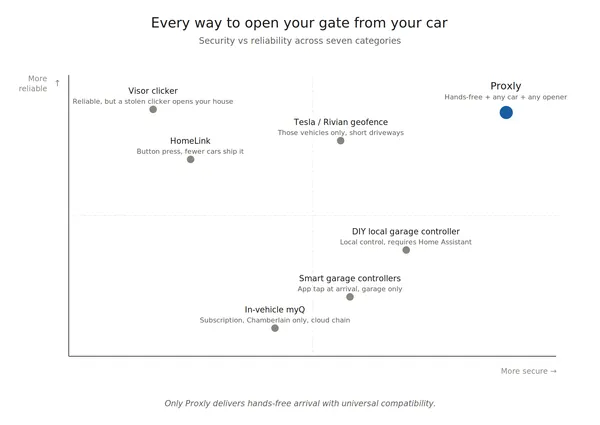
Every Way to Open Your Gate or Garage From Your Car in 2026
Seven categories of solutions for opening your gate or garage from your car — honest pros and cons, the security note no one mentions, and a side-by-side comparison.
Why Your Gate Closes Halfway and Reverses
A gate that stops and reverses before fully closing is almost always triggered by the obstacle-detection safety circuit. Here is how to diagnose and fix it without a service call.