If you’ve been shopping for a budget-friendly smart garage controller and explicitly want HomeKit support without a subscription, Meross is the answer that keeps coming up. The hardware is cheap, the app is functional, and HomeKit integration works the way Apple Home users expect. This review walks through what Meross Smart Garage Door Opener actually does, where it fits, where it falls short, and how it compares to other modern alternatives — including a section on the cases where Proxly is a better fit.
About Meross
Meross is a smart-home hardware brand that has shipped a broad lineup of HomeKit-compatible accessories since around 2019 — smart plugs, smart switches, smart bulbs, garage door controllers, and a handful of other connected devices. Their positioning across the product range has been consistent: budget-friendly hardware, no subscription, broad smart-home platform support (HomeKit, Google Home, Alexa, SmartThings), and a no-frills app experience.
The Smart Garage Door Opener (model MSG100 and successors) is one of the most-recommended budget options in r/HomeKit, r/homeautomation, and r/smarthome discussions. The audience that specifically wants HomeKit support without paying Chamberlain’s myQ subscription tends to land on Meross. The brand is smaller than Chamberlain, with less mature support and a less polished app, but the underlying hardware is competent and the no-subscription posture is structurally consistent across their entire product line.
Overview of Meross Smart Garage products
Meross’s garage door lineup has stayed simple over the years.
Meross Smart Garage Door Opener (MSG100 / current-generation single-door)
The flagship product. One Meross controller unit, one door sensor, all wiring, and a power adapter. Controls a single garage door. Approximately $30-$40 depending on the retailer.
Meross Smart Garage Door Opener (multi-door kit)
A kit that includes additional door sensors so one Meross controller can manage two or three garage doors. Approximately $50-$70 depending on door count.
Add-on door sensors
Available separately for households with more than one garage door who want to add doors to an existing Meross controller.
Meross Smart Garage Door Opener review
Features
The Meross platform includes — all free with the hardware:
- Open and close from anywhere via the Meross app (cellular or Wi-Fi)
- Door state visibility (open, closed, moving)
- Notifications when doors open, close, or are left open longer than a configurable amount of time
- Schedules and time-based auto-close rules
- Multi-user access with separate accounts for household members
- Apple HomeKit (native, no bridge required)
- Google Home
- Amazon Alexa
- Samsung SmartThings
- IFTTT
What Meross Smart Garage Door Opener does NOT include:
- Hands-free arrival (still requires app tap, voice command, or smart-home automation trigger)
- Camera or video features (Meross has not entered the camera-equipped smart garage market)
- Direct driveway gate support on all gate brands (compatibility is partial)
- CarPlay / Android Auto integration as a first-class feature (HomeKit + Siri can be used as a workaround on iOS, but there’s no native CarPlay button on the Meross side)
Pricing
Hardware:
- Meross Smart Garage Door Opener (single-door): approximately $30-$40
- Multi-door kit: approximately $50-$70 depending on door count
- Additional door sensors: approximately $10-$15 each
Subscription:
- None. Meross does not charge a subscription for any feature.
Pros
- Cheapest mainstream smart-garage retrofit. $30-$40 hardware for a single-door installation is the entry-level price point in the category. Households that want to add smart-home control to an existing garage without committing significant money find Meross the easiest sell.
- No subscription on any feature. HomeKit, Google Home, Alexa, SmartThings, schedules, multi-user — all included. The audience that has been burned by myQ’s subscription gating picks Meross specifically for the no-subscription posture.
- HomeKit integration is native and reliable. Apple Home households can add the garage to scenes, automations, and Siri commands without bridging through a third-party adapter. This is one of the strongest reasons Apple-centric households pick Meross.
- Broad opener brand compatibility. Works with most residential garage door openers via standard dry-contact wiring — LiftMaster, Chamberlain, Genie, Marantec, Stanley, Linear, and many others.
- Hardware that just works. The controller is small, the wiring is documented, and most installations complete in under 45 minutes. Returns and complaints in the audience are mostly about app polish, not hardware reliability.
Cons
- App-based, not hands-free. Meross is a phone-app controller. The garage opens when you tap a button, use a smart-home automation, or trigger Siri. Households where the daily friction is the press itself find that Meross solves a different problem.
- Cloud-dependent for most features. Local commands work on home Wi-Fi but remote control routes through Meross’s cloud servers. Cloud outages or account issues affect the from-anywhere experience. HomeKit integration uses local Apple Home routing where available but falls back to cloud for some functions.
- App polish is below platform leaders. The Meross app is functional but less refined than myQ or Tailwind’s app experiences. Some users report occasional sync delays or UI quirks. None are typically blockers for daily use but the experience is less smooth than the mainstream alternatives.
- No CarPlay button. Meross does not have a first-class CarPlay or Android Auto integration. iOS users can reach the garage through Siri voice commands routed through HomeKit, but there’s no in-screen Meross button comparable to Tailwind’s or paid-tier myQ’s CarPlay buttons.
- Limited driveway gate coverage. Meross targets garage doors as the primary use case. Some gate operators with standard dry-contact wiring will work; others (especially commercial-grade or proprietary gate controllers) will not. Households with both a driveway gate and a garage door may need a different solution for the gate side.
- No state-of-the-art camera or AI features. If you want camera-equipped smart garage hardware with package detection, person recognition, or video storage, Meross is not in that segment.
- 2.4 GHz Wi-Fi only. The Meross controller does not connect to 5 GHz Wi-Fi. Households running mixed-band routers need to make sure the 2.4 GHz band is enabled and that the garage has 2.4 GHz coverage.
Meross Smart Garage Door Opener vs Proxly
Meross and Proxly share the hardware-only, no-subscription business model — both companies sell hardware once and don’t charge ongoing fees. The differences are in architecture and the daily-use experience.
| Feature | Proxly | Meross |
|---|---|---|
| Hands-free arrival (no button, no app tap) | Yes | No (app tap or voice command required) |
| Works with any opener brand | Yes | Most residential brands; some commercial / proprietary not covered |
| Works with driveway gates | Yes | Partial (some gate brands, not all) |
| Multi-opener households (gate + garage + guesthouse) | Yes (one Hub, multiple openers) | Yes (up to 3 doors per controller, garage-focused) |
| Free app for remote open/close, schedules, notifications | Yes | Yes |
| Free HomeKit, Google Home, Alexa integration | Yes | Yes |
| Free CarPlay / Android Auto button | Yes | No (Siri via HomeKit is workaround) |
| No subscription required | Yes | Yes |
| Cloud-free critical path (works without internet) | Yes (local radio between Tag and Hub) | Partial (local on home Wi-Fi; remote needs cloud) |
| Anti-theft protection on in-car device | Yes (Tag non-functional if stolen) | N/A (no in-car device) |
| Hardware cost | $179-$229 single-stack at GA | $30-$50 single-door |
| Camera / video features | No | No |
| Established brand in smart-home category | Pre-launch, founded 2025 | 5+ years across HomeKit accessories |
What Meross does better
Meross hits a price point Proxly doesn’t aim at. At $30-$50 for a single garage door, Meross is the cheapest way to add smart-home garage control to an existing setup. For a household whose primary use case is “open the garage from Apple Home” or “set a schedule to auto-close at 10pm” — and who explicitly does not want hands-free arrival — Meross is genuinely an excellent answer.
Meross also has a mature lineup across other smart-home categories. Households already running multiple Meross devices (plugs, switches, bulbs) get a unified app experience.
What Proxly does better
For households where any of these conditions apply, Proxly is the cleaner fit:
- Hands-free arrival is the actual daily friction. Meross reduces friction (Siri voice command is convenient) but does not remove the action itself. Proxly removes the press, tap, or voice command entirely.
- A driveway gate is in scope. Meross’s gate support is partial; Proxly handles gates and garages off the same Hub with broader brand coverage.
- Local-radio operation matters. Meross’s remote control path routes through their cloud. Proxly’s auto-open runs on local radio with no internet dependency on the critical path — meaning the garage opens even when home internet is down.
- The household wants multi-driver Tag-based credentials. Proxly supports per-Tag pairing so every household member has their own credential; Meross uses phone-based access tied to user accounts.
- CarPlay / Android Auto integration matters. Meross relies on Siri-via-HomeKit as the workaround; Proxly has first-class in-car-screen support.
Why Proxly is a strong alternative
If you fit one or more of the situations above, the decision case for Proxly over Meross comes down to four points:
- The arrival experience itself. Meross brings smart-home automation to your existing garage; Proxly removes the need to interact at arrival at all.
- Driveway gate coverage. Meross is garage-focused. Proxly is opener-agnostic and works on most gates with the same Hub.
- Local-radio reliability. Meross’s from-anywhere path is cloud-routed. Proxly’s auto-open is local — no internet required for the daily-use experience.
- Tag-based access for households with multiple drivers. Proxly supports per-Tag credentials with built-in anti-theft; Meross uses phone-app account access.
Proxly is built for the cases where Meross doesn’t quite fit — hands-free arrival, multi-opener households (gate plus garage), driveway gates Meross can’t speak to cleanly, or local-radio operation without cloud dependency. If that’s your situation, learn more at getproxly.com.
If your situation is a clean Meross fit — single garage, Apple Home or Google Home as the primary smart-home platform, comfortable with app-based or voice-based control, no driveway gate — then Meross at $30-$40 is genuinely one of the best products in the category and the right move is probably to stay with what works.
Frequently asked questions
Is Meross Smart Garage Door Opener free to use?
Meross is hardware-only revenue. The smart garage door opener kit is approximately $30-$50 one-time. There is no subscription. All app features including HomeKit, Google Home, Alexa, SmartThings, schedules, notifications, and multi-user access are included with the hardware purchase.
Does Meross work with my garage door opener?
Meross Smart Garage Door Opener is designed to work with most residential garage door openers that have a standard wall-button input (dry-contact terminals on the motor unit). This covers LiftMaster, Chamberlain, Genie, Marantec, Stanley, Linear, and most other US residential brands. Some commercial-grade openers and a small number of proprietary residential designs are not compatible. Check the Meross compatibility list for your specific opener model.
Does Meross work with HomeKit?
Yes. Apple HomeKit integration is native and works out of the box — the Meross app sets up HomeKit during the initial onboarding. Once paired, the garage door appears as a controllable HomeKit device that can be added to scenes, automations, and Siri voice commands. The HomeKit integration is one of the most-cited reasons Apple Home households choose Meross over myQ.
Does Meross work with driveway gates?
Meross Smart Garage Door Opener is designed primarily for garage doors. It can work with some driveway gate operators that have a standard dry-contact wall-button input, but support is partial. Compatibility depends on the specific gate brand and motor model. The Meross compatibility list is the authoritative source for specific gate models.
How does Meross install?
Installation involves running two low-voltage wires from the Meross controller to the wall-button terminals on the garage door opener’s motor unit, plugging the Meross controller into a nearby outlet, mounting the included door sensor on the garage door for state awareness, and pairing the unit to the Meross app via 2.4 GHz Wi-Fi. The process is documented and most homeowners complete it in 30-45 minutes.
What are the best alternatives to Meross?
Meross is itself a strong no-subscription alternative to platforms like myQ. The case for moving beyond Meross usually comes down to one of these: needing hands-free arrival (Meross is phone-app based; still requires a tap or voice command), supporting driveway gates Meross doesn’t cover cleanly, multi-opener households where gate + garage + guesthouse need a single coordinated system, or preferring local-radio operation over cloud-routed control. Proxly is built for those cases — it works on any opener brand including gates, supports unlimited Tags and openers off one Hub, and triggers hands-free as your car arrives via a Tag with its own GPS. Learn more at getproxly.com.
Last updated: 2026-05-24. This review reflects information available at the time of writing and is presented to the best of our knowledge from publicly available sources. Pricing, product availability, integrations, and platform features may change after publication; please verify current details directly with the manufacturer before making a purchase decision. Proxly is an independent product and is not affiliated with, sponsored by, or endorsed by Meross Technology Limited or any other company mentioned in this article. All product names, logos, and trademarks are the property of their respective owners. If you spot an inaccuracy or have a correction, please email getproxly@gmail.com — we update reviews as new information becomes available.
Frequently asked questions
- Meross is hardware-only revenue. The smart garage door opener kit is approximately $30-$50 one-time. There is no subscription. All app features including HomeKit, Google Home, Alexa, SmartThings, schedules, notifications, and multi-user access are included with the hardware purchase.
- Meross Smart Garage Door Opener is designed to work with most residential garage door openers that have a standard wall-button input (dry-contact terminals on the motor unit). This covers LiftMaster, Chamberlain, Genie, Marantec, Stanley, Linear, and most other US residential brands. Some commercial-grade openers and a small number of proprietary residential designs are not compatible. Check the Meross compatibility list for your specific opener model.
- Yes. Apple HomeKit integration is native and works out of the box — the Meross app sets up HomeKit during the initial onboarding. Once paired, the garage door appears as a controllable HomeKit device that can be added to scenes, automations, and Siri voice commands. The HomeKit integration is one of the most-cited reasons Apple Home households choose Meross over myQ.
- Meross Smart Garage Door Opener is designed primarily for garage doors. It can work with some driveway gate operators that have a standard dry-contact wall-button input, but support is partial. Compatibility depends on the specific gate brand and motor model. The Meross compatibility list is the authoritative source for specific gate models.
- Installation involves running two low-voltage wires from the Meross controller to the wall-button terminals on the garage door opener's motor unit, plugging the Meross controller into a nearby outlet, mounting the included door sensor on the garage door for state awareness, and pairing the unit to the Meross app via 2.4 GHz Wi-Fi. The process is documented and most homeowners complete it in 30-45 minutes.
- Meross is itself a strong no-subscription alternative to platforms like myQ. The case for moving beyond Meross usually comes down to one of these: needing hands-free arrival (Meross is phone-app based; still requires a tap or voice command), supporting driveway gates Meross doesn't cover cleanly, multi-opener households where gate + garage + guesthouse need a single coordinated system, or preferring local-radio operation over cloud-routed control. Proxly is built for those cases — it works on any opener brand including gates, supports unlimited Tags and openers off one Hub, and triggers hands-free as your car arrives via a Tag with its own GPS. Learn more at [getproxly.com](https://getproxly.com).
Is Meross Smart Garage Door Opener free to use?
Does Meross work with my garage door opener?
Does Meross work with HomeKit?
Does Meross work with driveway gates?
How does Meross install?
What are the best alternatives to Meross?
Keep reading
Why How You Open Your Garage Door Actually Matters
Most car owners don't think about how they open their garage door. After 1,000 button presses a year, they should. Here's the convenience and security case.

Replacing a Dead Gate-Opener Battery (12V vs 24V)
A dead backup battery is the most overlooked cause of a gate opener that stops working during a power cut. Here is how to identify the right replacement and install it safely.
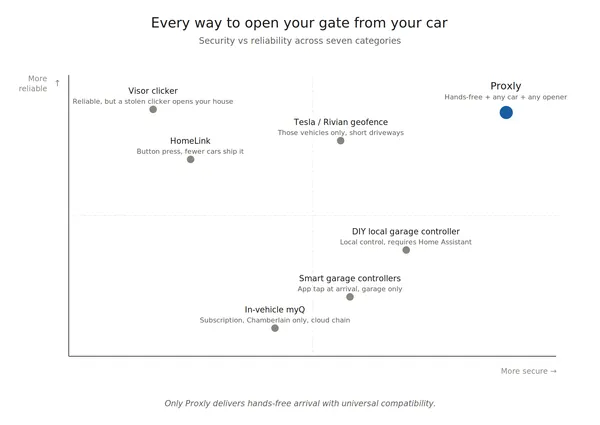
Every Way to Open Your Gate or Garage From Your Car in 2026
Seven categories of solutions for opening your gate or garage from your car — honest pros and cons, the security note no one mentions, and a side-by-side comparison.