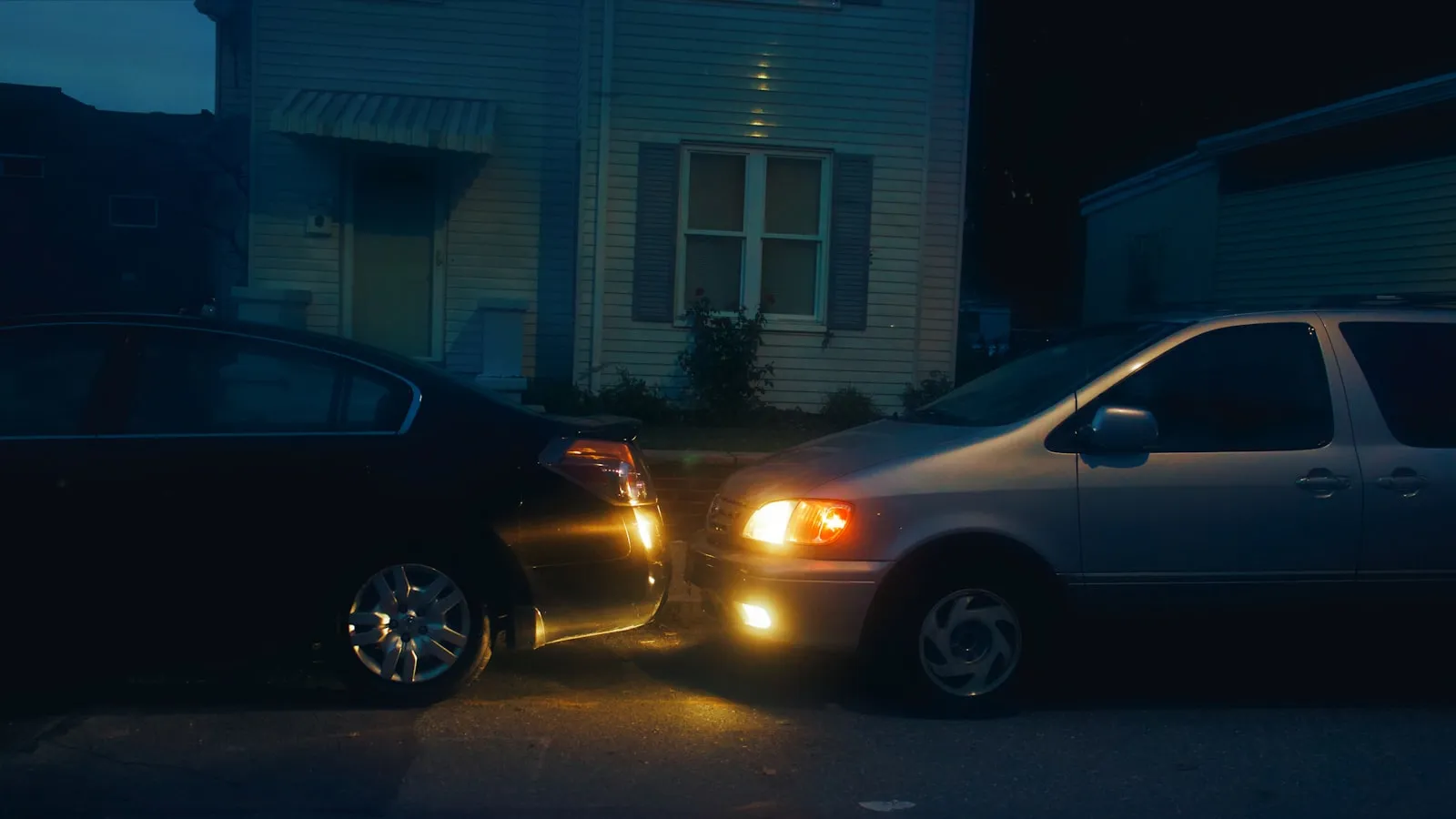
The most overlooked security gap in many American homes lives in the cupholder, on the visor, or clipped to the sun shade. A garage door clicker is paired to the garage door opener — not to your car. That distinction matters because anyone holding the clicker can use it on the matching opener, and the garage is increasingly the primary entry point to American homes.
Across the last decade, a specific crime pattern has been documented enough times in local news reporting to be worth understanding: thieves break into parked cars, take the garage door opener, and then enter the home. Sometimes minutes later. Sometimes hours. Sometimes after using documents found in the glovebox to identify the home’s address.
This article walks through seven verified incidents, what police and industry say about the pattern, the technical reason it works, and what actually defends against it.
The pattern, anchored: Lehi family, Salt Lake City Airport, June 2023
The cleanest documented case is one that began at a Salt Lake City International Airport parking garage.
Blake and Tina Brown of Lehi, Utah parked their car on Level 3 of the covered SLC airport garage for a week-long vacation. While they were away, a suspect broke into the vehicle, took the garage door opener, opened the glovebox, found the vehicle registration with the Browns’ home address in Lehi, drove to the address, used the opener to enter the garage, and ransacked the house.
Total loss: roughly $15,000 in property, plus a second vehicle stolen from the garage, plus a Social Security card and a birth certificate that were later used to open two fraudulent credit card accounts.
KSL covered the case in detail at the time. Lehi police followed up with surveillance photos of a suspect. The Browns came home from vacation to a house that had been emptied while they were gone.
The Brown case is the canonical version of the attack: car break-in, registration consulted, opener used, home address visited, homeowner not present to interrupt.
Six more verified cases
Sioux Falls, South Dakota — April 2022
A man named Dean Moss entered an unlocked vehicle while the owners were at church on a Sunday morning. He took the garage door opener, used the vehicle registration to find the home address, and was inside the house stealing items when someone returned home. KELOLAND covered the initial case. Moss was charged with burglary, criminal entry of a motor vehicle, fleeing police, parole absconding, possession of burglary tools, and possession of stolen property. Investigators later connected him to three additional burglaries with the same pattern.
This is the only case in this set with a clean arrest outcome.
Moraga, California — June 2024
Five suspects in a stolen Lexus hit roughly fifteen unlocked vehicles on and around Larch Way in Moraga in a single early morning. They took garage door openers, used them on nearby garages, and entered four homes. Surveillance video captured the pattern. KTVU covered the case.
Moraga Police Chief Jon King characterized the pattern: “They’re looking for a crime of opportunity. They’re literally going down the street, checking car doors to see if they’re locked or not.” Officers pursued the stolen Lexus but called off the chase for safety. BART police recovered the vehicle later near East Oakland. No arrests were made in the initial reporting.
Danville, California — July 2024
Two weeks after Moraga, the same pattern hit a Danville neighborhood off Crow Canyon Road. At least eight cars were broken into and five garages were entered. Suspects in black hoodies and face masks drove a white Honda Accord, captured on surveillance around 7 a.m. on a Sunday. KTVU covered the case; KRON4 followed up with community reaction coverage. Police pursued the suspects into Dublin and lost them at the county line.
The Moraga and Danville incidents — two weeks apart, in adjacent East Bay communities, with the same MO — suggest a recurring local pattern rather than isolated cases.
Point Loma, San Diego, California — March 2017
Thieves broke into at least five to seven vehicles around Piedmont Drive in Point Loma. In one case, the stolen opener was used to enter a homeowner’s garage, where bikes, tools, and other items “worth thousands” were taken. 10News covered the case with the resident’s verbatim quote: “They took his garage door opener and opened our garage.”
Tempe, Arizona — March 2024
Two suspects entered a home’s garage at approximately 1:20 a.m. using a built-in garage door opener taken from a vehicle. They loaded approximately $2,000 of property — including a bicycle — into a U-Haul and left. AZFamily / 3TV covered the case.
Tempe Police Sgt. Ryan Cook addressed it directly: “What you need to do is take your belongings out of the car, including your garage door openers.”
Orland Hills, Illinois (southwest Chicago suburbs) — January 2020
A coordinated pattern across Orland Hills, Orland Park, and Tinley Park. An Orland Hills resident heard her garage door closing while she slept — thieves had unlocked her car, taken the opener, and opened her garage. Nothing was taken in that specific case, but the suspects kept the opener. NBC Chicago covered the pattern.
Orland Hills Police Chief Thomas Scully quoted in the coverage: “These crimes happen very quickly. These guys are in and out in six or seven seconds.”
The technical reason it works
A handheld RF garage door remote is paired to the receiver at the opener, not to your car. The pairing process happens once — when the remote is first associated with the opener — and the remote doesn’t care whose car it lives in afterward.
So when a thief takes a remote from a car, they’re holding a working key to that opener regardless of who they are. They don’t need to crack a code, defeat encryption, or replay a signal. They just need to press the button.
Modern openers use rolling-code technology (Security+ 1.0, Security+ 2.0, Security+ 3.0 from Chamberlain and LiftMaster; equivalents from Genie, Liftmaster, Marantec, and others) that defeats signal-recording attacks. A thief can’t simply record your remote’s transmission from across the street and replay it later. That’s a real improvement on older fixed-code systems.
What rolling-code does NOT defend against is physical theft of the remote itself. The remote keeps its rolling-code synchronization with the opener; whoever holds it can keep using it. The “rolling code defeats this attack” framing some manufacturers reach for is technically correct for the signal-replay case and entirely inapplicable to the physical-theft case documented in every one of the cases above.
What the incidents have in common — and what they don’t
The seven cases share several characteristics:
- Most involved unlocked vehicles. Moraga, Danville, Point Loma, Orland Hills, and Sioux Falls all explicitly noted unlocked or otherwise easy-access cars. The Brown family case at the Salt Lake airport involved a locked car broken into rather than unlocked, but it’s the exception in the set.
- Most happened during predictable absence windows. Sunday morning church (Sioux Falls), early-morning hours (Moraga, Danville, Tempe), week-long vacations (Lehi/SLC airport). Thieves work when homeowners are predictably away.
- Most yielded relatively low arrest rates. Six of seven cases had no arrests reported in the initial coverage. Only Sioux Falls (Moss) produced a clean conviction-track arrest.
- The registration-as-address-leak step is documented in two specific cases (Sioux Falls and Lehi) but not explicitly in the others. Treat that step as part of the pattern but don’t assume every case used it — sometimes the parking proximity to home is enough.
What the cases DON’T tell us: how common this pattern is in aggregate. The FBI’s Uniform Crime Reporting program categorizes burglaries by entry method (forced vs unforced) but doesn’t break out “garage opener used” as a category. No national statistic exists. Any claim like “X% of burglaries begin with a stolen opener” would be unsourced.
What the industry actually says
The Door & Access Systems Manufacturers Association (DASMA) published “Remote Theft: Stealing the Key to the New Front Door” in 2006, which directly addresses the pattern. Editor Tom Wadsworth wrote at the time that “reports of remote-control thefts are clearly on the rise.” DASMA’s recommended defenses:
- Lock cars
- Store remotes in glovebox or purse, not on the visor
- Park inside the garage when possible
- Use mini keychain remotes instead of visor units
- Change opener codes if a theft occurs
- Secure or remove the vehicle registration (since it lists the home address)
State Farm, in the same DASMA piece, said the company was NOT seeing this as a major loss category. Brian Maze, a State Farm representative: “We are not seeing this as a major type of loss … or as a growing problem.” Chamberlain Group and Marantec America likewise said they did not consider remote theft widespread.
So the honest characterization: this is a documented pattern that police, industry, and consumer advocates all acknowledge. Insurance industry data does NOT suggest it’s a top-five burglary entry method. The risk is real and credible enough for multiple police departments — Aurora and Lakewood CO via 9News, Wichita KS, Tulsa OK, San Diego CA, and La Habra CA — to issue formal advisories. It’s not common enough to drive insurance industry concern.
For the average household, the practical takeaway: the risk is non-zero, the cost of mitigation is low, and the cases that do happen produce significant losses. The Browns lost $15,000+ plus a vehicle. Sioux Falls produced multi-burglary spree connections to a single suspect. Moraga and Danville hit dozens of households across two weekends.
What actually defends against it
Police PSAs and DASMA guidance converge on a consistent set of defenses:
- Lock the car. This is the universal first step. Most documented cases involved unlocked vehicles or easily-accessed cars. Locking alone defeats the entire attack class for those cases.
- Don’t keep the registration in the glovebox. Or keep it in a less obvious location. The registration is the address leak that connects “I have a garage opener” to “I know where its garage is.”
- Park inside the garage. If the car is inside, the opener isn’t accessible to a parking-lot thief.
- Move the clicker out of sight. Center console, glovebox, or any place that requires effort to find beats the visor clip.
- Change opener codes if a clicker is lost or stolen. Modern openers can re-LEARN remote codes; an erase-and-re-pair takes 5 minutes and invalidates the stolen remote. Most homeowners don’t do this until something happens.
These are the practical defenses for an existing visor-clicker setup. They reduce the attack surface but don’t eliminate it. The clicker remains a paired credential that anyone holding can use.
There’s a structurally different approach worth knowing about: a credential that’s paired to your CAR rather than to the opener. If the device only works when paired to a specific vehicle, taking it from the car doesn’t help a thief — they would need to take the entire car (and even then, the device would still be paired to that specific car, not a generic opener).
This is the design we’re building at Proxly. The Tag is paired to your car and includes anti-theft protection that renders it non-functional once removed from the vehicle. A stolen Tag won’t open your gate or garage even if a thief brings it to your house. The Tag-paired-to-car architecture eliminates the parking-lot attack vector entirely.
Proxly is pre-launch as of 2026. The Tag anti-theft feature is one of the design decisions that came directly out of looking at the documented attack pattern in this article — see getproxly.com or r/proxly for build updates.
The bottom line
Seven verified cases from KTVU, 10News, KELOLAND, KSL, AZFamily, KRON4, and NBC Chicago document the same pattern: car break-in, garage opener taken, opener used to enter the home. Multiple police departments have issued formal advisories. DASMA — the industry trade association — published guidance on the threat almost two decades ago.
It is not the top-five burglary risk for most households. It is not a sophisticated attack that requires technical countermeasures. It is a crime of opportunity that succeeds when an unlocked car is parked near or far from the home, the clicker is on the visor or in the console, and the registration is in the glovebox.
The defenses are simple and cheap: lock the car, hide the clicker, remove the registration, change opener codes if a clicker goes missing. They work for the vast majority of households.
For households that want to remove the attack vector entirely, Tag-paired-to-car systems exist now or are pre-launch. That’s the structural fix.
Frequently asked questions
Are car break-ins to steal garage door openers common?
Documented but not statistically dominant. Seven specific cases across California, Utah, Arizona, Illinois, and South Dakota are reported in this article from the last decade, and multiple police departments have issued formal advisories. However, State Farm explicitly said this is NOT a major loss category they track, and the FBI does not break it out as a burglary entry method. The risk is real and documented; it’s not the top-five burglary entry method.
How does a thief know which house the stolen opener belongs to?
In two of the documented cases (Sioux Falls and Lehi/SLC airport), the thief used the vehicle registration found in the glovebox to identify the home address. In other cases, the thief used the opener on nearby garages in the immediate vicinity of the parking location (Moraga, Point Loma) — particularly when cars were parked in residential neighborhoods near homes. The registration-as-address-leak is one path; the proximity-of-parking-to-home is another.
What’s the simplest thing I can do to defend against this?
Lock your car. Most documented cases in this article involved an unlocked or easily-accessible vehicle. Locking alone defeats the entire attack class for those cases. If you want a second layer, remove the registration from the glovebox (keep it in your wallet, phone case, or a less obvious location) and move the garage door clicker off the visor into the console or glovebox.
Can the thief use my stolen opener on someone else’s garage?
Only if the other garage opener has been paired to that specific remote. RF garage door remotes are paired to specific opener receivers, but a remote can be paired to multiple compatible receivers. So a stolen remote can’t open every garage in the neighborhood — only the openers it has been paired to. The pattern in these cases is that thieves use the remote on its own associated opener.
Will rolling-code (Security+) technology protect me from this attack?
No. Rolling-code technology defeats signal-recording attacks. It does not defend against physical theft of the remote itself. The remote keeps its rolling-code synchronization with the opener; whoever holds the remote can keep using it. Six of the seven documented cases in this article occurred after rolling-code technology became widespread (post-2004).
Is HomeLink (the visor button built into the car) safer than a clicker?
Slightly. HomeLink is bolted to the car’s mirror or visor, so a thief can’t simply remove it the way they can a clip-on clicker. However, if the car itself is stolen — or if a thief enters the cabin and uses the HomeLink button while inside — the same attack works. HomeLink is harder to steal individually but doesn’t eliminate the risk.
What about smartphone-based garage openers like myQ?
A smartphone garage opener (myQ, Tailwind, Meross, etc.) requires unlocking the phone and opening an app to operate, which is a meaningful additional barrier. A stolen-and-unlocked phone could still operate the opener if the app is logged in. Phone-based openers also have separate cloud-dependency reliability issues unrelated to the theft pattern.
Last updated: 2026-05-26. This article reflects information available at the time of writing and is presented to the best of our knowledge from publicly available sources including KTVU, 10News, KELOLAND, KSL, AZFamily, KRON4, NBC Chicago, the Door & Access Systems Manufacturers Association (DASMA), and various police department advisories. The cases described are based on contemporaneous local news reporting; details may have evolved or been updated by subsequent investigation. Statistical claims in this article are limited to what is documented in cited sources; no national aggregate statistic for “burglaries beginning with a stolen garage opener” exists in FBI Uniform Crime Reports. Proxly is an independent product and is not affiliated with, sponsored by, or endorsed by The Chamberlain Group LLC, LiftMaster, Genie, Marantec America, Gentex Corporation, DASMA, State Farm, or any law enforcement agency mentioned. All product names, logos, and trademarks are the property of their respective owners. If you spot an inaccuracy or have a correction, please email getproxly@gmail.com — we update articles as new information becomes available.
Frequently asked questions
- Documented but not statistically dominant. Seven specific cases across California, Utah, Arizona, Illinois, and South Dakota are reported in this article from the last decade, and multiple police departments (Aurora and Lakewood CO, Wichita KS, Tulsa OK, San Diego CA, La Habra CA) have issued formal advisories. However, State Farm explicitly said this is NOT a major loss category they track, and the FBI does not break it out as a burglary entry method. The risk is real and documented; it's not the top-five burglary entry method.
- In two of the documented cases (Sioux Falls and Lehi/SLC airport), the thief used the vehicle registration found in the glovebox to identify the home address. In other cases, the thief used the opener on nearby garages in the immediate vicinity of the parking location (Moraga, Point Loma) — particularly when cars were parked in residential neighborhoods near homes. So the registration-as-address-leak is one path; the proximity-of-parking-to-home is another.
- Lock your car. Every documented case in this article involved an unlocked or easily-accessible vehicle. Locking the car alone defeats the entire attack class. If you want a second layer, remove the registration from the glovebox (keep it in your wallet, phone case, or a less obvious location) and move the garage door clicker off the visor into the console or glovebox.
- Only if the other garage opener has been paired to that specific remote. RF garage door remotes are paired to specific opener receivers, but a remote can be paired to multiple compatible receivers. So a stolen remote can't open every garage in the neighborhood — only the openers it has been paired to. The pattern in these cases is that thieves use the remote on its own associated opener (the one that came with the car the remote was in).
- No. Rolling-code technology defeats signal-recording attacks (where a thief records the remote's transmission and replays it later). It does not defend against physical theft of the remote itself. The remote keeps its rolling-code synchronization with the opener; whoever holds the remote can keep using it. Six of the seven documented cases in this article occurred after rolling-code technology became widespread (post-2004).
- Slightly. HomeLink is bolted to the car's mirror or visor, so a thief can't simply remove it the way they can a clip-on clicker. However, if the car itself is stolen — or if a thief enters the cabin and uses the HomeLink button while inside — the same attack works. HomeLink is harder to steal individually but doesn't eliminate the risk.
- A smartphone garage opener (myQ, Tailwind, Meross, etc.) requires unlocking the phone and opening an app to operate, which is a meaningful additional barrier. A stolen-and-unlocked phone could still operate the opener if the app is logged in. Phone-based openers also have separate cloud-dependency reliability issues unrelated to the theft pattern.
Are car break-ins to steal garage door openers common?
How does a thief know which house the stolen opener belongs to?
What's the simplest thing I can do to defend against this?
Can the thief use my stolen opener on someone else's garage?
Will rolling-code (Security+) technology protect me from this attack?
Is HomeLink (the visor button built into the car) safer than a clicker?
What about smartphone-based garage openers like myQ?
Keep reading
Why How You Open Your Garage Door Actually Matters
Most car owners don't think about how they open their garage door. After 1,000 button presses a year, they should. Here's the convenience and security case.

Replacing a Dead Gate-Opener Battery (12V vs 24V)
A dead backup battery is the most overlooked cause of a gate opener that stops working during a power cut. Here is how to identify the right replacement and install it safely.
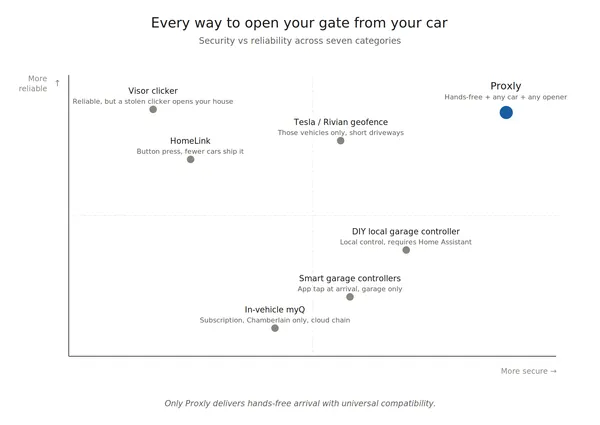
Every Way to Open Your Gate or Garage From Your Car in 2026
Seven categories of solutions for opening your gate or garage from your car — honest pros and cons, the security note no one mentions, and a side-by-side comparison.