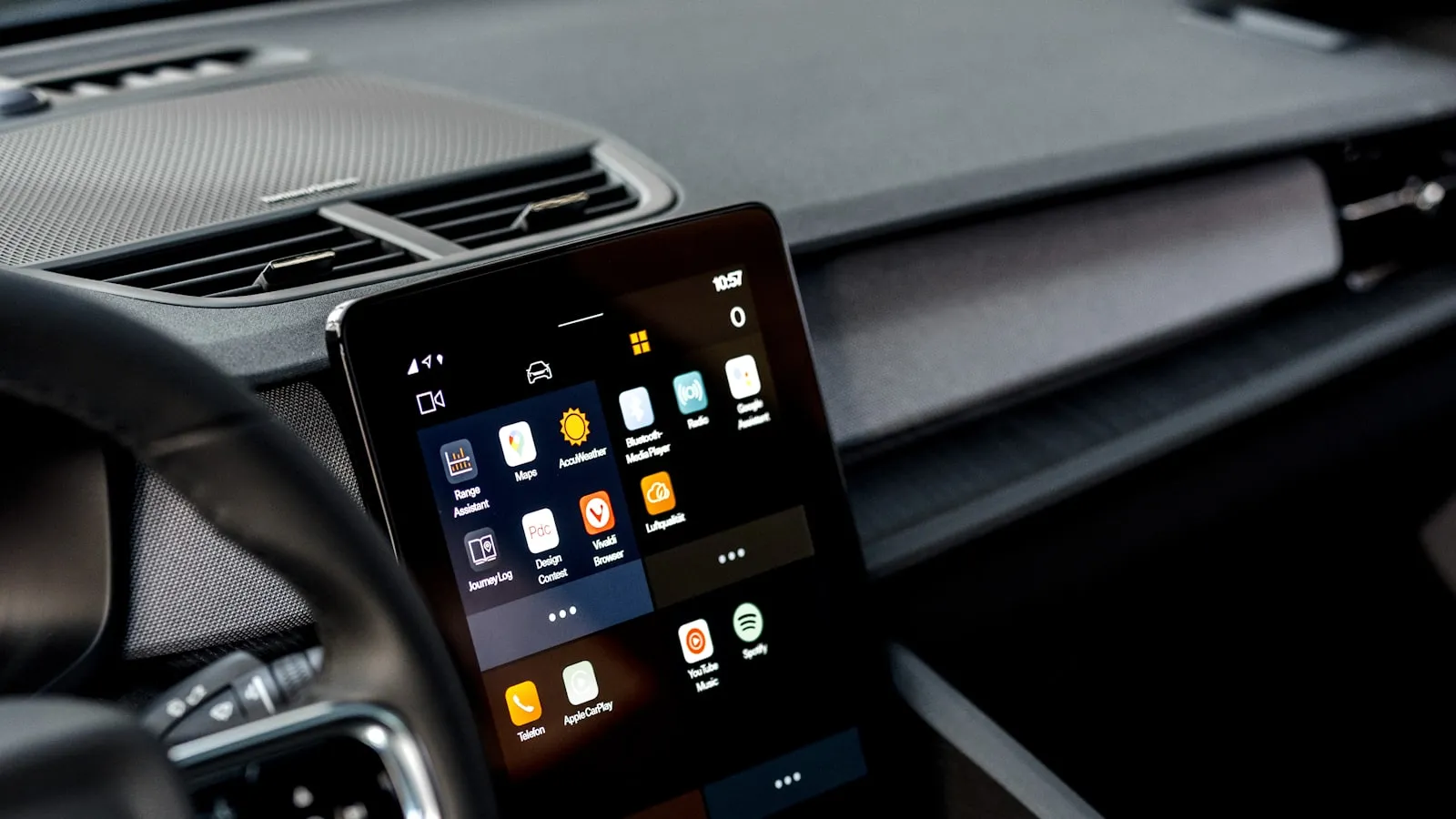
HomeLink, the visor button that opens your garage or gate, is no longer standard in many new EVs. Tesla made it a roughly $300 add-on on the Model 3 and Model Y, the Cybertruck ships without it, and Polestar leaves it off entirely. The button had been standard in premium cars since 1994, and its removal hits owners with driveway gates hardest, where RF range matters most.
The shift is happening without much announcement from manufacturers. EV owners with gates and garages are noticing it after delivery.
Some of this is our own research. The brand-by-brand breakdown further down is something else: a compilation of owner reports. We asked EV owners on Reddit what their cars ship with, and a 100-plus-comment thread on r/EvDrivers built a live picture across makes, models, and trims. The owners did the legwork; we organized it into the list below.
What happened at Tesla
Tesla’s approach has been the most visible. The company removed HomeLink from the standard equipment list for Model 3 and Model Y. The technology — a module in the overhead console that transmits RF signals to open garage doors and driveway gates — is now a separate purchase, available through Tesla’s shop for around $300. Owners who received a Model 3 or Model Y without it must either buy the retrofit kit or weigh the alternatives to HomeLink for getting through the gate.
Model S and Model X still include HomeLink as standard. The Cybertruck, by contrast, ships without HomeLink and has no factory retrofit path — owners rely on the myQ subscription or an aftermarket workaround.
The move was almost certainly driven by cost. HomeLink is a licensed technology from Gentex Corporation, and integrating it requires a certified module for each vehicle line. On a platform Tesla was working to bring to a lower price point, a licensed visor module used by a fraction of buyers was an easy target.
Polestar and the broader pattern
Polestar has not included HomeLink on any of its production vehicles. Owners of the Polestar 2 and Polestar 3 have no factory or aftermarket retrofit equivalent to the Tesla kit.
The pattern across EV brands is uneven. Some manufacturers continue to include HomeLink as standard equipment. Others have made it optional or omitted it, often pointing buyers toward app-based integrations as a substitute. Whether that substitution actually works depends heavily on what the owner is trying to open and how far from the road it sits. And it isn’t only EVs: premium cars are dropping HomeLink across gas and electric lineups, and Honda has unbundled it into a myQ subscription.
Which EVs still have a built-in garage button (2026)
From those owner reports (see the note up top), here’s where the built-in garage button stands. Availability often varies by trim and model year, so confirm on the specific build you’re looking at — and corrections from owners are welcome.
Still ships a physical button (usually on or under the rear-view mirror, often on higher trims): Hyundai Ioniq 5/9 (see the Ioniq 5 & 6 HomeLink setup guide) and Kona, Kia EV9, Subaru Solterra, Toyota bZ, Ford Mach-E (some owners report weak range and fall back to a remote), Audi Q6 e-tron (the buttons live in the mirror, where Audi previously routed the feature through the MMI touchscreen), Lexus hybrids, and some Polestar models. Availability still varies by trim and year within a brand — owners report some 2026 Subaru builds with a HomeLink mirror and others (a 2026 Forester hybrid was one example) where the fancy mirror shipped without it, so this is worth checking on the specific build.
Moved to the touchscreen (no physical button, on-screen control): Rivian (which also adds proximity detection and a steering-wheel shortcut), Tesla Model X, Cadillac Vistiq, Audi Q8, Honda Prologue, Polestar 3.
App or software only: Cadillac Optiq, Polestar 3’s HomeLink app.
Paid add-on or nothing: Tesla Model 3 and Y (~$300–350 installed retrofit), Cybertruck (no HomeLink at all — the myQ subscription is the only sanctioned path), VW ID.4 (no button; VW sells an enhanced HomeLink mirror as a genuine accessory for around $224 plus install), Ford F-150 (none on most trims).
The Ford picture has widened beyond the truck. Ford removed the universal garage door opener from the 2026 Mustang entirely — it was previously available in higher packages and standard on the 2025 GT Premium — and from the 2026 Bronco Sport, where it had been part of the Convenience Package and standard on Outer Banks. Both deletions are confirmed by Ford-focused outlet Ford Authority, and owners report dealers can’t add it back as a factory part.
Two things stood out from the owners who weighed in. First, the feature is largely US-market: many owners outside the US had never heard of HomeLink and instead use Somfy rolling-code openers with HomeKit or Home Assistant. Second, where people value it, what they value is the hands-free arrival (Rivian’s steering-wheel proximity prompt, Tesla’s auto-open), not the on-screen button itself.
One detail several owners kept circling back to: a plain visor clicker or HomeLink button is fire-and-forget. It sends the signal, but it can’t tell you whether the door actually opened or is still sitting open. App-based systems like myQ know the door’s state, but put that behind a cloud connection and, increasingly, a subscription. The combination owners described wanting — automatic open on approach, the ability to confirm and close from anywhere, an alert if the door’s been left open, and no recurring fee — isn’t something any of the factory options currently bundles together.
Why the app alternative falls short at gates
For a garage door attached to a house, a phone-based system can work reasonably well. The distance from phone to opener is short, and a reliable connection is usually available.
Driveway gates are different. The gate receiver may be 100–300 feet from the street, past a long driveway and possibly behind trees or terrain. An RF signal at 315 or 433 MHz from a HomeLink unit will reach that receiver reliably. A cloud-relayed app, or even a local Bluetooth signal, typically won’t.
This is the gap owners with longer driveways encounter when their EV doesn’t include HomeLink. Why HomeLink stops working with your driveway gate covers the RF mechanics in more detail, including why the physics of the signal matters more at gate distances than at garage distances.
Retrofit options
For EVs that shipped without HomeLink, the main option is the Gentex retrofit kit — the same RF module, designed to clip to a standard visor mirror. It programs the same way as a factory-installed HomeLink unit and supports rolling-code protocols including Security+, Security+ 2.0, and Intellicode. At around $300, it is not inexpensive, but it restores the same capability owners would have had from the factory.
Universal visor clickers are available at lower price points, but most use fixed-code transmission. Fixed-code clickers won’t pair with Security+ or Security+ 2.0 openers, which are the most common type on residential gates.
For a side-by-side look at what’s available for driveway gate access when HomeLink isn’t included — hardware, app-based, and category alternatives — HomeLink alternatives for driveway gates covers the full field honestly.
The gap this opens
As HomeLink shifts from a standard fitting to a premium add-on, the default access experience for EV owners with driveway gates gets more complicated. A newer category of vehicle-paired openers addresses this directly: the gate responds to the car’s proximity rather than a visor button or phone tap. The Premium-EV Arrival Stack covers how that access layer fits into the broader EV home-arrival picture.
Proxly is building in this category. If you have a driveway gate and an EV without HomeLink, the beta list is open while the product is in pre-launch.
The visor button served its purpose for three decades. Whether the replacement is a retrofit module, an app, or a different access layer depends on the driveway length and how much friction is acceptable at the gate.
Frequently asked questions
- Tesla Model 3 and Model Y no longer include HomeLink as standard equipment — it is a separately purchased module, available through Tesla's shop. Polestar does not include HomeLink across its lineup. The Cybertruck ships without HomeLink and has no factory retrofit. Tesla Model S and Model X still ship with HomeLink installed.
- Yes. Gentex, which makes HomeLink, sells a retrofit kit that mounts to the visor mirror and uses the same RF protocol as built-in units. It costs around $300, works with most vehicles that have a standard visor mirror, and installs without a dealer visit.
- Generally yes. Driveway gates sit farther from the house, so RF range is more critical. App-based alternatives that work well at an attached garage often struggle at the 100–300-foot distances typical of gated driveways. HomeLink's RF signal maintains reliable range at those distances.
- Owners who have lived with both generally say no. A visor or mirror button can be pressed from muscle memory without looking away from the road; a touchscreen control has to be found on screen, tapped, and then visually confirmed. Some cars add a geofence that surfaces the control automatically near home, but owners report it still requires a glance and a tap, and doesn't always fire at the right moment. Where the touchscreen version genuinely improves on the button is door-state awareness — knowing whether the door is open or closed.
- The clearest current example is Honda. Starting with the 2026 CR-V, Passport, and Pilot, Honda replaced the built-in HomeLink button with a myQ Connected Garage integration through HondaLink — a 30-day free trial, then $129 for 3 years or $179 for 5 years. Kia is pushing myQ on newer EV6 head units as a cloud alternative as well. In both cases the underlying garage door can still be opened for free through the opener brand's own app or a separate clicker; the subscription buys the in-dash convenience specifically.
Which new EVs don't include HomeLink?
Can I add HomeLink to an EV that didn't come with it?
Does losing HomeLink matter more for driveway gates than garage doors?
Is the touchscreen garage button as good as the old visor button?
Which cars now require a subscription to open the garage?
Keep reading

GMC Hummer EV HomeLink: Driveway Gate Setup and Timing
The Hummer EV weighs 9,063 lbs. Most driveway gates take 15-20 seconds to open. Here's how to program HomeLink and get the approach timing right.
Why Tesla HomeLink Fails on Driveway Gates (And the Fix That Isn't a Better Button)
Tesla HomeLink works reliably on garage doors. Driveway gates are a different problem. Here is what goes wrong and what fixes it.
Cybertruck Driveway Gate: Three Ways In, One Hands-Free
Cybertruck owners have three options for a driveway gate: built-in HomeLink, Tesla's geofence, or a GPS tag that opens at 300 feet with no button press.